
Baroque-inspired and Rococo-inspired jewelry offer related ways to enjoy elaborate ornament, not two boxes that every design must fit. Baroque references often emphasize drama and movement; Rococo references frequently draw on curling, shell-related ornament. For a contemporary purchase, the useful choice is which arrangement you enjoy—not which historical date you can assign from a photograph.
Related traditions, not a heavy-versus-light rule
The Victoria and Albert Museum's Baroque overview describes a tradition in which different arts worked together to create a dramatic effect. Its discussion of ornament includes scrolling foliage and stylized plant forms. That gives you more to look for than simply “lots of decoration.” Consider how the parts contribute to the whole.
The museum's Rococo introduction describes another highly ornamental tradition, including shell-related motifs, acanthus and curling forms. The styles share some vocabulary. Neither “Baroque means massive” nor “Rococo means delicate” is a reliable buying rule, and an abundant floral design does not establish either attribution.
Notice what the ornament is doing
Imagine two necklaces with equally elaborate borders. In one, broad curls gather around a conspicuous center. In the other, smaller branches and turns keep drawing your attention outward. You might prefer the first for its concentrated focus and the second for its wandering detail. Those are useful preferences even if neither listing supplies a defensible historical label.
Also distinguish a shape from its treatment. A shell can be a plainly recognizable subject, a suggestion in a curling edge, or one element among many. A scroll can frame an accent, connect neighboring sections or become the main attraction. Buying “something ornate” leaves all these possibilities open; deciding what you want to notice first makes the search more specific.
Symmetry does not settle the name
Rococo is often associated with asymmetrical ornament, but that is not a universal sorting test. The Met's American Rococo essay explains that its motifs were also adapted into symmetrical compositions. A mirrored outline does not automatically exclude the reference.
The whole design and a small detail can behave differently, too. A necklace may balance around its center while individual curls vary. Conversely, a repeated motif can sit within an uneven overall arrangement. If you like orderly repetition with lively edges, describe that combination rather than rejecting it because a style checklist tells you the two cannot coexist.
Baroque pearl shape is a separate subject
In pearl-shape vocabulary, baroque concerns an irregular form. It does not date the finished jewel to the historical Baroque period. GIA's pearl quality-factor guide treats shape as a characteristic to evaluate separately from other attributes.
Keep composition separate as well. A pearl-style accent is not identified as a natural or cultured pearl merely because its outline looks irregular. Our pearl-label guide addresses that material question. A style reference for the entire necklace and a shape description for one accent can both be relevant without meaning the same thing.
Read a current necklace on its own terms

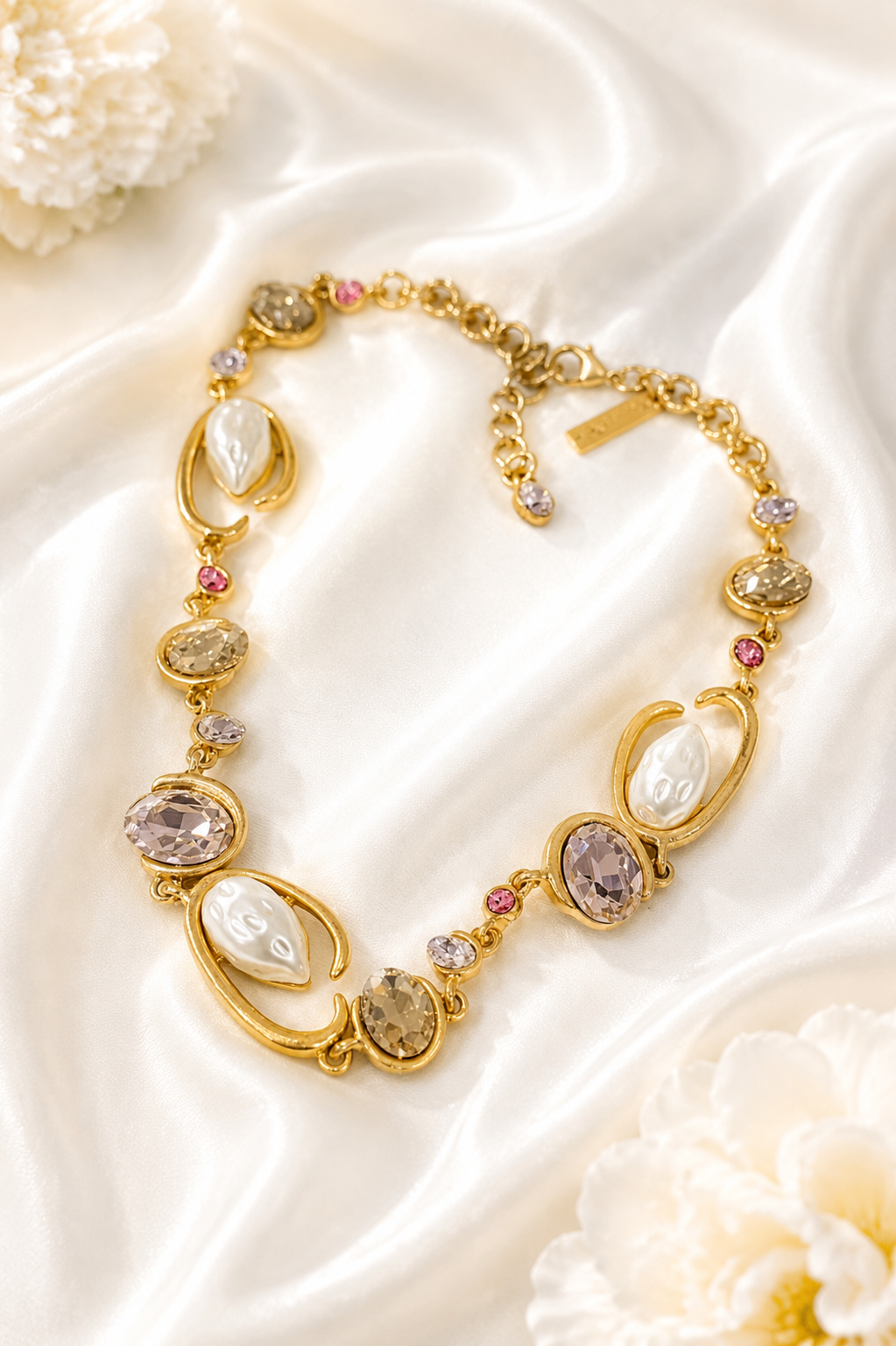
The Baroque-Inspired Light Pink Rhinestone Jewelry Set listing offers Necklace, Bracelet and Earrings separately. The photograph here matches the Necklace option, not a purchase of all three pieces.
Broad open loops surround irregular white accents, while pale pink and other light-colored faceted accents interrupt the sequence. You can enjoy the relationship between the open frames and the denser color areas without calling the necklace authentically Baroque, reclassifying it as Rococo or identifying its materials from the image.
Choose the ornament before choosing a historical story
Try a preference such as “open looping frames with alternating color accents” or “branching detail that spreads beyond a central motif.” These descriptions preserve what attracts you and travel well between sellers whose style labels may differ.
Compare the current necklace collection with that preference in mind. If you specifically want a historical object, its date, maker and provenance need their own evidence. For contemporary inspiration, liking the composition is enough; it does not need a borrowed history to be satisfying.