
A ribbon motif suggests a strip that bends, loops or trails. A bow commonly organizes loops around a tied-looking center, often with tails. A knot emphasizes the apparent interlacing or crossing of a cord or strip. In jewelry, these may be representations rather than literal knots: the visible design does not tell you that anything can be untied.
Trace a path instead of naming a silhouette
Start at a visible end and follow the strip with your eye. Where it disappears behind another part, pause. Resume only where the continuation is clear. This distinguishes an apparent crossing from two unrelated curves placed close together.
Look for changes in width, folded-looking edges and the arrangement of the ends. A broad band may read as ribbon; a narrow rounded form may read as cord. These are visual descriptions, not proof of textile, hollow construction or a particular forming method. If the path is hidden, “interlacing-looking forms” is a sensible stopping point.
A bow is more than two symmetrical curves
Count the loops, identify the central tie-like area, and note whether tails are visible. A bow need not resemble a perfectly symmetrical shoelace bow. Multiple loops, uneven tails and a central accent can complicate the design while preserving its ribbon reference.
The Met's record for Félix Leblanc's brooch design distinguishes an upper ribbon bow from a lower square-edged knot within the same composition. That is a useful example of why bow and knot need not be competing labels for an entire object: each can describe a different area.
Ribbon can form a rosette rather than a bow
In another Met jewelry-design album page, the catalog describes a ribbon arranged into a rosette. Rounded loops gathered into a flower-like mass are not necessarily a botanical flower. They can suggest folded fabric instead.
Compare three imaginary outlines: a pair of loops with two tails; a compact interlaced center without visible loops; and a circular cluster of repeated folded-looking loops. “Bow,” “knot” and “ribbon rosette” respectively may be useful descriptions. They are not fabrication instructions, and a photograph may leave more than one reading plausible.
Do not turn the illusion into an operating instruction
A tied-looking center is not an invitation to pull the tails. A crossing does not establish a hinge. An open gap does not prove adjustability. Before using any feature as a closure or an adjustment point, rely on the maker's instructions for that exact object.
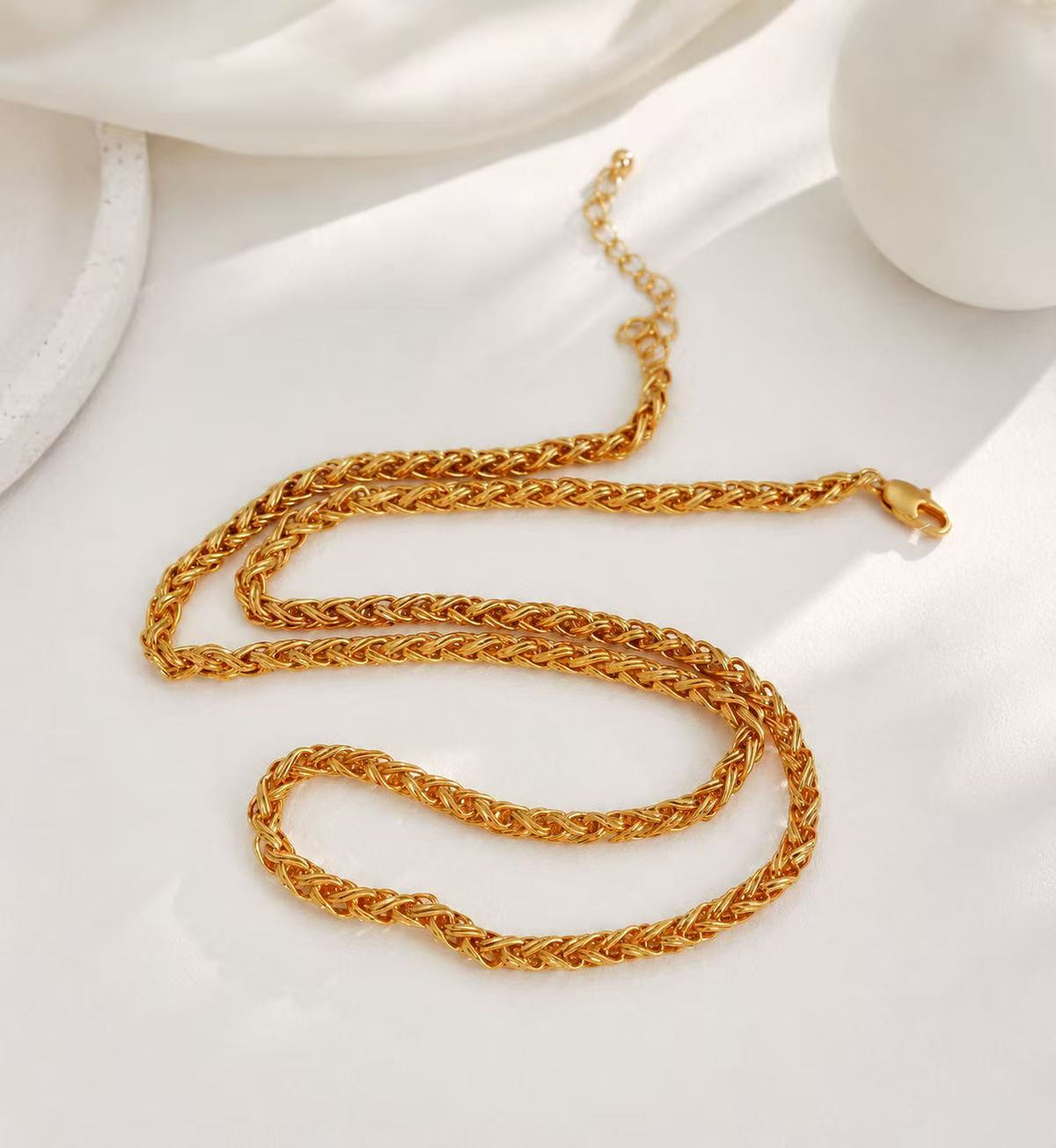
A gold-tone woven-look chain necklace makes the distinction concrete. Its visible interlacing texture can be described as woven-look, but that does not identify a ribbon bow or authorize unweaving, pulling or reshaping a decorative section.

For words about the surface itself, see the finish and texture guide. Other forms in the necklace collection can be compared by following the visible path, without assuming they share a mechanism.
Keep a symbolic interpretation attached to its source
A bow or knot shape does not establish one universal symbolic meaning.
If a family calls a piece a love knot, preserve that name as an attributed family description. Do not expand it into a documented message from an unknown maker. The same distinction applies to an evocative product name: it may describe an idea rather than an identifiable historical tradition.
Finish with a shape-specific description
Try “an asymmetrical ribbon bow with one long tail” or “three interlacing, cord-like loops with no visible ends.” Those sentences help another person recognize the design. Add a construction statement only when supported separately. The pleasure of the motif lies partly in making hard material appear soft; understanding that illusion does not require treating it as real fabric.