
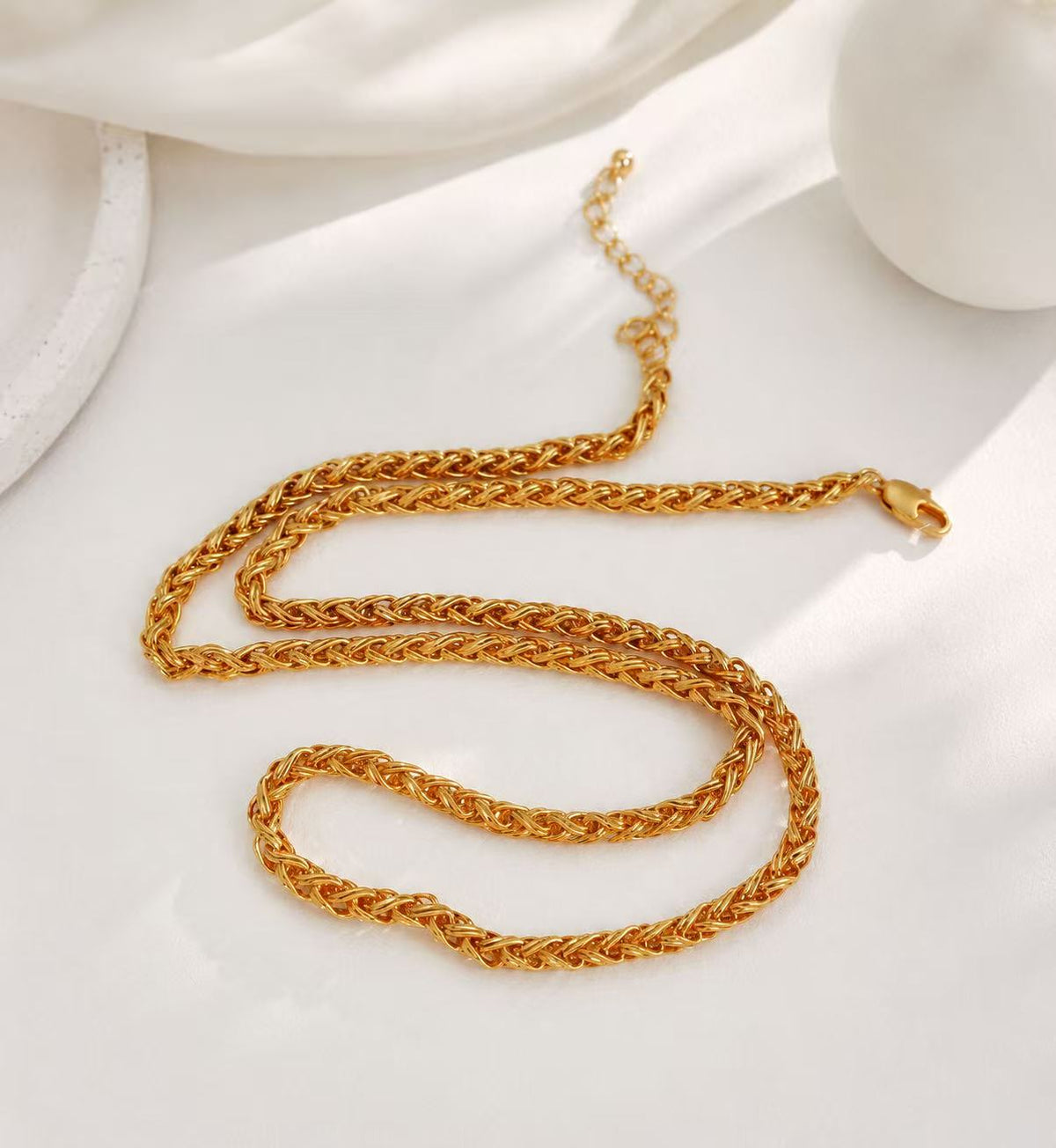
A chain-strap bag and a necklace do not have to match, but “both gold-tone” is not enough to describe their relationship. Two chains can share a finish while differing in link size, the amount of open space between links, and whether they read as separate loops or a continuous band.
First establish that the strap and necklace can coexist without pressing, catching or pulling. If not, change the combination before styling it. The comparison below begins after that practical prerequisite; it is about the two decorative patterns, not mapping a loaded strap's movement.
Look at the openings as well as the metal
With an open-link chain, the background visible inside each loop is part of the pattern. A densely woven-looking chain may read more like a textured strip. A chain threaded with leather introduces another alternating surface within the links.
Chanel's Classic handbag design description identifies its leather-laced chain as a visual signature. That is one specific construction example, not a requirement for matching jewelry or a description of every chain bag.
Look at your actual bag chain against the clothing you are wearing. If a dark insert blends into a dark top, the metal may stand out as isolated flashes. Against a contrasting top, both the inserted strip and the metal links may be easier to distinguish. Judge that pattern before selecting the necklace.
Separate link scale from overall chain width
Two chains can be similarly wide yet contain very different-sized visible shapes. One might show a few broad oval openings; the other many tiny interlocking details. Comparing only their width misses this difference in rhythm.
Inspect the portion that is visible together on your upper body. Some necklaces change scale along their length: Tiffany's graduated-link design is a manufacturer-described example. Do not compare the bag's main links only with a necklace's smaller side section if its largest links will sit at the center.
No fixed size ratio is necessary. Ask whether you see two versions of the same repeated shape or two clearly different patterns.
Work through one bag with two necklace outcomes
Imagine a plain shirt and a bag with conspicuous open oval links. Keep both unchanged. You have already checked that the jewelry options sit independently of the strap.
Option one: a necklace with similar open ovals. If the visible loops are close in size and spacing, the necklace repeats the bag's rhythm. Choose this when you want the two objects to feel like a deliberate related pair. If they look almost, but not quite, like one matched chain system and you dislike that effect, changing metal tone alone may not be enough.
Option two: a necklace with a continuous woven-looking surface. The bag retains its large openings while the necklace reads as a textured band. Choose this when you want the necklace to have a separate identity. If both nevertheless appear as two equally broad strips from a distance, compare a narrower band or a different necklace rather than assuming “woven” automatically creates enough contrast.
That is the practical fork: preserve similar visible loops for an echo, or change the structure for separation. Neither option is universally more refined.
Check parallel lines versus a visual crossing
Two chain sections that run alongside each other invite comparison of their spacing and repeated shapes. If they nearly merge, decide whether you enjoy a layered-chain effect or want a more distinct necklace outline.
Where the lines appear to cross but are already physically separate, see whether you can still follow each object. Open loops may create a dense cluster at that intersection; a continuous band against open links may be easier to distinguish. This is a visual observation, not permission to ignore actual contact.
Keep the product example separate from its unknown fit
The gold-tone woven chain illustrates the continuous-surface option. Use the picture only for that outline comparison. Its total wearing length and designed adjustment range are not supplied in the current product description; obtain them from the seller before judging its position. Do not estimate the chain's dimensions or weight from the image.

Once the two patterns have the relationship you want, our mixed-tone guide can help with the separate finish decision. Browse necklace silhouettes with a specific visual aim: repeated loops, a contrasting band, or a different scale of openings—not merely “something that matches the bag.”