
Look for movement before measuring drama
Drop and dangle earrings both extend below the point where they attach to the ear. In common retail descriptions, drop often suggests a relatively fixed hanging element, while dangle emphasizes a lower ornament that can swing. The terms overlap, so neither the title nor the length alone reliably tells you how a particular pair moves.
A small earring can have a freely moving connection. A long ornament can be mostly rigid. And a teardrop-shaped accent can appear in either design. To understand the listing, follow the connections from the ear attachment to the bottom rather than sorting earrings into “short drop” and “long dangle.”
Blue Nile's comparison uses movement to distinguish these common categories. Treat that as useful shopping vocabulary, not a standardized engineering definition or a guarantee about every item carrying either name.
Draw the earring as three connected parts
Make a simple sketch with three labeled boxes: attachment, connector, and ornament. The attachment is what fastens at the ear, such as a post or clip mechanism. The connector joins that upper area to the lower decoration. The ornament is the part whose shape and movement you are evaluating.
In some earrings the connector is barely visible. In others there are several links, allowing different parts to move independently. Do not assume every decorative ring in a photograph is an articulating joint; confirm what the image or video actually shows.
| Part | Useful observation | Common mistaken inference |
|---|---|---|
| Ear attachment | Post, hook, clip, or another stated fastening | A stud top means nothing below it can move |
| Connector | Visible joint between upper and lower elements | Every circular detail is a moving link |
| Lower ornament | One rigid form or several connected elements | A teardrop shape determines the whole earring category |
This sketch separates fastening preference from movement preference. You might want a post attachment with a moving lower ornament, or a clip-on attachment with very little lower movement. The phrase dangle does not decide that choice for you.
Mark additional connectors below the first one when they are documented. A fixed upper section followed by a moving charm is a mixed structure, not necessarily a mislabeled product.
Read a demonstration in a controlled sequence
Start with the earring at rest. Find the ear attachment, then identify the lowest point of the ornament. If a video is available, watch a gentle change of position and follow the relationship between the upper section and the lower part. Does the whole piece move together, or does the lower ornament continue moving after the upper part settles?
That distinction is more useful than how much sparkle appears. A bright flash can occur on a rigid surface without proving that a joint moved. Likewise, a hand rotating the entire earring is not the same demonstration as the ornament swinging independently beneath its top.
Next, watch the return to rest. Note whether separate parts overlap, turn sideways, or hang in a different arrangement. Those are observations about the shown movement, not proof of how the earring will behave on every ear. A display card, a hand, and an ear hold the attachment differently.
Record the sequence in plain language: “upper disc remains steady; lower oval turns at the connector.” If the video only rotates the whole item, write that instead. You have identified the precise missing view without turning your entire comparison into a list of unanswered questions.
Keep shape words separate from construction words

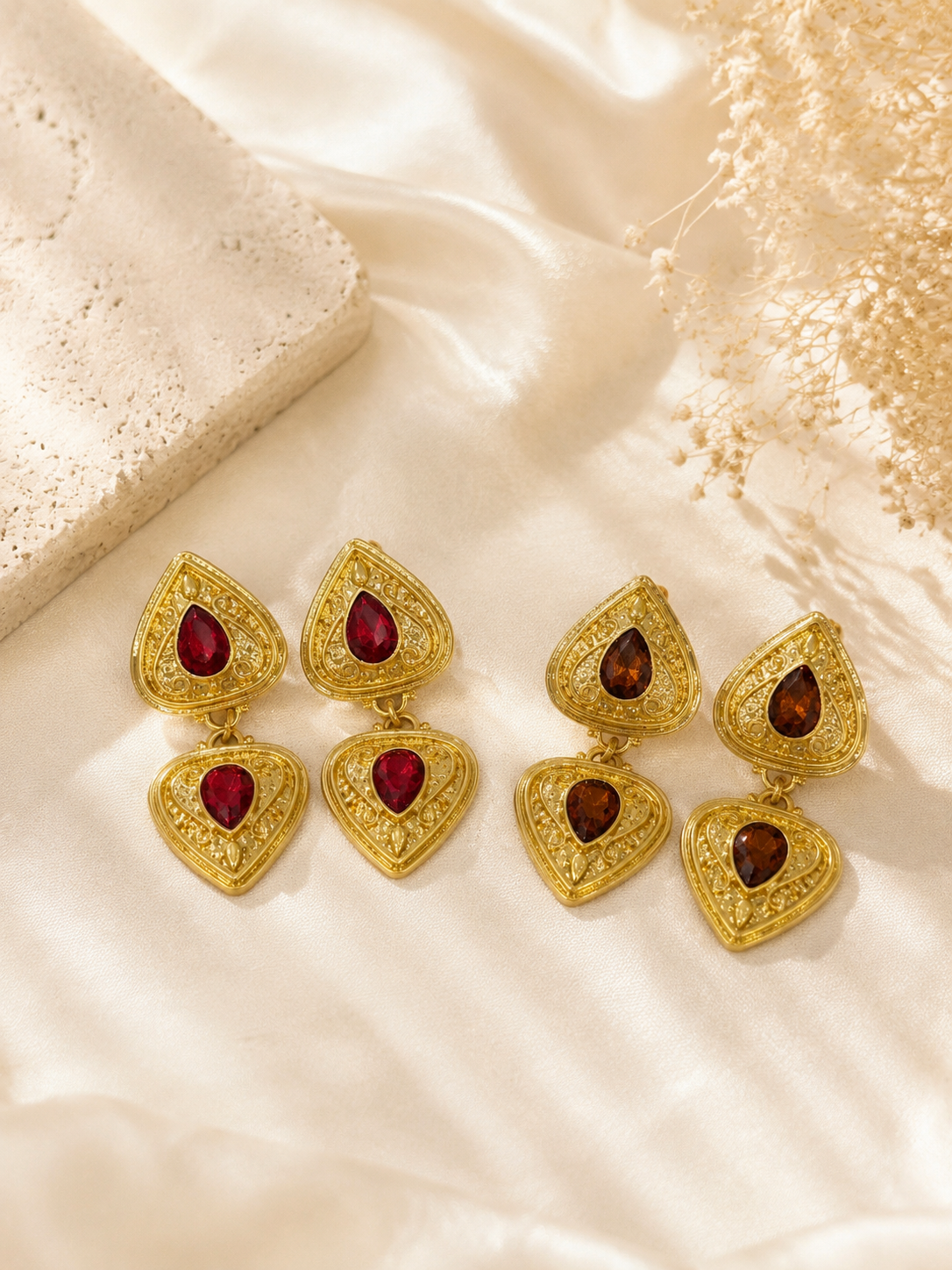
The linked RJC earrings are described with a stud-style upper element and linked drops, with Red and Brown options. Here, stud-style describes the front appearance. It does not by itself confirm a post or clip fastening; that requires its own back view or explicit specification. Keep the upper element's appearance separate from the attachment box in your sketch, while using the linked-drop description to understand the lower design.
Teardrop describes the ornament's outline. Crystal-style describes the visual presentation of its accents. Neither word establishes a particular gemstone, a total weight, or a level of comfort. Preserve the selected color and the listing's one-pair quantity while you compare construction.
To make a comparison note, use this order: “stated attachment; number of connected sections; lower shape; observed movement.” That order lets you compare another earring with a different marketing title on the same practical basis.
Try two fictional descriptions that sound contradictory
First consider “minimal drop earrings with a fixed bar and a swinging bead.” The bar may create a restrained drop silhouette while the bead provides a small amount of independent motion. Calling the whole design a drop does not erase that lower joint. Draw the bar as one part and the bead as another before deciding whether the movement suits you.
Now consider “long teardrop stud earrings.” The ornament could be an elongated rigid form attached directly to a post. Its length and teardrop shape would not automatically make it freely swinging. A side view or construction description is more informative than replacing the seller's name with a category you prefer.
Seaspray's drop-and-dangle discussion includes designs with both fixed and moving elements. The broader lesson is to describe the component relationship first. You can then use the category label as a convenient summary instead of expecting it to carry every detail.
Neither fictional example predicts ease of wear from appearance. A small rigid ornament and a long articulated design still need their own stated dimensions, fastening information, and personal fit consideration.
Build a shortlist around the motion you actually want
Write one requirement before searching: “I prefer a mostly steady silhouette,” “I want a moving lower accent,” or “I want several articulated sections.” Then add your attachment preference separately. This turns a vague wish for dramatic earrings into two concrete filters.
Compare the shortlist using the same three-part sketch. If two titles differ but their documented connections behave similarly, treat them as practical alternatives. If two titles match but their construction differs, keep that difference visible in your notes.
Browse the earring collection for actual options and the Journal for other listing questions. A useful drop-versus-dangle decision is not about winning a terminology argument. It is about understanding what attaches, what hangs, and what moves.