
Choosing earrings for a headset involves two different questions: where does the whole cup sit relative to the jewelry, and which positions must the microphone boom reach during use? A visible gap beside the cushion answers neither question completely. Plan around the headset's actual operating states, not a general recommendation for small earrings.
Separate the cup interior from the cushion footprint
First identify how your own headset is intended to sit. A cup that surrounds the ear presents a different space problem from a cushion resting against part of the ear. For example, Jabra lists the Evolve2 65's form factor as an on-ear headband. Do not assume every cup contains an empty enclosure around the whole ear.
| Where the jewelry sits | Question the visible edge cannot answer |
|---|---|
| Inside an enclosing cup | Does the complete ornament, including its depth, occupy space already used by the ear or meet the cup's inner surface? |
| Under the cushion's footprint | Does the cushion rest on an upper ornament or fastening even though the lower decoration hangs outside? |
| Across the lower cup boundary | Does a link or upper section cross the cushion while the visible drop remains below it? |
These are observation questions, not clearance measurements. The opening's width does not establish usable interior depth. Do not compress a cushion or press jewelry inward to manufacture space. If the relevant area is hidden and cannot be assessed, record it as unknown rather than calling the combination suitable.
List operating positions, not just wearing positions
Check the exact model and its current controls. The Evolve2 65 manual describes raising the boom to mute and lowering it to unmute. Lowering it can also answer an incoming call. Those features are enabled by default but can be disabled in Jabra software, so the physical position alone does not establish your current mute setting.
For an owner who uses those defaults, “talking with the boom down” is only one required state. The raised position and the travel between positions also belong in the jewelry decision. Write down the controls you actually use; do not copy another model's routine or invent an intermediate boom angle to accommodate an ornament.
Work through a boom-up, boom-down example
Consider a hypothetical Evolve2 65 stereo user who normally raises the boom to mute. The following observations are invented to show a decision, not results from a wear test or claims about a particular earring:
| Required state | Hypothetical finding | Consequence |
|---|---|---|
| Cups in their normal position; boom raised | The wearer can inspect the relevant cup-facing jewelry and observes no contact. | This addresses the cup and one boom endpoint only. |
| Boom lowered for speaking | The boom's final position is separate from the ornament. | Two clear endpoints still leave the connecting path unresolved. |
| Raising the boom to mute | The moving arm meets the earring's upper detail. | Stop rather than pushing through or repeating the contact. This pairing does not support the stated routine. |
“Leave the boom down” is not a complete answer for someone who uses its raised state throughout calls. In this example, the wearer leaves the earrings off during headset work. Another owner may normally use a documented button control, but that is a different operating plan—not evidence that the first pairing passed. Do not disable a familiar control merely to make a jewelry assessment look successful.
Know what changing sides can and cannot solve
A manufacturer-permitted side change may relocate a boom path, but it does not remove the cups' footprint on the ears. Logitech explicitly permits the Zone Wireless microphone on either side; that is model-specific permission, not a rule for every headset. Apple instead directs AirPods Max users to follow the cushions' left/right markings. Do not reverse marked equipment on the assumption that all models behave like the Logitech example.
Keep the diagnosis specific: a cup-occupancy problem calls for reconsidering the earring or when it is worn; a boom-only problem calls for checking the permitted operating arrangement. Moving the microphone cannot create space beneath a cushion.
Carry the decision into the actual session
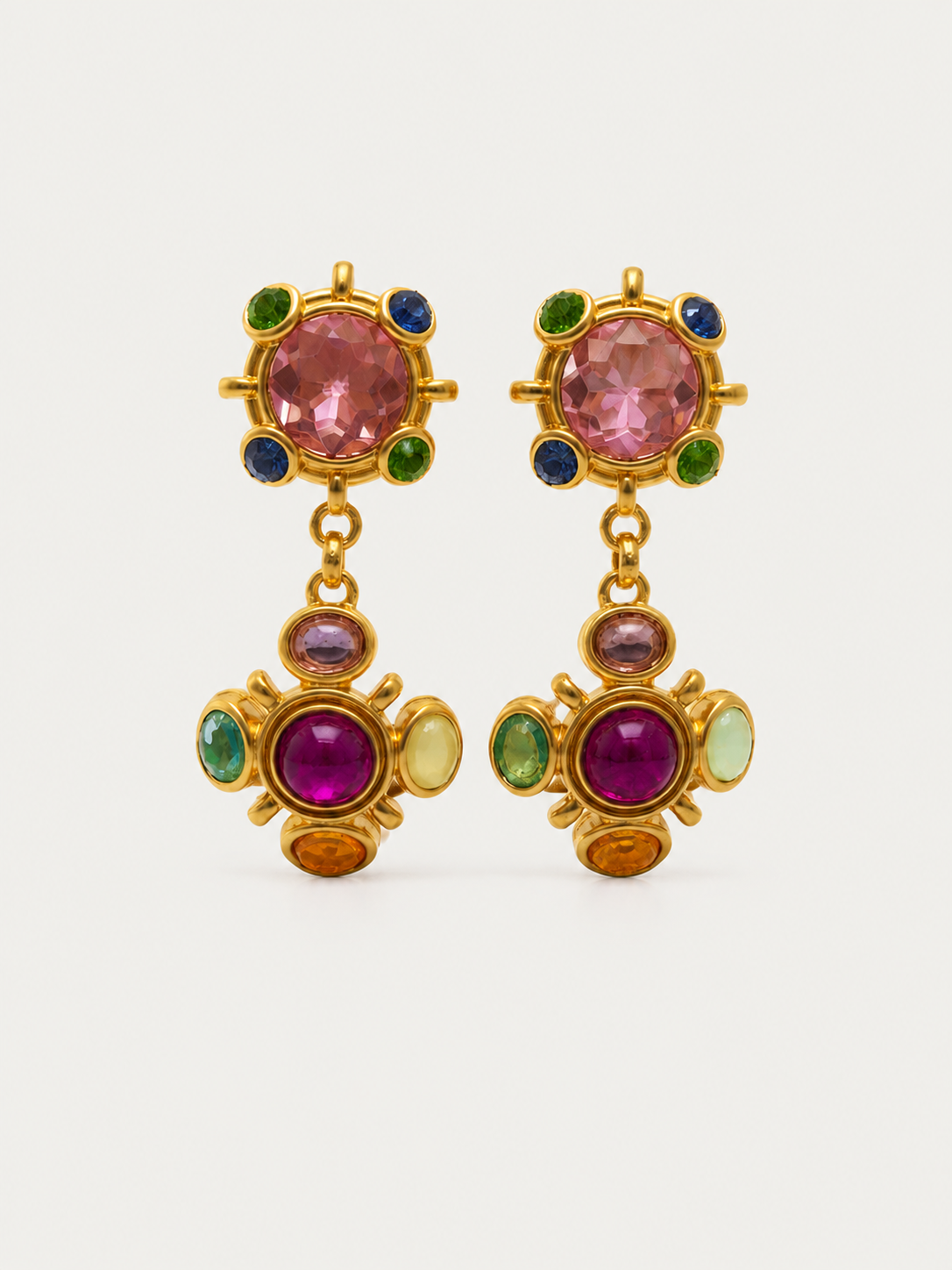
The multicolor drop earrings illustrate why both the upper detail and lower drop matter. Their front photograph supplies no usable cup depth, rear projection or boom clearance, and no headset pairing has been tested.

Finish with the model, permitted orientation, cup-area observations and required boom states. An unknown interior is still unknown; a clear speaking position is not approval for every control movement. Normal headset removal must also remain unobstructed, but it is not a substitute for this operating-state decision.
If glasses are involved, use the separate eyeglass clearance guide for their temple paths and movement sequence. Browse the earrings collection only as possible alternatives, not as a list of headset-compatible designs.