
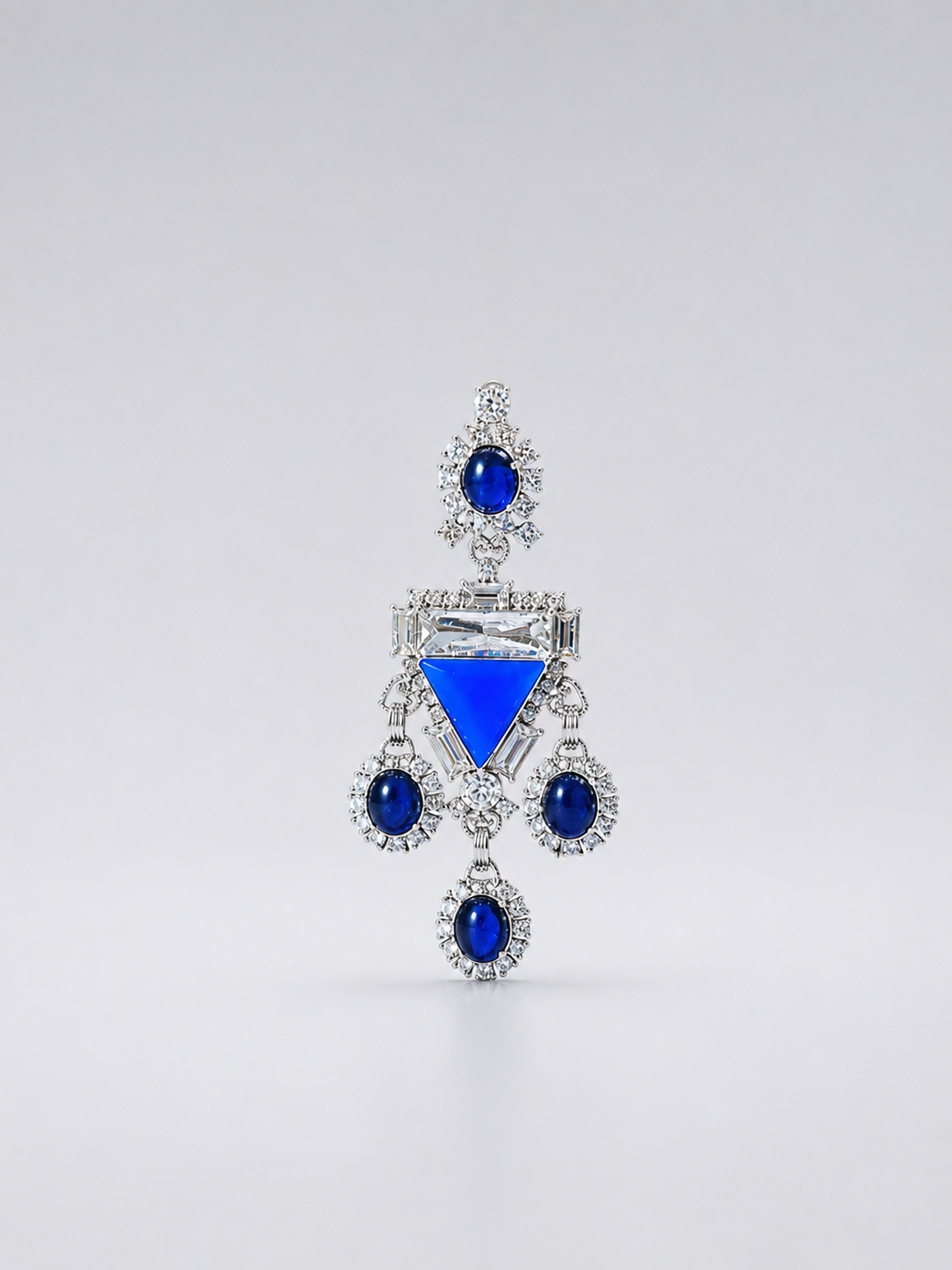
Foil-backed describes a layer behind an accent, not the identity of the accent itself. That backing can contribute to what you see from the front. Before cleaning an unfamiliar jewel, distinguish three separate things: the visible accent, any material directly behind it, and the surrounding setting. A photograph of a bright blue front rarely resolves all three.
Think in layers rather than labels
Imagine a side-view drawing, not a dismantled jewel. At the top is the transparent or translucent accent; beneath it there may be a reflective or colored backing; around the assembly is the mount. The layers can have different roles. Calling the top “glass-style” does not tell you whether a backing exists, and identifying a metal-colored exterior does not identify what lies inside.
The British Museum's Sarre Brooch record specifically describes garnets over patterned gold foil. Foil is therefore not, by itself, proof that the front is imitation glass. Nor does that historical example mean an unrelated current accent is garnet, gold-backed or made in the same way.
Color can belong to the assembly
The British Museum's study of watch WB.189 identifies rock-crystal cover pieces backed by colored foil. Its discussion explains how the backing contributes to the gemstone-like appearance. This is a particularly useful correction to the idea that the color seen from the front must be the inherent color of a single solid stone.
For your own piece, use a layer note with four entries: front appearance, stated accent material, stated backing, and stated mount. “Blue; material not identified; backing not identified; silver-tone surround” is complete enough to expose the unanswered questions. It is better than replacing every unknown with one confident gemstone name.
A closed back answers a narrower question
A metal-covered reverse tells you that the rear surface is covered where you can see it. It does not independently prove foil, adhesive, a particular gemstone, or the date of manufacture. Likewise, a hole in the mount does not guarantee that every part of an accent's reverse is accessible.
Ask for an existing back photograph or a construction description before seeking a closer view. Do not pry open a cup, lift an accent, scrape a backing or insert a tool through a hole. A photograph showing a dark patch is evidence of a dark patch under those lighting conditions, not a diagnosis of foil deterioration. Record the location and whether its appearance has changed.
Resolve construction before choosing a liquid
The Canadian Conservation Institute's silver-care note requires examining construction before treatment and warns against immersion for specified hollow or composite silver objects. That is not a cleaning recipe for unidentified costume jewelry; it demonstrates why the accessible outer surface is an inadequate basis for treating the whole assembly.
When a backing or enclosed construction is unknown, postpone soaking, steam, ultrasonic cleaning and chemical dips until the maker or an appropriate professional can address the actual piece. Ask: “Does this accent have an applied backing, and is the recommended method safe for that backing and its attachment?” A recommendation for the front material alone does not answer that question.
Keep a visual example within its evidence
The product image for the silver-tone blue stone-style chandelier earrings shows one earring with blue and clear accents. It does not establish the materials behind those accents, and the single pictured object does not establish sale quantity.

The rhinestone, crystal-style and glass wording guide addresses the front-material vocabulary. This guide adds a different question: what other layers must be considered before care? Use that question when examining your own pieces or comparing details in the earrings collection.
The practical result is modest but valuable: a layer-aware description and a specific unanswered care question. Neither requires sacrificing a backing to discover whether it was there.