
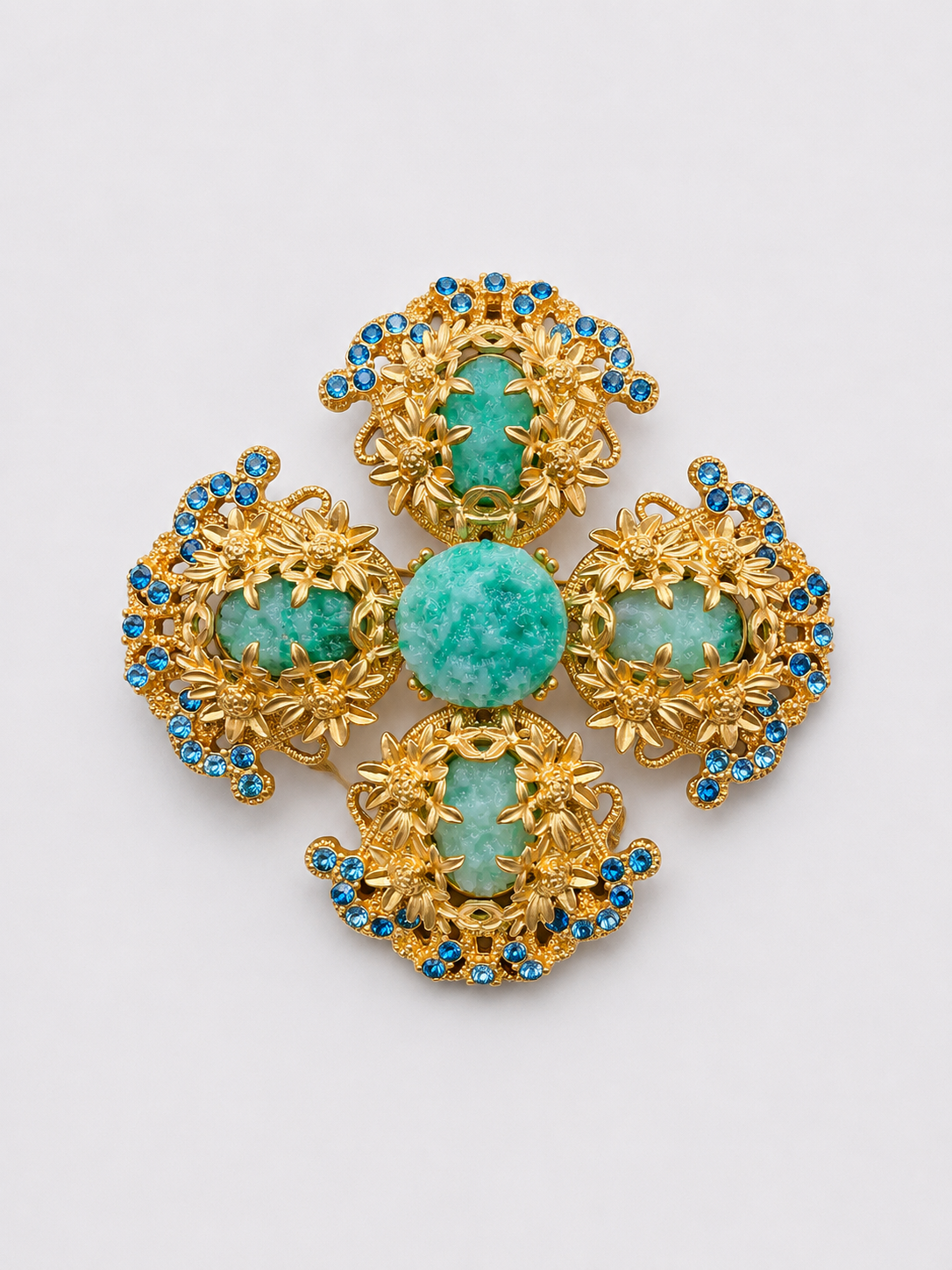
Giardinetti, usually translated as little gardens, describes a recognizable jewelry composition of small flowers arranged as a miniature garden or floral display. A basket, vase or pot can be central to the design. The useful reading task is to follow how the blooms, stems and container work together, rather than treating any flower-shaped jewel as a giardinetti.
Look for the arrangement beneath the flowers
The Toledo Museum of Art's Giardinetti Pendant provides a documented example and describes arrangements of tiny blooms in baskets, vases and pots. Its label supplies the historical term and its connection to the miniature floral arrangement. Those facts belong to the museum's example and discussion, not to every current floral accessory.
Start at the lowest recognizable element. Is there a vessel with a rim, a basket-like body, or a base from which several stems rise? Follow those stems upward. Do they lead to individual blossoms at different levels? Do leaves help connect the parts? This bottom-up reading makes the whole composition clearer than counting bright accents first.
A row of colored ovals may evoke flowers without drawing a garden. Conversely, a comparatively flat representation can communicate a basket and bouquet without individually modelled petals. The composition is not dependent on one particular color palette.
Compare three botanical arrangements
A single blossom concentrates petals around one center. Its chief structure is radial: parts surround a focal point. It may have leaves or a stem, but that does not automatically turn the subject into a contained garden.
A spray or tied bouquet brings several branches or stems together. In the Met's Mellerio Borgnis design drawings, some brooch designs bundle branches and leaves with a ribbon. These are useful comparisons for the idea of gathered botanical elements; the record does not need to label them all giardinetti for their composition to be informative.
A contained little garden gives the flowers a basket, vase or similar organizing base. The vessel participates in the subject rather than functioning as an unrelated decorative frame. A handle, a lip or a rounded container body may help you recognize it, but do not invent a hidden basket where the image only shows an oval surround.
These categories are descriptive aids, not a rigid classification system for every hybrid design. “A floral spray above a basket-like base” can be more accurate than forcing a disputed object into one historical label.
The same motif need not imply the same material or date
London Museum's ring A20477 has a stamped flower-basket motif, and its record relates that design to the giardinetti type. It offers a useful contrast with a jewel whose miniature flowers are assembled from separate gem-set elements. Similar subject matter does not require identical fabrication.
Do not infer precious metal, gemstone identity, original manufacture in Italy or an eighteenth-century date from the Italian term. A record can identify a particular historical object; visual resemblance alone cannot transfer that object's history to another one.
For a broader comparison of design languages, the Art Deco and Art Nouveau guide examines line, rhythm and symmetry. Here, the question is narrower: what botanical arrangement is actually depicted?
Make a small composition sketch
Take a copy of an image and mark three zones: base, connecting stems, and flower heads. If one zone cannot be found, leave it absent rather than filling it in from expectation. This is a diagram of visible organization, not a reconstruction of the object's manufacture.
On the gold-tone turquoise stone-style floral brooch, concentrate on the documented floral design and turquoise-color center. The product record does not identify a basket composition or a historic giardinetti object, and turquoise-color is not a claim of turquoise material.

The brooch collection contains other botanical forms to compare. End with a compact composition sentence, such as “one large flower with surrounding leaves” or “several blossoms rising from a basket.” You will then be able to explain why a little garden differs from a flower, even when both are vividly colored.