
Granulation names a technique involving tiny metal granules attached to a surface or assembled into decoration. Milgrain describes a fine bead-like edge detail, often made with a tool that impresses a repeating pattern. Beaded texture can be a useful appearance description when the process is unknown. The distinction matters because not every little bump is an individually attached bead.
Notice where the small detail sits
Start with location before reaching for a technical name. Does the pattern run along an edge? Does it fill a field? Does it form clusters projecting into space? Is the round element actually a separate pale accent rather than metal decoration? These observations are available even when manufacturing information is not.
In GIA's metalwork discussion, granulation concerns attached tiny gold particles, while a milligraining tool can roll a bead-like pattern along an edge. “Milgrain” and “milligrain” spellings both appear in jewelry writing. The relevant distinction here is between a fine border treatment and individually applied granules, not a spelling contest.
Do not let placement become a manufacturing test
An edge of dots is a reason to look for a documented milgrain description, not proof that a particular tool was used. Similarly, a dotted field does not prove that separate spheres were attached. A finished casting or another process may reproduce a beaded appearance; a photograph cannot reveal every join.
Use magnification only as an aid to describing what is visible, not as permission to scrape or pick at a dot. An apparent line around one bump could be a shadow, a boundary, or something else. If a technical identification matters, ask for maker information or an appropriate examination rather than trying to detach a sample.
Two museum records break the age shortcut
The Met identifies granulation on its Etruscan gold earrings. It also discusses the technique in Daniel Brush's Double Pyramid earrings, dated 1975. Together, these records make a useful narrow point: use of granulation is not sufficient to date an unrelated jewel to antiquity.
The Brush record is also a reminder that granules can contribute to a three-dimensional construction, not merely decorate a flat background. The record supplies that information; it does not authorize us to identify similarly textured current products as the same technique. The page currently provides no image, so its technical narrative should not be described as a visual inspection.
Build a detail caption that survives uncertainty
A good caption moves from the broad area to the small feature. Try “a fine, repeating bead-like border around the oval surround” rather than “ancient granulation.” For a different piece, “clusters of small rounded metal-colored forms across the center” may be more accurate than “milgrain,” because the description concerns a field rather than an edge.
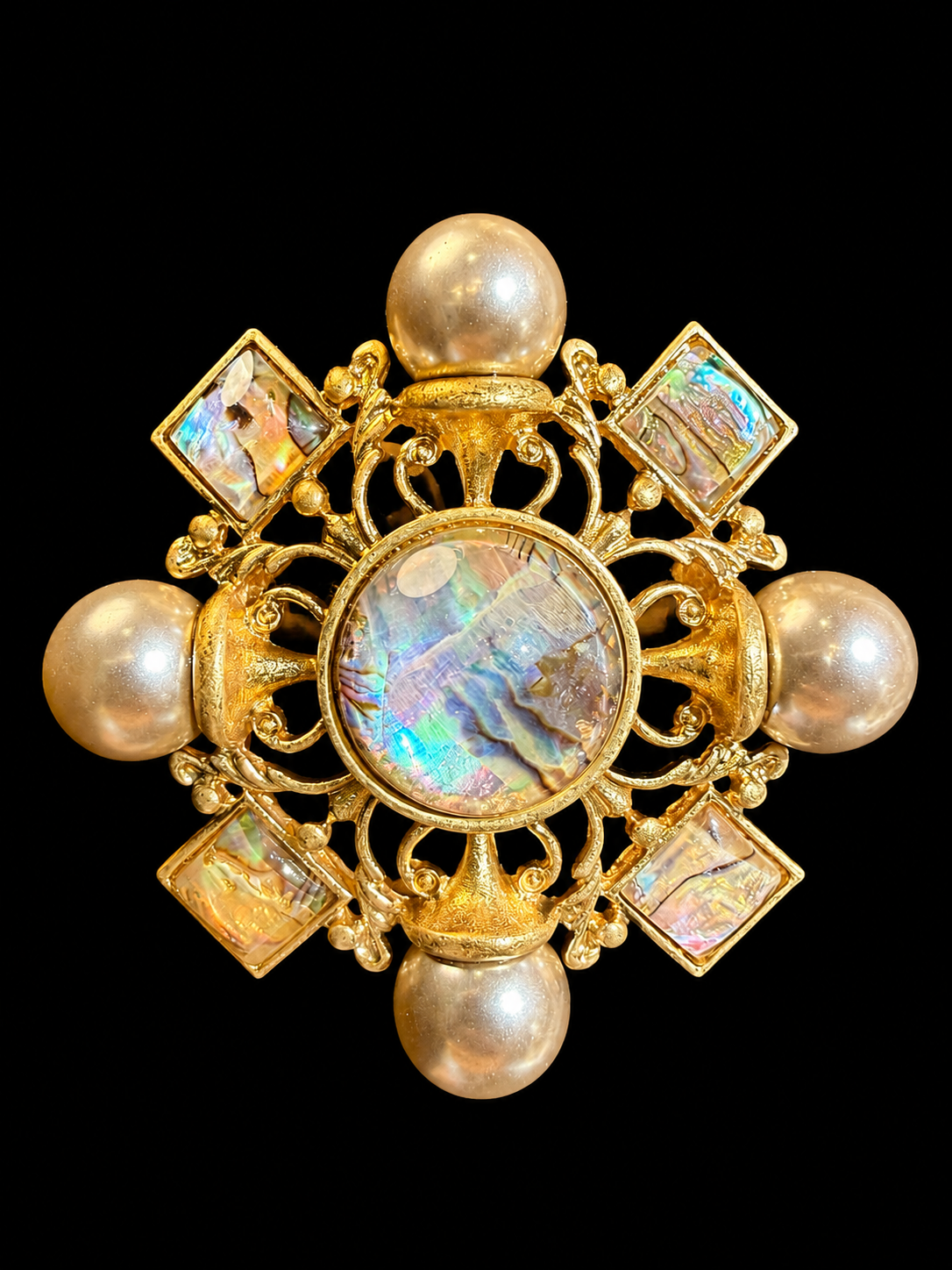
The gold-tone pearl-style and iridescent-style brooch contains ornate borders and pale round accents. Those pale accents should not be renamed metal granules, and the product description does not establish a granulation or milgrain process.

On a copy of its image, you could mark one border and one large pale round accent, then give each a separate description. This simple exercise prevents a single technical-sounding word from being applied to different kinds of detail across the whole piece.
Keep neighboring terms in their own jobs
Filigree and openwork address wire-based work and openings, not the same question as tiny granules or edge dots. A design can present openings, a beaded-looking border and prominent accents at once. Describe each feature independently before assigning any process.
When looking through the brooch collection, a practical three-line note is enough: location of the detail; visible shape and repetition; documented process, if any. Leave the third line “not stated” when necessary. You will have a useful description without confusing an attractive surface with evidence of age, material or manufacture.