
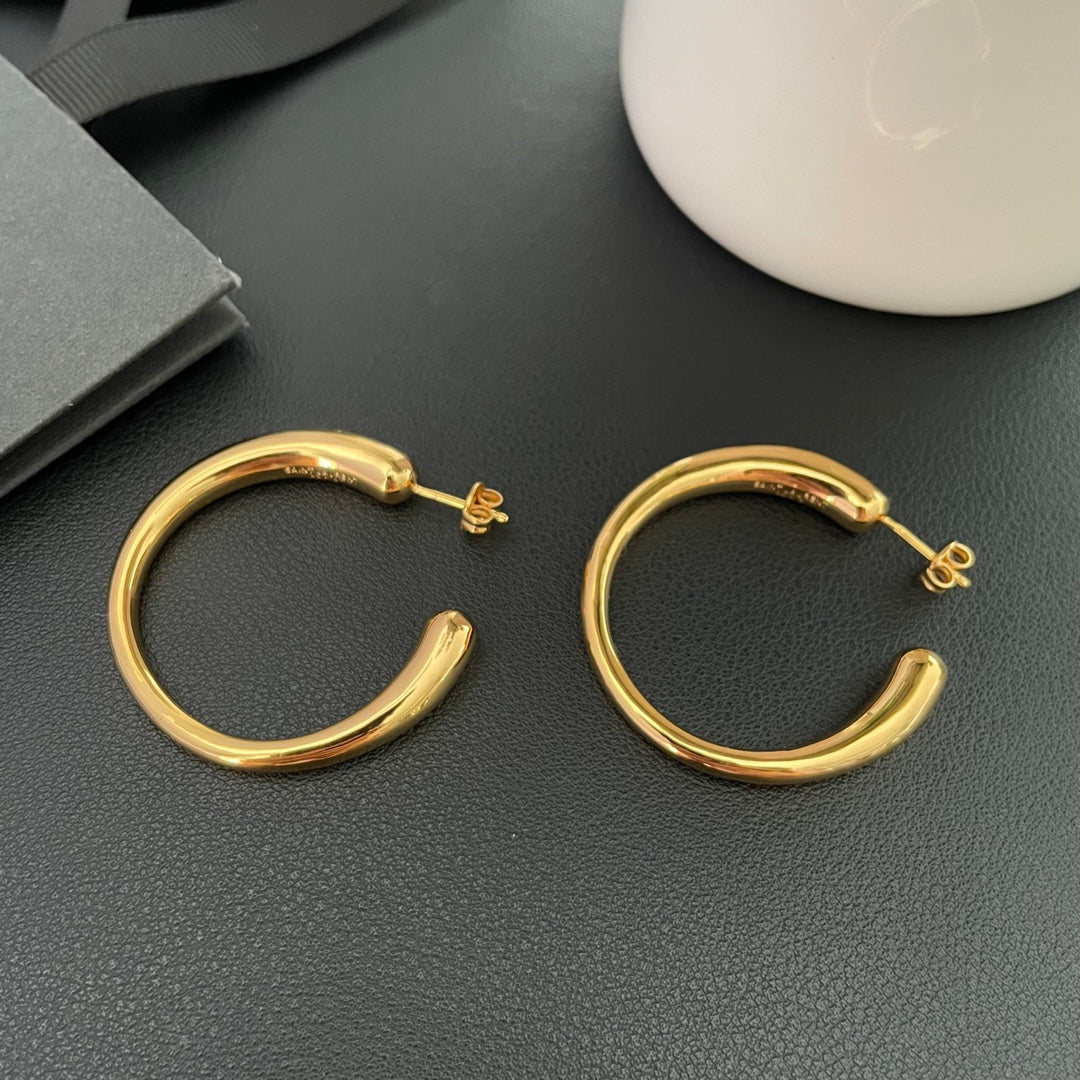
Huggies are small hoop earrings designed to sit close to the earlobe. Hoop is the broader style family: it includes close-fitting designs as well as larger, open, sculptural, and decorated outlines. The shopping choice is therefore between different hoop proportions, rather than between two completely separate kinds of jewelry.
Start with the space around the lobe
Astrid & Miyu's earring glossary describes huggies by their close relationship to the earlobe. That relationship is the useful distinction. A small-looking product photograph does not establish how closely an earring will sit on your particular ear.
| Feature | Hoop family | Huggie style |
|---|---|---|
| Overall idea | A curved or ring-like earring outline | A small hoop intended to sit close to the lobe |
| Visible space | Can leave a substantial opening below the ear | Usually aims for a more compact relationship |
| Decorative surface | Plain, textured, wide, narrow, or ornamented | Can also be plain, substantial, textured, or ornamented |
| Fastening | Must be checked on the exact item | Must still be checked; the name is not a complete hardware specification |
Do not substitute a universal diameter cutoff for that comparison. A retailer's small, mini, and huggie categories belong to its own range. The same word can cover different proportions elsewhere.
Keep body width separate from the opening
A close-fitting hoop can have a thick, rounded body and create a noticeable band beside the lobe. A larger hoop can use a much narrower body and leave more open space. Small does not automatically mean visually delicate, and a wide-looking body does not provide a measured weight.
When comparing photographs, identify the outer outline, the inner opening, and the width of the earring body as separate features. Choose whether you want a compact band of decoration or an outline that extends farther away from the ear. This is a design preference, not a ranking of quality.
Check the fastening without guessing from the front
Hinged, clicking closures are common in huggie collections, but a style name does not tell you every detail of the post, hinge, or receiving part. Larger hoops also use several fastening constructions. Request a clear reverse or side view if the hardware is obscured.
A hoop outline can even belong to a finished clip-on earring. That does not make it interchangeable with a pierced hoop. Decide which fastening you need before using a silhouette to narrow the search, and check whether the selected listing is one earring or a pair.
Read a current hoop example precisely

The RJC listing identifies a brass base, gold-plated finish, rounded hoop silhouette, post-back closure, butterfly backs, and one pair. The photograph supports the open rounded outline. Neither the description nor the image supplies a diameter or establishes a huggie fit.
This is a direct example of the hoop family, rather than a pair relabeled to fill the huggie side of the comparison. A huggie preference would require a separately documented candidate with the close-fitting proportions you want.
Use the name to shortlist, then compare specifications
Write down your preferred visual relationship: close to the lobe, a visible opening below it, or a pronounced hanging circle. Then compare the actual product details. Our hoop diameter guide explains the separate measurement task and why inside and outside dimensions must not be mixed.
Materials, quantity, and fastening remain independent requirements. No hoop-family label promises comfort, suitability for a particular piercing, or a secure fit for every wearer.
Choose by the outline you want to wear
Browse the earring collection for the shape that matches your preference. If the closure or dimensions are missing, ask about that exact pair before treating a small photograph as a close-fitting design. The useful result is a supported choice of proportion and fastening, not merely the right style word.