
To style a vintage-inspired brooch, choose one place where you want the outfit's focal point: a jacket lapel, a coat shoulder, or a detail on an accessory. Compare its outline against the clothing before opening the pin. The visual choice comes first; whether that particular garment can support that particular brooch is a separate check.

Choose a shape that reads against your clothing
A plain jacket gives an ornate brooch room to be seen. Against a busy print, the same details may blend into the pattern; try a quieter garment if you want the brooch to lead. On a textured coat, compare the outline from a few steps away rather than judging only the close-up view.
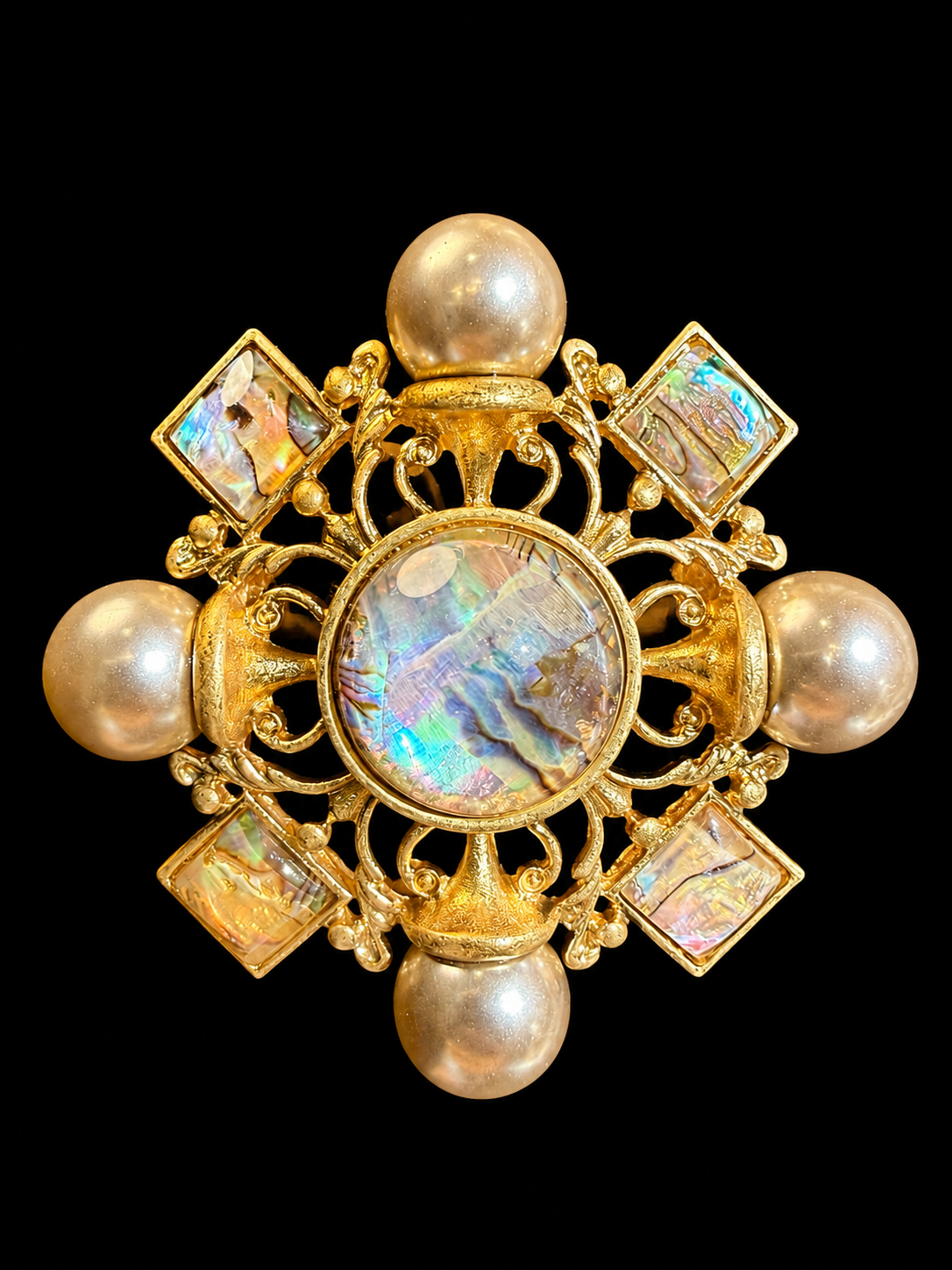
The pictured Gold-Tone Pearl-Style Iridescent Cabochon Statement Brooch is a useful example. Its current product description identifies an ornate openwork frame, pearl-style round accents, iridescent center and corner panels, and a pin closure shown on the back. A dark blazer is one styling option for contrasting its ornate outline and gold-tone details; a cream coat can make the overall palette softer. These are outfit ideas, not confirmation that either garment can carry this piece.
Gold-tone and pearl-style describe the appearance here. They do not establish solid gold, real pearls, the underlying materials, or a vintage date. The product description does not list measurements or weight, so use the photograph for design comparison and ask for those specifications before choosing it for a particular placement.
Give a jacket or coat one clear focal point
On a blazer, start by comparing the brooch near the upper lapel with a position farther down. The higher option brings the detail closer to the face; the lower option may sit nearer a pocket or button. Leave enough visual space around the decoration that it does not look like part of the jacket's hardware.
On a coat, compare a lapel placement with a position near the shoulder. Look at the outfit with the coat both open and closed: an overlap, scarf, or bag strap may cover the spot you preferred. Either side can work for ordinary styling. Choose the clearer arrangement rather than treating the left lapel as a requirement.
While comparing, keep the pin closed and support the brooch in your hand near the garment. A lapel is a candidate to inspect, not automatic proof of suitability. Use the brooch fabric guide for the separate attachment decision instead of repeatedly repinning to find the best visual position.
Treat scarves, hats, and bags as individual decisions
For a scarf, consider whether the brooch would be a decorative accent or a fastener that must hold the arrangement. Those are different jobs. A photograph of a brooch on a scarf does not show that any other brooch can secure your scarf, especially when the pin must accommodate folded layers. Arrange the scarf independently and clarify the piece's fastening and dimensions before relying on it to hold anything.
On a hat, compare a side position near the band with the rest of the silhouette. The brooch should have room to be seen without crowding another ornament, but the hat's construction still determines whether attachment is appropriate.
For a bag, keep the same distinction between a visual idea and a usable attachment. A strap or thick panel is not automatically a suitable pinning point. If you do not want the surface pierced, choose a different accessory or a purpose-made attachment you have confirmed is compatible. You can enjoy the color pairing without committing to a hole.
Balance the rest of the jewelry around the brooch
Start with the brooch alone, then add earrings and see whether both details have enough space. An ornate brooch near the face often looks clearer with a simpler earring shape. If you prefer two statement pieces, repeat one color or finish and compare their outlines in the complete outfit.
You do not need a matching set. With the pictured brooch, gold-tone details or rounded shapes elsewhere in the look can create a connection without repeating every feature. If a necklace, scarf pattern, and brooch all compete at the neckline, remove one and compare the result. The useful test is whether you can see the detail you chose as the focal point.
Buy for the garment you actually plan to wear
Before choosing a brooch for a specific outfit, collect the information that a front photograph cannot answer:
- Footprint: the brooch's height and width, so you can compare it with the available lapel or accessory area.
- Weight: the exact piece's weight, especially when the intended fabric is fine, stretchy, or loosely constructed.
- Back and fastening: a clear reverse view and the closure's operation, rather than an assumption based on another brooch.
- Intended use: whether you want decoration or need it to hold folded fabric, and what garment or accessory is involved.
If an essential detail is missing, ask before buying for that use. Confirmed dimensions can help you assess the available space; they cannot guarantee fabric compatibility. A piece may suit the colors of an outfit while requiring a different garment or placement.
Finish with a wear-and-care check
After you have established an appropriate attachment, look at the complete outfit while seated and moving normally. Check whether the brooch meets a strap, coat edge, or scarf. If the fabric pulls or the placement interferes with another item, remove it carefully and reconsider the combination.
Follow the Jewelry Care Guide before cleaning, and store the brooch separately so other pieces do not press on its pin or decoration.
Browse the Rustic Jewel Co brooch collection with one garment and one focal point in mind. If a design appeals but its measurements, weight, or fastening remain unclear, send us the product link and your intended outfit so you can clarify the details before choosing.