
Choose jewelry for a job interview by resolving the practical brief first: what the employer has requested, what you will do, and which familiar piece you can wear without managing it throughout the conversation. You do not need to buy a new accessory to make an interview outfit complete.
Put the evidence in the right order
An instruction from the recruiting team is more useful than an internet rule about what every professional should wear. Next consider the actual work environment and the agenda. Photographs of employees can offer context, but a promotional portrait is not an interview dress policy.
Harvard's attire guide combines attention to organizational expectations with personal expression. Its separate interview guide takes a more conservative approach to conspicuous jewelry. Read those as context-dependent advice. Neither can tell you what one particular employer requires or measure your competence from an earring.
Write a three-line interview brief
Divide a note into confirmed, observed, and unknown. A confirmed entry might be “business casual, two interviewers, portfolio discussion.” An observation might be “team photographs show varied accessories.” An unknown might be “a tour is mentioned, but the work area is unspecified.” Do not silently promote the observation into a rule.
Ask one focused question if the unknown changes your choice: “Does the visit include a practical demonstration or a work area with clothing or jewelry requirements?” This requests useful preparation information without asking the recruiter to approve your personal taste.
Match the jewelry to the work you will demonstrate
| Interview activity | Question to settle | Useful preparation |
|---|---|---|
| Writing or portfolio handling | Does wristwear repeatedly meet the desk or pages? | Use the actual folder and pen once. |
| Walking tour | Are there site-specific requirements? | Ask the organizer; keep required equipment unobstructed. |
| Seated discussion | Do you keep reaching to straighten a piece? | Rehearse an answer with your ordinary gestures. |
| Remote meeting | Does the accessory meet the headset or microphone? | Check the complete call setup before the appointment. |
The University of Washington's academic interview guidance notes that a visit can involve sitting, walking, transport and meals. Your jewelry plan should reflect your own agenda, even if it is much shorter.
Compare one familiar option with one alternative
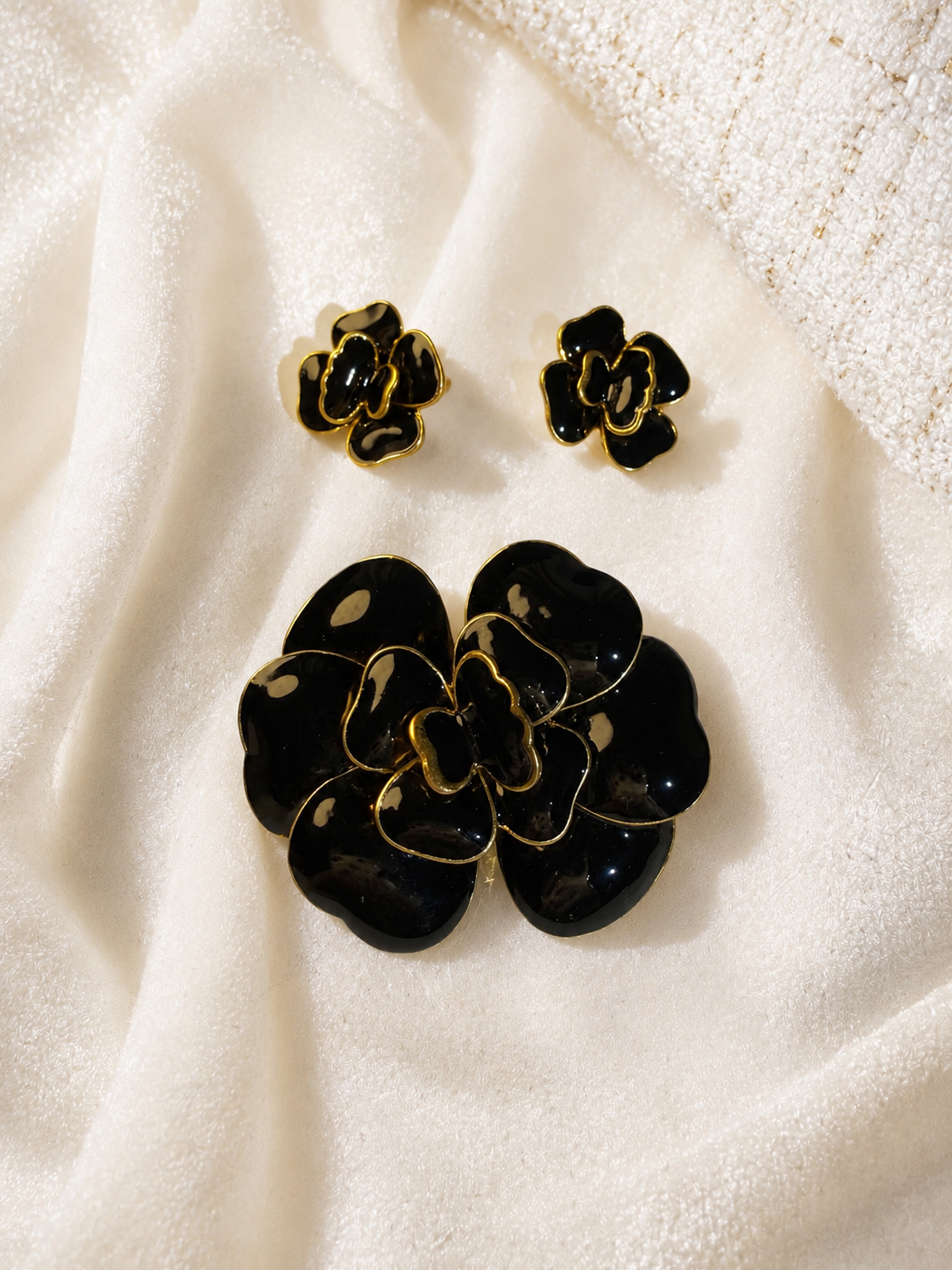
Start with a piece you already know how to put on and remove. If you want another choice, change a single element. For example, compare your usual earrings with a floral stud design, while keeping the rest of the preparation constant. Speak through a short example from your work and turn to an imaginary second interviewer. The useful observation is whether you stop thinking about the accessory.
The black flower brooch and stud-earrings set illustrates two possible placements. You could consider the earrings alone; owning a set does not require wearing every component. The picture cannot establish weight, on-ear scale or suitability for your interview.

Set a decision deadline
Finish the jewelry decision before your final interview preparation session. If an option still requires repeated adjustment, another purchase or an unanswered specification, use the familiar alternative or wear no jewelry. That leaves preparation time for examples, questions and logistics.
A later work celebration is a different brief; the office holiday party guide addresses that change of context. For an interview, browse the earrings collection only after identifying a real gap. The finished decision should be a sentence you can leave alone: “This follows the confirmed brief and lets me use my portfolio normally.”