
A jewelry set bill of materials, or BOM, lists the exact components and quantities needed for one defined set. It is a recipe, not another pile of inventory. When two set offers share the same component, calculating each offer independently can make the combined opportunity look larger than the stock can support.
Write the recipe in unambiguous units
Give the parent set a reference and revision. For each component, record its exact variant identifier, description, quantity required, and counting unit. If earrings are managed as pairs, write “one pair,” not “two earrings” in a quantity field that otherwise counts pairs.
A hypothetical Set A contains one necklace and one earring pair. Set B contains one brooch and one pair of the same earring variant. Packaging can have a separate packing checklist; do not silently treat a presentation box as jewelry stock or count a spare component as included merchandise.
Faire's inventory-sending guidance provides a marketplace reference for keeping physical units and their identifiers aligned. Verify component identity before assembly; a correct recipe cannot compensate for a mislabeled input.
Calculate a single offer's whole-set capacity
For each component required by the selected recipe, divide usable, unallocated quantity by its required quantity per set, which must be greater than zero. Exclude rows with a zero requirement for that recipe; they are not division inputs. Round down to a whole number. The smallest result limits that offer. This mirrors the component-based calculation described in Shopify's bundle inventory guidance. Its calculation also has tracking and overselling-setting caveats; a displayed estimate is not a physical inspection.
| Hypothetical component | Available units | Set A requirement | Set B requirement |
|---|---|---|---|
| Necklace | 4 | 1 | 0 |
| Brooch | 5 | 0 | 1 |
| Earring pair | 6 pairs | 1 pair | 1 pair |
Set A alone has capacity four. Set B alone has capacity five. Those are alternative calculations using the same six pairs, not permission to promise nine sets.
Allocate shared components before adding promises
If four Set A units are allocated, four earring pairs are consumed by that plan. Only two pairs remain for Set B, so the feasible plan is four A plus two B. Another feasible plan is one A plus five B. Both use six pairs; neither establishes which mix customers want.
Keep the allocation date and responsible person with the planning record. Recalculate after a component sale, reservation, hold, or quantity correction. Avoid separate spreadsheets that each assume the shared pool is untouched. A single source of component availability is more important than an elaborate recipe format.
Separate a virtual recipe from a prepacked set
A virtual offer draws from component stock when the relevant transaction occurs. A prepacked set already exists as a physical unit. Do not count a packed set and its enclosed components as independently available at the same time. Confirm the behavior of your inventory tool before relying on automatic deductions.
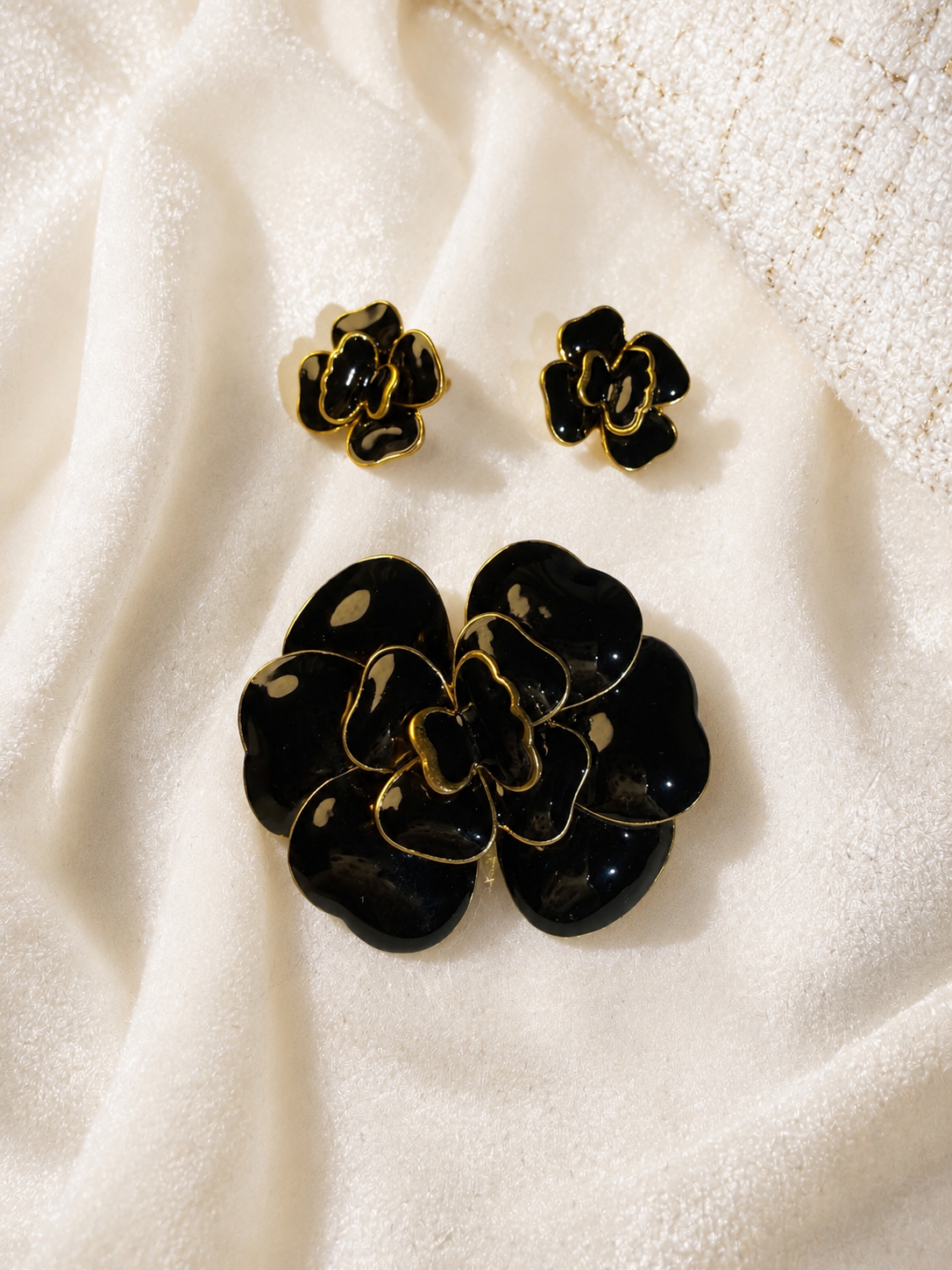
The black flower brooch and stud earrings set is a real example of a defined set, not evidence that its parts can be ordered separately. Its photograph cannot establish a component-stock balance.

Version the recipe when contents change
Record changed components explicitly instead of substituting a near match under the old recipe. For GS1-identified physical assortments, the GTIN Management Standard, section 2.9, addresses changed composition and identity. Follow the applicable identification rules rather than inventing a GTIN from an internal set code.
The separate bundle-pricing guide covers the pricing decision; a BOM answers the prior question of what can actually be supplied. Use the wholesale inquiry page to ask about exact set contents, without assuming component availability or custom assembly terms.