
“In the blue-jewelry drawer” works until the assortment changes or another person puts the stock away. A shelf or bin address should identify a place, even when the merchandise inside changes. Product names, SKUs, and storage addresses need separate fields.
Build the shortest useful address
Start with the store location, then add only the physical levels staff need to navigate. A fictional address such as MAIN-B-02-03 means Main Store, backroom zone, unit 02, compartment 03. Put the explanation on a small map. If there is only one cabinet, a simpler cabinet-and-compartment code may be enough.
Use consistent lengths for numbers so printed lists sort predictably. Shopify's bin-location guidance specifically explains why leading zeros help. Avoid using color as the sole distinction between locations; printed text should carry the identity.
Separate the shelf from the tray that can move
A fixed address belongs on the fixture. A movable tray can have its own container ID. If tray T-14 moves from a cabinet to a photography table, T-14 remains the same tray, but its location changes. Giving both the shelf and tray the same code makes it difficult to explain what actually moved.
| Record | Hypothetical value | Meaning |
|---|---|---|
| Product identity | DEMO-BR-17 | The exact stocked variant |
| Container | T-14 | A movable tray |
| Fixed address | MAIN-B-02-03 | The tray's current storage place |
| Temporary destination | PHOTO-01 | A controlled working area |
This is an internal addressing scheme, not a standardized GS1 location identifier. The inventory worksheet supplies the item record; the address adds a reproducible route to the object.
Decide how overflow will be found
A variant may physically occupy a display pocket and backstock compartment. Choose one primary find location and an explicit overflow reference. Do not put “plus some upstairs” in a free-text note that disappears from the picking view.
Shopify currently allows one assigned bin per variant per location. If you need quantities split across several bins within the same store, use an appropriate supporting process or inventory tool; do not pretend the single bin field holds that full breakdown. Its migration guidance also distinguishes transfers between locations from movements within one location.
An overflow card can point to the authoritative location record without repeating a quantity that quickly becomes stale. When overflow empties, retire the pointer. Empty containers should not remain on the map as if stock still occupies them.
Protect identity inside the compartment
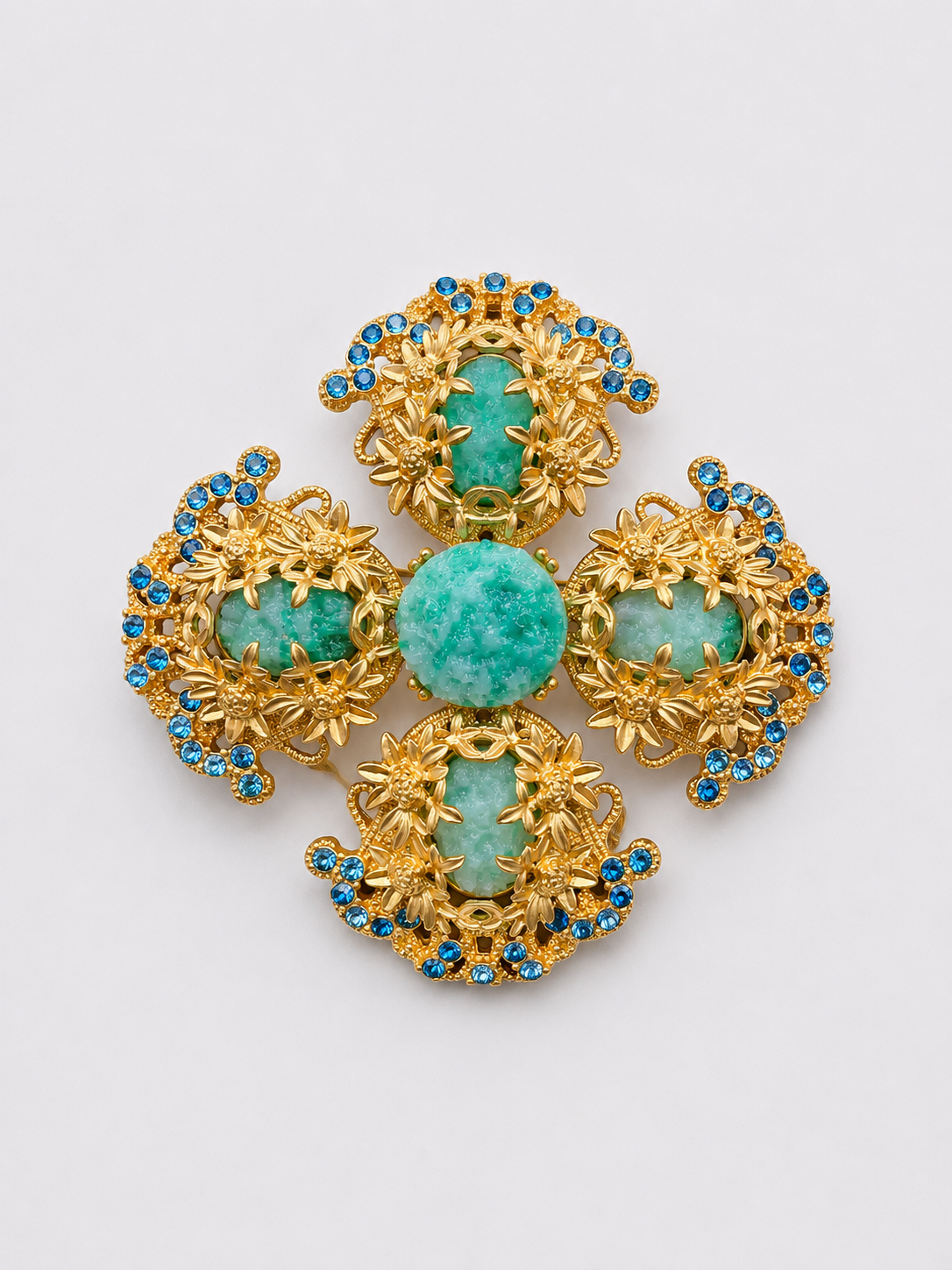
The turquoise-colored floral brooch has a recognizable motif, but “turquoise flowers” is an unreliable shelf name. Another brooch might share that description, and the photographed color does not identify a material.

Use separated, labeled positions where similar variants share a drawer. Keep the product's identity attached to its own support or container so returning one item does not depend on remembering which corner it came from. A location may contain several SKUs; that does not make the contents interchangeable.
Run a retrieval test before expanding the scheme
Give a colleague one item reference and the location map. Ask them to find the correct unit and return it without hints. Note where they hesitate: unclear room prefix, numbering direction, hidden label, or an overflow pointer with no destination. Fix those problems before labeling the entire stockroom.
Faire's stockroom guide emphasizes signs that staff can follow without the owner's knowledge. Recheck the route after furniture moves, and retain a dated map revision. For a new brooch selection, decide where the units will live before putting them into an unmarked temporary pile.