
Before styling jewelry with a wrap top, find out what actually holds the front together. A tied blouse and a fixed crossover knit can form similar V shapes, yet their overlapping panels do different jobs. The necklace should decorate the finished arrangement, not become part of its fastening.
This is especially useful when you like a wrap's diagonal line but find a pendant repeatedly disappearing between its layers. Changing the jewelry's color will not solve that particular problem.
Trace the fastening with the top off
Lay out the garment and follow its actual construction. Does one tie pass through a side opening before the other panel closes over it? Are the crossing fronts permanently joined at the side seams? Is a visible knot functional or simply decorative? Do not pull at a sewn junction to find out; inspect the seams and follow the maker's dressing instructions.
True Bias's Calvin instructions demonstrate a real wrapping sequence, with ties and an optional separate garment closure. Cashmerette's Dartmouth instead offers fixed crossover fronts, including a ruched version. Those construction differences—not a general rule about V-necks—change the jewelry decision.
Finish the closure before locating the ornament
Put the top on with its intended underlayer, settle any designed shoulder adjustment, and fasten it normally. Keep jewelry off while doing this. If the front does not provide the coverage or stability you want, address the garment fit or choose another layer before styling the necklace.
Do not tighten the waist tie beyond a comfortable position to make room for a pendant. Do not add a brooch through both fronts simply to make the necklace sit better. That changes the clothing problem into a fastening problem that decorative placement advice cannot resolve.
Once the top works without jewelry, identify the upper panel and the point where its diagonal edge crosses the lower one. That crossing is not automatically the best place for a pendant.
Use the construction to choose the next step
| Your wrap front | Inspect this area | Useful jewelry decision |
|---|---|---|
| Tie-fastened woven top | The overlap after the ties are settled | Keep a necklace wholly outside the panels; leave the tie route independent. |
| Fixed crossover knit | The sewn crossing as the top rests on the body | Check whether a pendant remains outside instead of slipping into the opening. |
| Ruched fixed front | The direction in which gathers converge | Choose whether the ornament stays away from that junction or intentionally sits above it. |
These are starting decisions, not guarantees of fit. The same necklace might work with the fixed top and fail with the tied one even when both have a similarly deep V.
Check for capture, not just contact
Try the necklace after the garment is secure. Reach forward and return to a relaxed position. Watch whether the pendant remains on the outside, falls behind the upper panel, or becomes caught at the crossing. If you have to retrieve it from between the layers, choose a different necklace position within its designed range or leave the front clear.
Never route a necklace through the wrap's side opening or behind one front panel to hold it off-center. A clean front view is not worth turning the chain into part of the closure. General above-versus-over-fabric choices belong in our neckline guide; the extra check here is that the overlapping layers remain independent of the jewelry.
Let the diagonal remain complete without a necklace
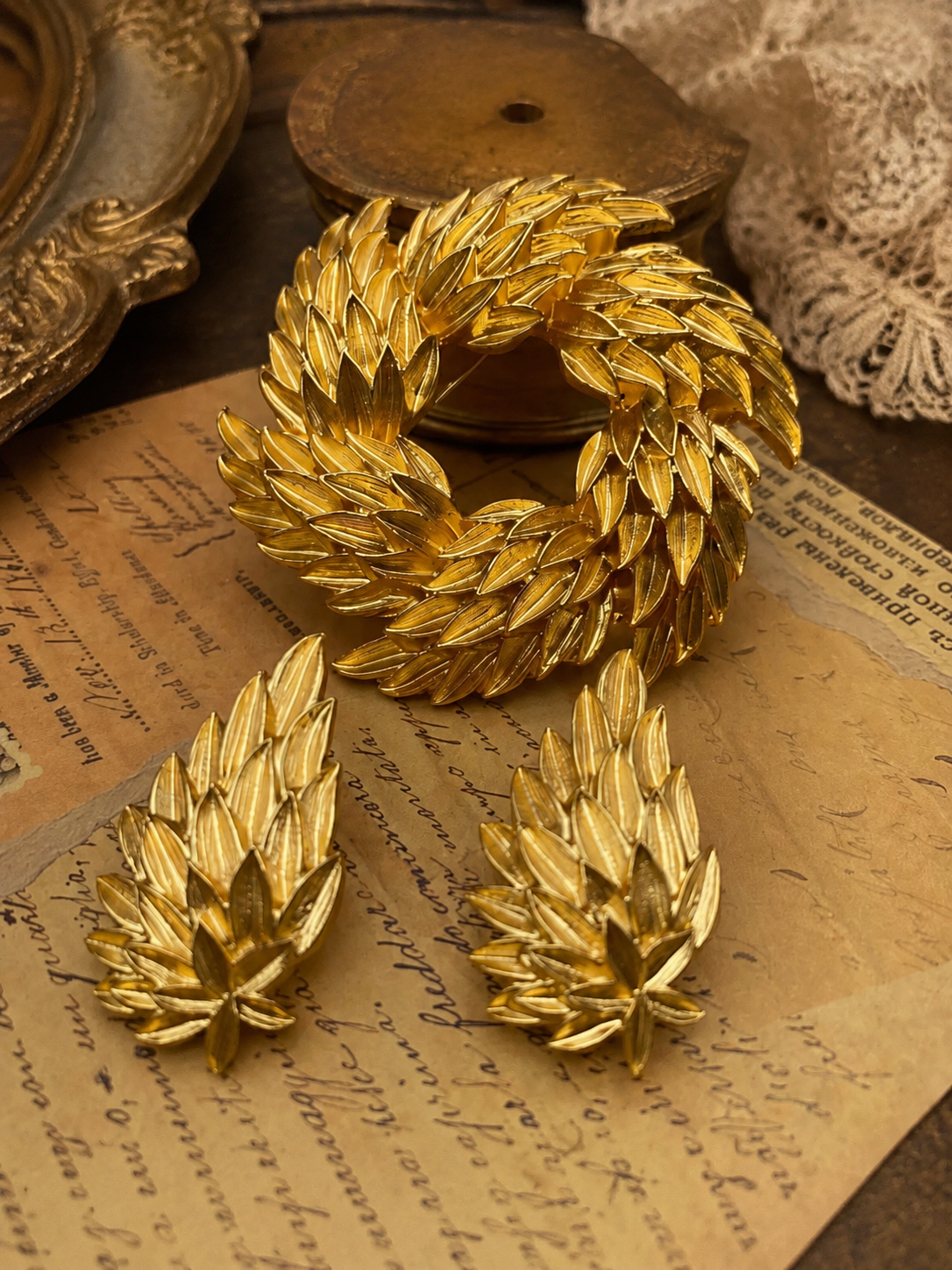
Earrings allow the wrap line and its tie to remain uninterrupted. The stud-earring component of the sculptural gold-tone leaf brooch and stud-earrings set illustrates that option. You can wear the earrings without putting the accompanying brooch at the crossing; owning a set does not require using every component in one outfit.

Compare earring shapes if no necklace stays outside the overlap naturally. The finished test is specific: the top fastens on its own, the panels settle normally, and the jewelry never has to hold or follow the working tie.