
With color-blocked clothing, first decide whether you want the garment's border to stay uninterrupted. A necklace inside one color area, a pendant centered across a division, and earrings away from the panels create different compositions. None requires matching every color in the outfit.
The useful question is not simply which jewelry color goes with the top. It is where the jewelry's outline lands in relation to the border.
Identify the border that changes the view
Put the garment on and locate its largest divisions: a horizontal band across the chest, a vertical split, contrasting side panels, or an irregular inset. A small contrast cuff is not the same problem as two large blocks meeting underneath a pendant.
Color can form part of a garment's architecture rather than merely decorating it. The Musée Yves Saint Laurent's discussion of the Mondrian dresses describes separate color areas joined within the construction. Your own sweater or shirt need not share that technique for its borders to deserve attention.
Look at the boundary in ordinary light. Strong contrast makes a division obvious; neighboring tones may create a quieter one. Choose the border you actually notice rather than inventing equal importance for every panel.
Keep an ornament within one field
If you want the color blocking to remain clear, try a necklace whose decorative section sits completely inside one panel. Leave visible background around the pendant so its shape does not merge with the panel edge.
For a top with a pale upper section and a dark lower section, compare a necklace above the division with one that ends directly on it. The first may read as a separate ornament; the second may look as though the pendant is hanging from the color border. Either can be chosen, but notice the difference before settling on it.
There is no prescribed distance. The space needs to be legible on the actual garment and remain there as the top settles.
Cross a division deliberately
A centered pendant over a vertically divided top can bridge the two sides. Examine both halves of the ornament: does one disappear into the darker panel while the other remains obvious? If so, try a more clearly outlined piece or move away from a necklace altogether.
Do not secure a necklace off-center with a pin or tuck it into a seam to force a particular background. Use the way it naturally hangs. An intentionally asymmetric jewelry design is a different option from an ordinary pendant that keeps sliding back to the middle.
A horizontal border can also be crossed, but avoid judging only the chain. Check the full pendant and any drops beneath it, especially if they are split between two backgrounds.
Let earrings preserve the front drawing
If the panels make a composition you enjoy on their own, earrings leave that drawing intact. A multicolor pair can repeat some of the outfit's energy without tracing its borders.
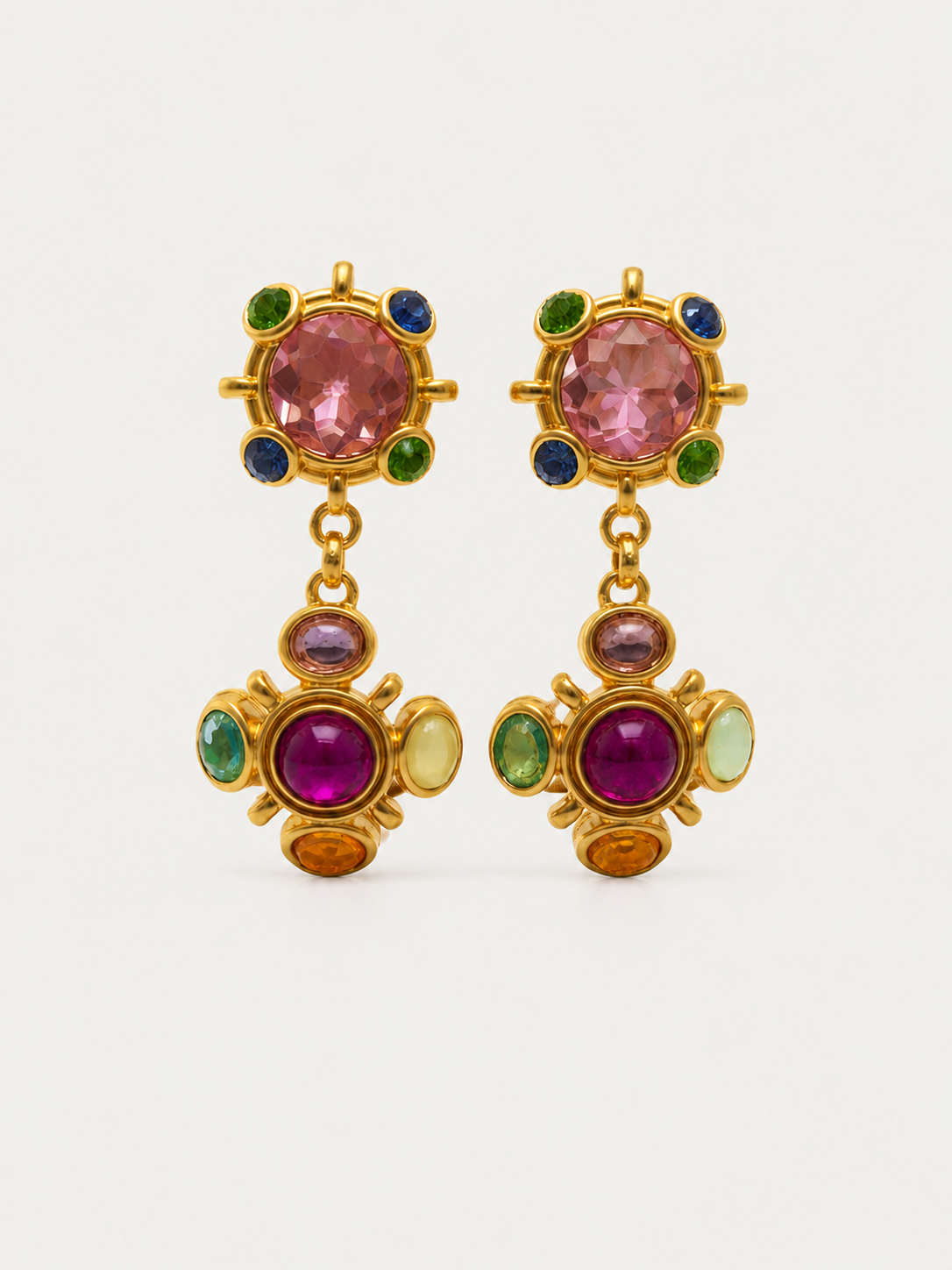
The gold-tone multicolor stone-style drops are one example. They do not need to contain every shade in the garment, and their rounded arrangement offers an alternative to its straight divisions.

For metal relationships rather than border placement, our mixed-tone guide for neutral outfits handles that separate choice. Color blocking can be quiet or vivid; it does not automatically demand more jewelry.
Use the same outfit for a fair comparison
Keep the top, trousers, and lighting unchanged. Compare a necklace contained in one area, a necklace crossing the border, and earrings with no necklace. Change only the jewelry placement so you can tell what caused the difference.
Browse earrings if preserving the garment's geometry is your preferred result. The goal is a deliberate relationship with the panels, not a rule that every block must receive a matching accessory.