
To choose jewelry around a crossbody bag or camera strap, follow the strap through the outing rather than judging one still position. A brooch may sit away from a strap while you stand straight, then enter its path when you bring a bag forward or lift a camera. The equipment needs its own uninterrupted route.
Set up the equipment as equipment first
Attach and adjust it according to the manufacturer's instructions. Nikon's camera manual calls for secure attachment at the camera's strap eyelets. Jewelry is not a substitute attachment point, decorative connector or repair for a missing component.
Different carrying systems have different configurations. Peak Design describes adjustment and configuration options for its Slide strap; those options do not apply automatically to another strap. Choose the normal configuration for your own equipment before deciding where a necklace or brooch might sit.
Use the bag with the contents you actually expect to carry, within its maker's guidance. An empty bag's position is not enough information about a loaded outing.
Draw a three-part path, not a fixed line
- Rest: where does the strap lie when you stand and walk normally?
- Reach: where does it travel when you bring the bag around or raise the camera?
- Exit: how does it pass your jewelry when you take it off?
Observe these ordinary movements in a clear space, following the equipment's handling instructions. Do not repeatedly drag a strap over jewelry to see whether it survives. When the paths overlap, stop and choose a different jewelry arrangement or omit that piece.
A mirror may show the resting line well while missing the moving edge. A photograph of the final outfit records only one of the three parts.
Include the venue's carrying position
A gallery may ask you to carry a bag differently from your commute. The Whitney's visitor policies, for example, allow small bags at the front or in the hand and require large bags and backpacks to be checked. Read the actual venue's requirements before settling the route.
In a hypothetical museum visit, your camera rests at one side outdoors but your bag moves to the front inside. A necklace that never met the strap outdoors may now share its path. Plan for the position required at the venue, not just the one you prefer on the walk there.
Choose jewelry outside the moving area
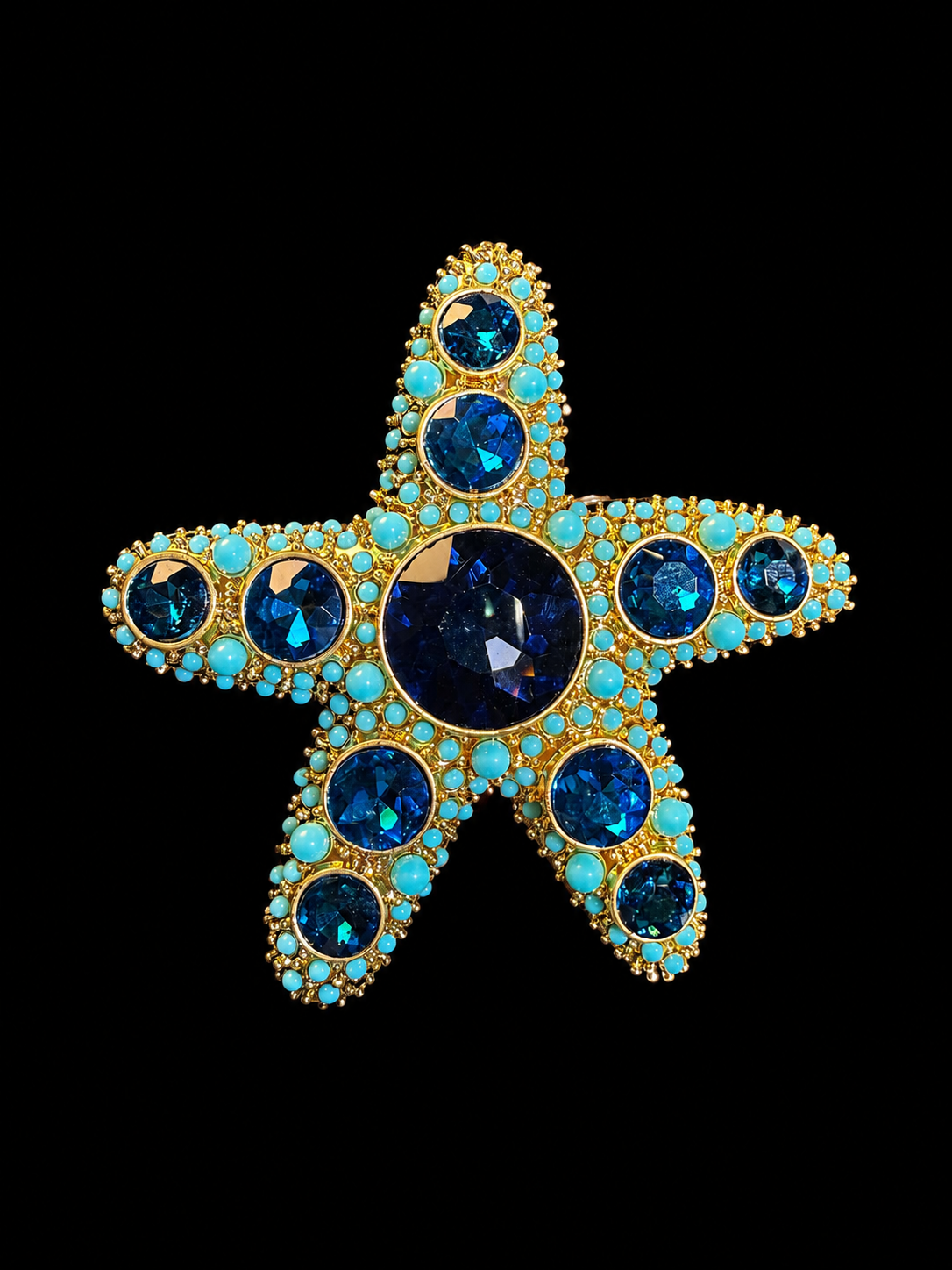
The blue starfish-shaped brooch provides a visible outline to consider. It is not certified for use beside a strap, and its decorative shape should not be used to hold equipment in place. Pendant capability also does not establish compatibility with an arbitrary chain.

If you move a brooch elsewhere, consider whether the new location actually supports it; the brooch and fabric guide addresses that separate question. Moving an object out of one conflict does not automatically resolve every other one.
For a necklace, consider the whole chain and pendant path, not just the focal accent. For a bag with several straps, include whichever ones you will actually use.
Use a simpler plan when the paths keep changing
If an outing involves constant camera lifts, bag access and venue changes, no torso jewelry may be the least demanding choice. You can enjoy the equipment and the visit without managing an additional moving interface.
Browse brooch designs for a different occasion if the piece you like cannot be kept separate from the equipment. The decision is about today's carrying tasks, not whether a design is generally wearable.