
With a pleated top, decide whether you want jewelry to trace the folds, cross them, or stay off the pleated area. The choice depends on what the pleats do. A few folds released from the neckline are not the same as fine pleating across an entire stretch top.
Start with the top on your body, not flattened on a table. You are styling its three-dimensional shape, including the places where folds open.
Identify what the pleats are shaping
Some pleats repeat across the full front. Others begin at a seam or neckline and release into a wider section. In Sew Over It's Clara blouse, neckline pleats provide bust shaping. Meanwhile, Issey Miyake's Square Stretch Pleats top uses vertical and horizontal pleating. These examples should not receive the same jewelry arrangement by default.
Without pulling the fabric, notice the direction of the ridges and where they stop. Then move your arms naturally. Which parts spread, and which remain anchored? That observation tells you whether a necklace would sit across a stable area or cut through the part creating volume.
Use a different approach for each fold layout
| Pleat layout | Placement to compare | What would change the decision |
|---|---|---|
| Fine vertical folds across the front | A distinct necklace curve crossing several folds | The ornament disappears into a trough or repeatedly sits askew. |
| Folds released from the neckline | Jewelry away from the gathering of fold ends | A necklace covers the point from which the garment's shape opens. |
| Horizontal and vertical folds together | An uninterrupted garment front with earrings | A necklace adds a competing grid rather than a clearly separate outline. |
These are visual comparisons, not rules against necklaces. A deliberate contrast can work when both the jewelry and the fold pattern remain recognizable.
Do not mistake a valley for a placement channel
A pendant may appear neatly centered when placed in one vertical trough, then move to the next as the cloth shifts. If the arrangement works only when you repeatedly put it back into that valley, choose a different endpoint or leave the front clear.
A broad necklace crossing the folds needs a different check: does it rest independently, or does it visibly flatten part of the silhouette? If it changes the shape you wanted to preserve, remove it rather than tightening it to hold the folds in position. Jewelry should not act as a pleat clamp.
Our texture guide addresses surface contrast. Here, the additional question is whether the accessory changes the actual opening of the folds.
Keep the upper shape clear with earrings
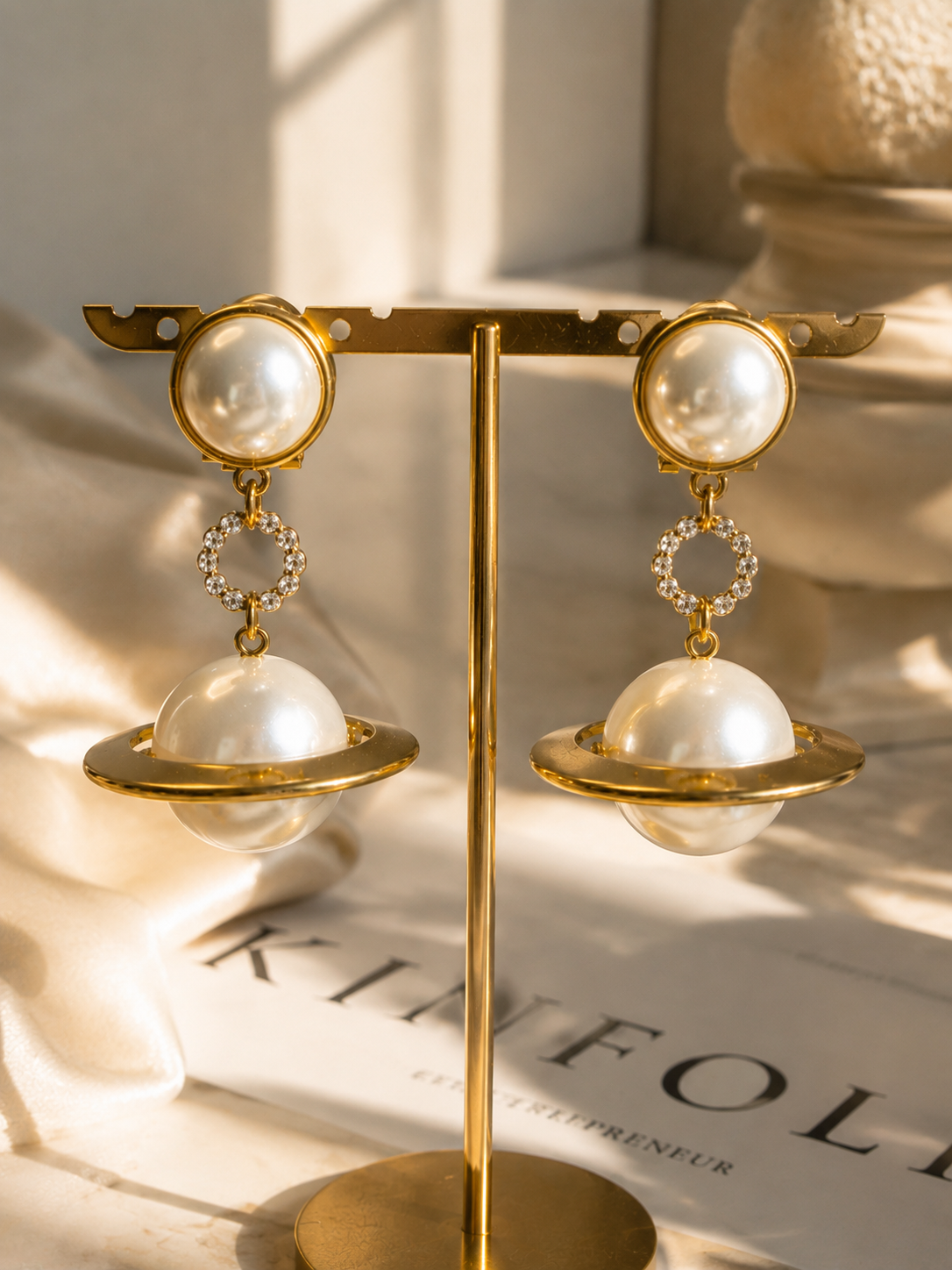
The gold-tone pearl-style orbital drops in the Clip-On option illustrate a curved detail away from the pleated field. The linked variant is labeled Clip-On; the front photograph does not establish its fastening. Their dimensions and weight remain unverified; obtain those details before deciding on fit.

With pleating that rises toward the neck or shoulder, check the earring beside the garment's highest fold. A clear front does not guarantee clear space at the sides.
Compare resting folds with ordinary movement
Take a front view with arms relaxed, then another after reaching forward and returning to rest. Do not stretch the top to exaggerate a difference. Compare whether the same fold junction remains visible and whether the jewelry settles without being repositioned.
Explore earrings if preserving the opening pattern is your priority. The best result may be a necklace that crosses the folds clearly, or no necklace at all; what matters is that the pleating still performs its intended visual job.