
Statement sleeves do not automatically rule out statement jewelry. First identify where the sleeve's volume ends. A short puff leaves much of the arm exposed, a balloon sleeve narrows into a cuff, and a bell sleeve can move over the hand. Those constructions call for different choices.
Choose the jewelry after seeing the sleeve at rest and with your elbow bent. An exposed wrist in one pose is not necessarily a useful jewelry space throughout ordinary movement.
Separate the shoulder from the opening
A blouse can be dramatic at the shoulder yet plain at the wrist. Conversely, a simple upper sleeve can end in a large flare. Megan Nielsen's Dove pattern offers elbow-length, flared, and bell-sleeve versions of the same blouse, a useful reminder that the opening can change independently of the bodice.
Ignore the overall label for a moment. Look at the final few inches of your sleeve: is the opening narrow, wide, elasticated, or loose? Is its edge plain or decorated? That small area is what interacts with a bracelet or ring.
Let a bell sleeve move freely
With a long bell sleeve, the hand may emerge only as the arm lifts. A bracelet that is mostly hidden can still be personally enjoyable, but it will not provide a consistently visible finishing line. If visible detail is the goal, try a ring whose shape remains clear beyond the sleeve edge.
Do not use a rigid bracelet to gather the flare unless both pieces were specifically designed for that arrangement. It changes the intended sleeve shape and may hold the fabric in an awkward fold. If you love the flare, allow it to remain the moving outline.
Keep a balloon cuff and bracelet distinct
A balloon sleeve gathers into a smaller opening. Let that cuff sit where it normally does before adding jewelry. A bracelet immediately against a decorative cuff can look like a second band, while a clear gap gives the two shapes separate identities. If no stable gap exists, the hand or ears may be a better place for another accent.
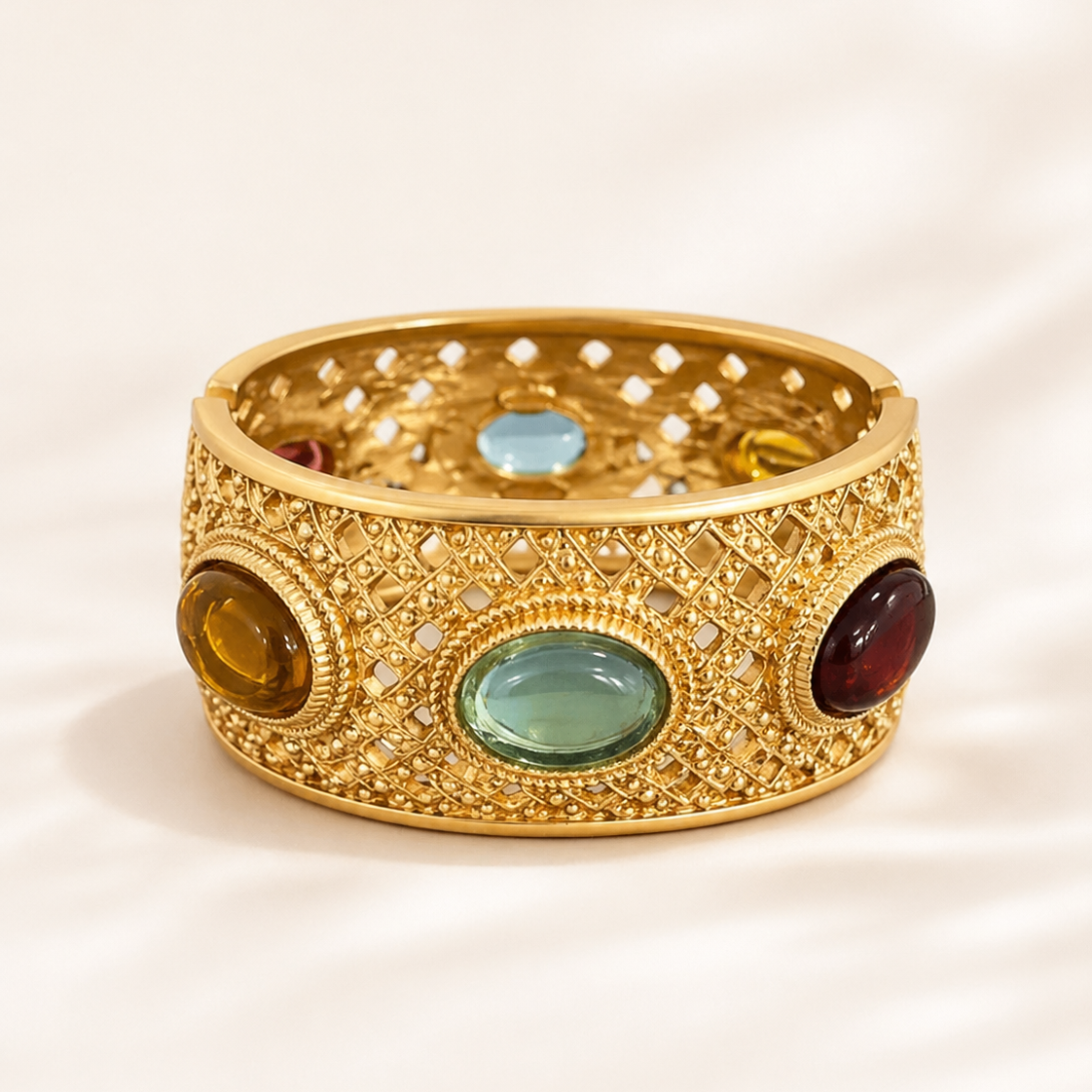
The gold-tone jeweled open cuff has an ornate outline worth comparing with a plain sleeve edge. Its suitability cannot be inferred from the open shape. Obtain the internal dimensions, opening size and weight from the seller before assessing fit; those details are not supplied in the current product description. Do not force it wider to accommodate fabric.

Use a short puff's exposed arm deliberately
A short puff ending above the elbow may leave enough bare arm for a wrist accent without interference. Here the question becomes visual: do you want the wrist to echo the rounded sleeve volume, or provide a narrower contrast?
For a comparison, try a short puff blouse with one broad cuff and no necklace. Then keep the clothes unchanged and substitute earrings. The first version connects shoulder and hand; the second concentrates detail above the bodice. Neither depends on making the puff less dramatic.
Compare the sleeve in three positions
- Let both arms hang and note which jewelry is visible.
- Bend one elbow and reach forward normally; watch the sleeve edge travel.
- Rest your hands in your lap and check whether fabric settles over or against the jewelry.
Change the accessory if it repeatedly disappears, catches, or requires you to push the sleeve back. Our focal-point guide helps decide where to move the emphasis. The earring collection offers alternatives when the sleeves deserve the entire hand area.