
Start with a measurement, not a standard-size assumption
To measure necklace length before buying online, start with a necklace you already enjoy wearing: unfasten it, lay it straight without stretching it, and measure from one end to the other, including the clasp. Then check whether the new listing uses the same measurement basis. Keep any extender and the drop of a pendant or charm separate rather than treating them as interchangeable inches.
If you do not have a useful reference, use a loose piece of string to explore a preferred position. The goal is a comparison you can explain—not a promise that a standard length will land at the same point on every person.
Identify what the listing actually measures
Before reaching for a ruler, read the length description carefully. A number might describe the necklace itself, a selectable chain length, or an adjustable range. A photograph may show the extender without saying how much length it adds. Write down the wording rather than silently deciding what it means.
Look for three separate answers: the stated necklace length, whether the clasp is included, and whether the extender is included or additional. If only one number is supplied, the other answers remain questions. “Adjustable” alone does not tell you the shortest or longest wearable setting.
Keep your notes in one unit so that a listing in centimeters is comparable with your ruler in inches. One inch equals 2.54 centimeters. Conversion changes the unit, not the certainty of an approximate measurement or its meaning.
Measure a necklace you already wear
Choose a reference for how it feels and sits, not simply because it looks similar. Place it on a flat surface beside a ruler or measuring tape. Open the clasp and arrange the necklace gently in a straight line; do not pull on links or force a rigid section flat.
- Measure the necklace end to end, including the clasp, and write down the result.
- If it has an extender, record that section separately rather than assuming you use its full length.
- Note the fastening position you normally choose, so your comfortable setting does not get confused with the maximum length.
- Repeat the measurement once with the same endpoints to catch a misplaced ruler or shifted chain.
GURHAN's necklace measurement guide also describes measuring an existing piece from clasp to clasp. Use that as a measurement method, not as proof that every seller labels length identically.
Use string to test a preferred necklace path
Without a reference necklace, take a flexible tape or a piece of nonstretchy string and hold it loosely around your neck. Use a mirror to explore where you would like the necklace to sit. Do not tie the string around your neck or pull it tight.
Mark where the ends meet, remove the string, and measure it flat. Try a second position if you are undecided and label the two measurements clearly. This gives you two personal reference points instead of an unexplained range copied from a chart.
Treat the result as a starting point: string does not reproduce a necklace's weight, rigid details or charms. After narrowing the measurement, consult the existing guide to matching a statement necklace to your neckline for styling questions rather than expecting the tape to answer them.
Keep chain length, extender range and charm drop separate
Chain length follows the necklace around the neck. A pendant or charm extends from a particular point on that necklace. Those are different measurements: adding a charm's height to the full chain length does not calculate a vertical distance down your chest.
A necklace with several charms also need not behave like a plain chain with one central pendant. When comparing photographs, use them to understand the arrangement, not to extract an exact drop from an image without a scale.
Build a short comparison record before browsing more options:
| Field | Your reference | New listing |
|---|---|---|
| Necklace length | Record measured endpoints. | Copy the stated length and unit. |
| Fastening and extender | Note your usual setting. | Record the range or mark it unknown. |
| Pendant or charm drop | Keep it separate from chain length. | Use a stated dimension, not a photo estimate. |
| Placement | Describe what you like when wearing it. | Treat a model photograph as illustration only. |
Read a current product example without filling in missing numbers
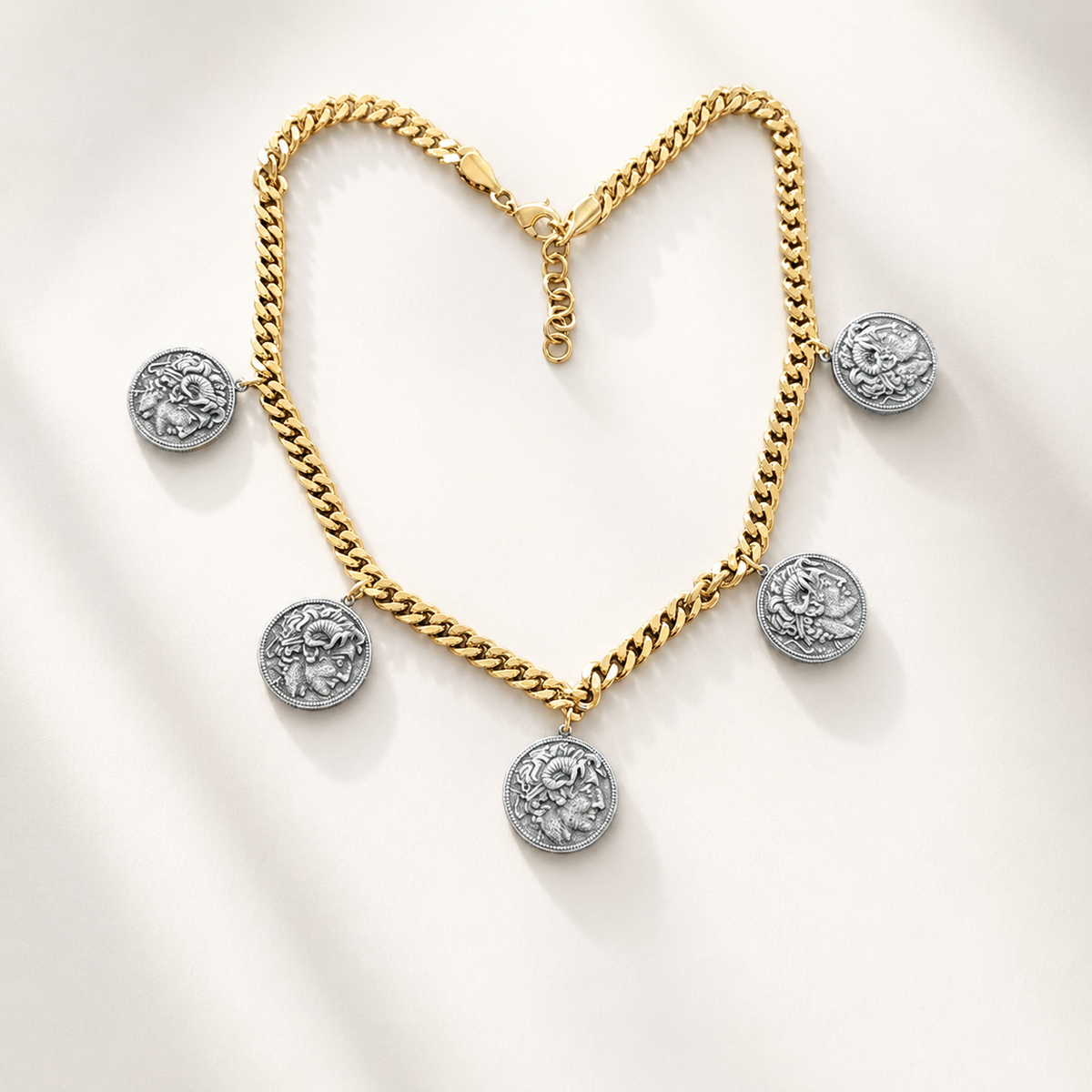
The Vintage-Inspired Two-Tone Alexander Coin Charm Necklace shows why those separate fields help. Its product description states approximately 17 inches long with an adjustable extender. The design has a gold-tone chain and five silver-tone coin-style charms.

Enter “approximately 17 inches” as the published description, not as a measurement you have personally verified. The exact extender length, the clasp-inclusive basis and individual charm drop are not established by that wording. Do not invent a minimum-to-maximum range or decide that the photograph supplies it.
The coin imagery is vintage-inspired fashion-jewelry design, not evidence of authentic ancient coins. Likewise, the visible gold-tone and silver-tone appearance does not establish precious-metal content. A useful product comparison preserves those distinctions while concentrating on the dimensions you need.
Make the final buy-or-ask decision
Return to your worksheet. If the stated measurement and your reference use different endpoints, resolve that difference before ordering. If the range is unclear, a targeted question is more useful than “Will this fit me?”
You can ask for the clasp-to-clasp length and extender range, explaining which setting you want to compare. Keep any unanswered dimension marked as unknown; choosing to wait is better than converting a guess into a purchase requirement.
When you are ready to compare vintage-inspired necklaces, bring your notes with you. A clear reference, consistent units and a few precise product questions make the decision more useful than relying on a standard-length label alone.