
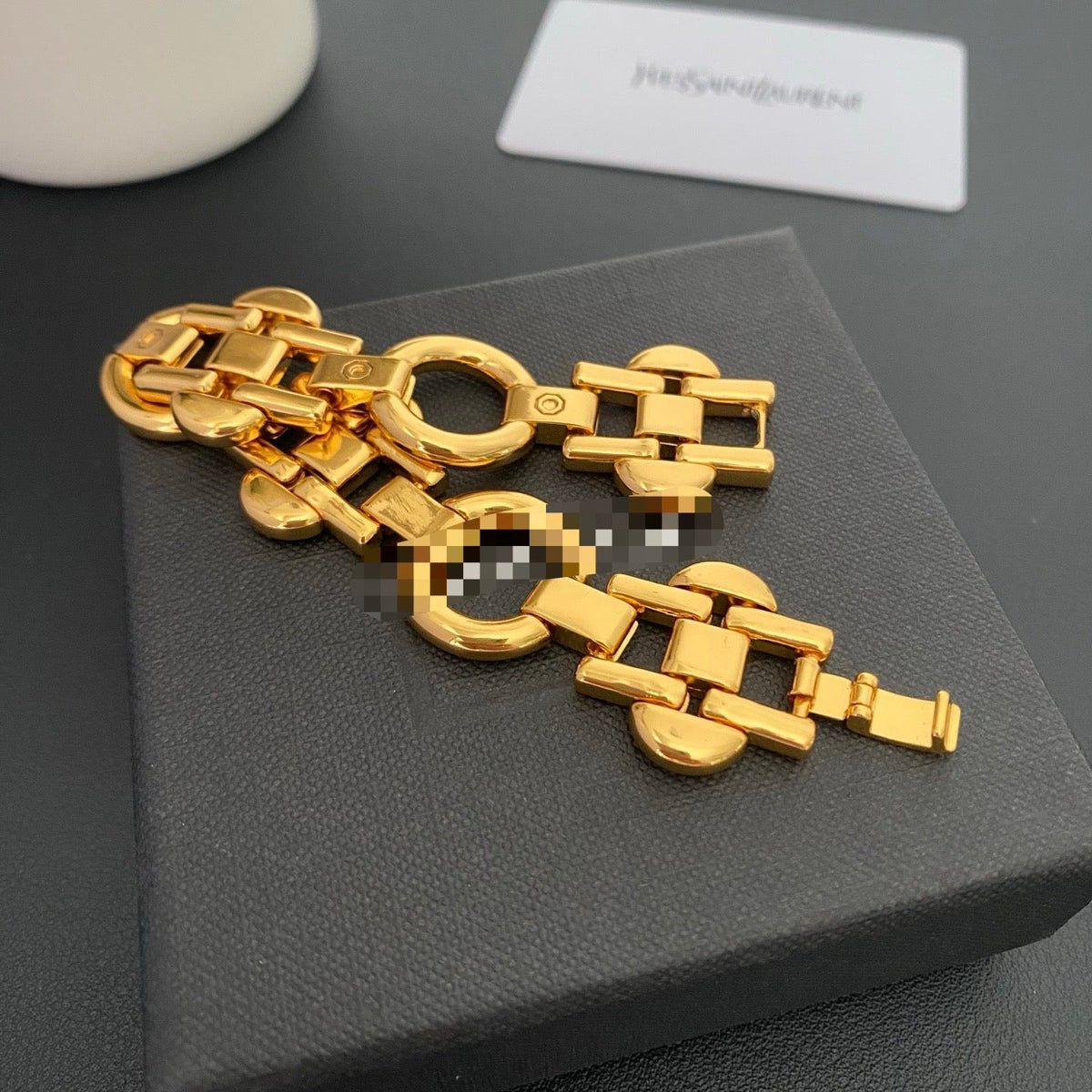
Keep wrist size and bracelet length on separate lines
To measure your wrist for a clasp bracelet, wrap a flexible tape around the place you expect to wear it and record the circumference without compressing the skin. Then measure a comparable bracelet you already like. Your wrist measurement describes your body; the bracelet measurement describes an object that also needs room for its construction and movement.
Do not convert one into the other by treating a universal extra allowance as a guarantee. Maker guides use different recommendations for different bracelet families. A fine chain, a broad articulated link, and a charm-loaded bracelet can behave differently even when their listed lengths match.
This method is for bracelets that open at a clasp and wrap around the wrist. It is not the hand-passage measurement used for a closed bangle, and it does not tell you how far an open cuff can be adjusted.
Take a repeatable wrist measurement
Choose the intended wearing position and note it: at the wrist joint, just below it, or farther up the arm. Keep your hand relaxed. Wrap a flexible measuring tape so it lies flat around the wrist, without a twist, visible slack, or pressure that leaves an indentation.
If you use a non-stretch strip instead, mark where its ends meet, lay it flat, and measure between the starting point and the mark. A stretchy cord can change length while you transfer it to the ruler. A broad, curled strip can also sit differently from a narrow flexible tape.
Repeat once after removing the tape completely. If the readings differ, check position and tension rather than averaging immediately. Record the raw measurement in millimeters or centimeters, then convert only when the listing uses another unit. One inch is 25.4 millimeters.
Measure the reference bracelet without pulling its links
Choose a bracelet with similar width and construction to the candidate where possible. A delicate chain is a weaker fit reference for a thick geometric link bracelet than another substantial linked design. Note which bracelet you used, not just its measured number.
Open its clasp normally and place it on a flat surface. Arrange the links in their natural extended line without stretching, twisting, or forcing stiff sections straight. Measure the complete laid-out length and identify exactly which endpoints you used.
Next, examine what changes when the clasp closes. A tab may insert into a housing; a hook or clasp may overlap its receiving ring. For an extender, record the link you normally use. A free tail beyond that connection does not form part of the closed path around your wrist.
Do not mistake overlap for usable inner space
Consider an illustrative bracelet whose open end-to-end measurement is 190 millimeters. If its specified closure arrangement overlaps by 8 millimeters, simply calling the closed path 190 millimeters overstates that path. Even a corrected path length is not automatically the same as the space available against the wrist.
Thickness occupies space inside a curve. Broad or deep links can therefore give a different inner fit from a thin flexible chain with the same outer or centerline length. The worksheet should preserve this distinction rather than trying to calculate a person's fit from a single number.
Do not press a rigid bracelet onto a circular template or bend components to measure the inside. If the inner-fit difference is decisive, ask for the seller's measurement convention or a professional fitting assessment. A ruler comparison is useful evidence, but it is not a substitute for trying the exact construction.
Use a three-record comparison sheet
| Record | Fields to keep |
|---|---|
| Wrist | Circumference, wearing position, unit, repeat reading |
| Reference bracelet | Construction, width, laid-out length, closure overlap, chosen extender link, observed fit |
| Candidate listing | Selected option, stated length, measurement convention, construction, confirmed wearing range if supplied |
Suppose your reference bracelet moves comfortably but does not slip over your hand during ordinary use. Write that observation beside its dimensions. If a candidate is both wider and more rigid, flag the construction change rather than choosing the same length automatically.
A second useful comparison is position. A bracelet worn farther up the forearm may need a different circumference from one worn close to the wrist. Record where the measurement was taken so a later shopping session does not mix two legitimate but different numbers.
Compare stated options without turning them into wrist sizes

Those RJC options are stated bracelet lengths. They should not be reworded as “fits a 6.7-inch wrist” or “fits a 7.5-inch wrist” without additional product-specific information. The description names alternating rounded and sculptural links; it does not define the inner wearing circumference.
Confirm that the selected bracelet opens at a clasp before using this method; the product description does not identify its closure. Then use the selected length option as the candidate entry on your sheet. Compare its construction with your reference and preserve any unanswered measurement-convention question. In the bracelet collection, a numerical option is more informative than a generic small or medium label, but it still needs a defined meaning.
Choose the next step from the actual discrepancy
If the wrist readings repeat and the candidate closely matches a known reference, you have a useful basis for comparison. If the key difference is clasp overlap or bulky construction, send that specific fit question with your recorded measurements. Do not replace an unresolved difference with a guess based on another brand's size chart.
Once the physical fit is addressed, explore the Journal's wrist-styling features for a separate decision about visual proportion. Measuring well means knowing what each number represents—not collecting more numbers until they appear to agree.