
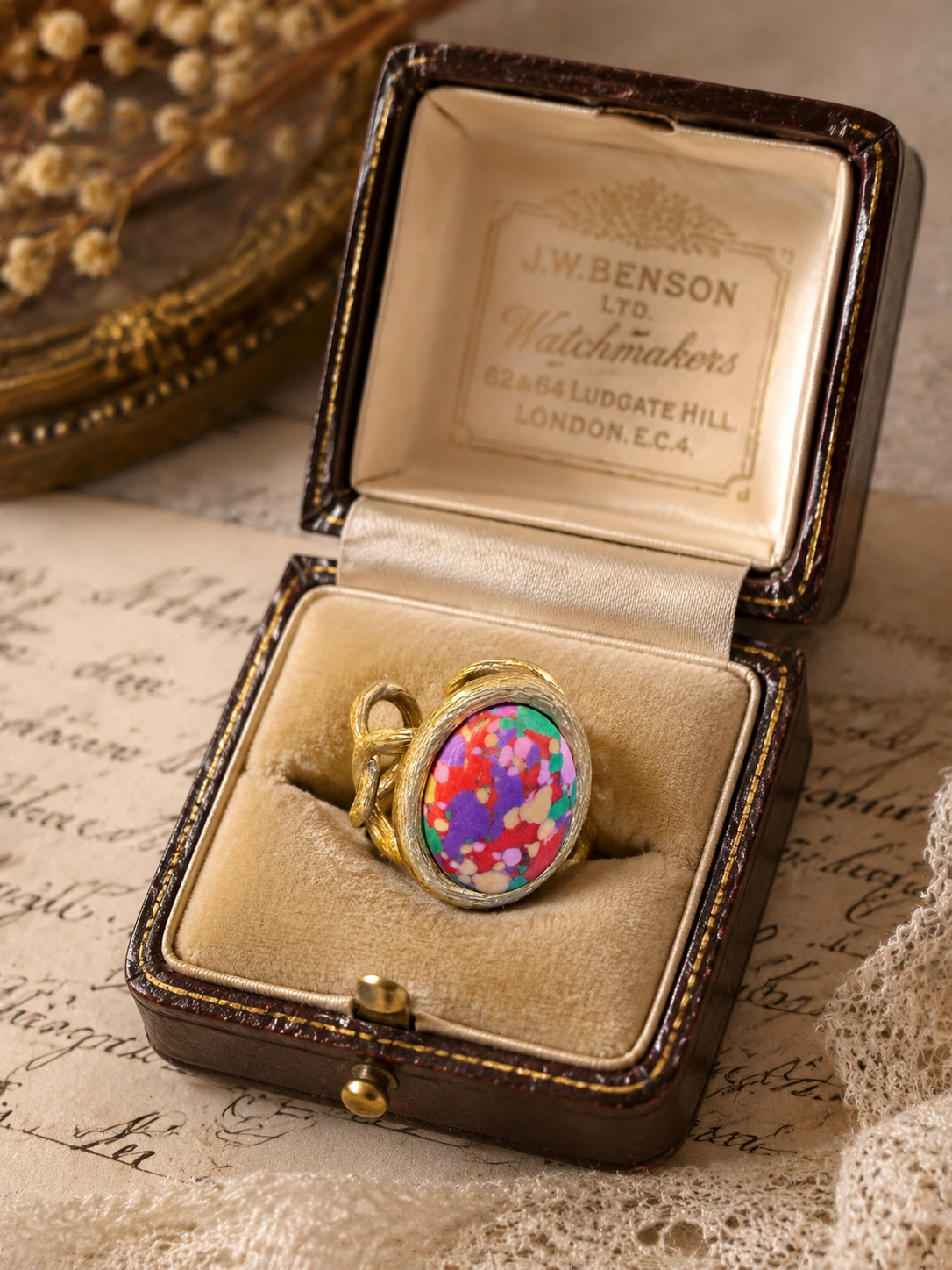
Opal-style jewelry is not, by that wording alone, confirmed natural opal. Nor does the phrase establish synthetic opal, resin, glass, or a particular layered construction. It describes a resemblance. If a specific material matters to your purchase, look for a separate identification rather than treating a colorful photograph as the missing specification.
Start with the difference between a look and a substance
A multicolor oval can be a lovely design choice without being a geological specimen. Decide which purchase you are making: a ring with the colors and outline you enjoy, or jewelry containing a documented kind of opal. The first task can be satisfied by an honestly described decorative piece. The second needs material information.
That distinction prevents two opposite mistakes: upgrading an appearance label into a gemstone claim, and dismissing every manufactured alternative as a misleading product. What matters is whether the description matches what is actually being offered. Our guide to rhinestone, crystal-style, and glass labels explains the same separation for other decorative accents.
Natural opal does not always show rainbow flashes
GIA distinguishes precious opal from common opal: precious opal displays play-of-color; common opal does not. In precious opal, microscopic arrangements of silica spheres interact with light to produce the changing colors. The presence or absence of a rainbow effect is therefore not a complete natural-opal test.
Even the word “fire” needs context. GIA describes fire opal by its yellow, orange, or red bodycolor and notes that it often lacks play-of-color. A seller's orange color name, however, is not enough to identify fire opal. Keep a color description separate from an explicit material statement.
Synthetic opal is not simply another name for an imitation
GIA's explanation of synthetic materials describes laboratory-made counterparts sharing virtually all the natural material's chemical, optical, and physical characteristics. It specifically notes that additional compounds can be present in synthetic opal. “Synthetic” describes an origin and material relationship, not merely a similar-looking color.
An imitation resembles another material without having that same relationship. Do not turn “created,” “hybrid,” “lab,” or “opal-style” into a precise composition by guessing what the seller intended. Ask what the centerpiece actually is and whether any added components or treatments are disclosed. A clear answer can distinguish two genuinely different offers; a more enthusiastic adjective cannot.
Why a convincing color effect cannot settle the question
In a 2019 GIA laboratory report, Nathan Renfro described an opal imitation that displayed pronounced play-of-color. Measured properties outside natural opal's range supported the imitation classification, rather than synthetic opal. Those findings concern the samples examined, not every colorful accent on the market.
The useful buying lesson is modest: an appealing moving-light video is not a substitute for identification. A single still photograph gives even less information about how a surface behaves as the light changes. Do not scratch, heat, soak, or dismantle a mounted accent to investigate it. If identity is essential and the seller's information is insufficient, obtain an appropriate professional assessment or choose an item with adequate documentation.
Construction is a separate question again
Natural versus manufactured origin does not tell you whether an accent is one piece or an assembly. An opal layer joined to a backing has a different description from a single piece of material. Our doublet and triplet guide covers that construction question, including why a dark-looking back is not enough to diagnose a join.
Ask about material, origin, and assembly separately when those facts affect your choice. The answers also matter before selecting care instructions. Guidance for documented opal is not automatically suitable for an unidentified decorative centerpiece, its setting, or an adhesive that may be present.
Read this ring without adding a gemstone claim

The Two-Tone Multicolor Opal-Style Adjustable Open Ring is described as an open-band ring with a textured setting and a mosaic-like multicolor centerpiece. The listing does not identify that centerpiece as natural opal, synthetic opal, resin, or glass. The display box does not establish a maker, age, or included packaging.
Choose it for the documented design if that is your goal. If opal identity is a requirement, ask about this exact product before ordering; do not fill the gap from the photograph. Its listed care is to store dry, avoid perfume or water contact, and wipe gently after wear. That is product-specific guidance, not a rule for every opal or opal-like material.