
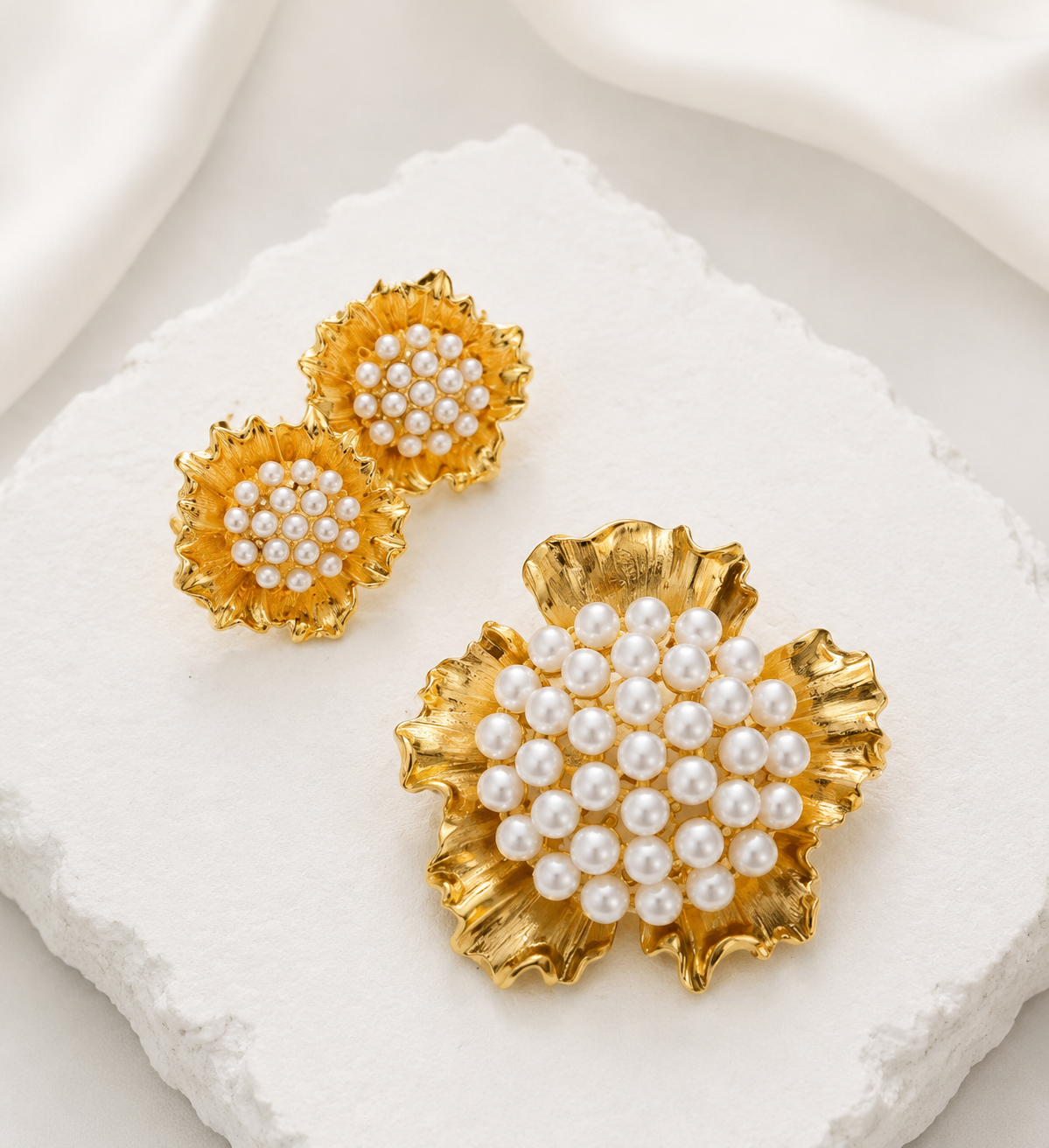
A suite name is not an itemized packing list
Parure describes a coordinated jewelry suite; demi-parure describes a smaller coordinated grouping. These terms help you recognize a relationship among pieces, but they do not replace the actual list of what is included. A necklace and earrings, a brooch and earrings, and a more extensive suite can all create counting questions when a listing mixes category names with individual objects.
The safest reading method is also the simplest: translate the suite name into an itemized list. Count jewelry categories, individual wearable objects, and units being sold separately. Those three counts may differ without any mistake. An earring pair can be one category and one selling unit while containing two earrings.
Borsheims' explanation of parures gives examples of fuller and smaller coordinated sets. Lang Antiques' reference also describes suites and demi-parures. Use these as vocabulary context, not as a universal numerical rule that overrides a seller's itemized contents.
Distinguish coordination from completeness
Coordination describes how pieces relate. They might repeat a floral motif, an accent shape, or a decorative border. Completeness describes whether the sale includes everything promised for that particular grouping. A brooch-and-earring set can be complete as offered even though it contains no necklace or bracelet.
Conversely, a photograph of a large coordinated family does not prove that every item in the image belongs to the selected purchase. Some product pages present several components together for comparison and sell them individually. The visual relationship is real, but the purchase unit still needs to be read.
The word demi-parure should not automatically become “incomplete parure.” A smaller grouping may be offered intentionally as a smaller set. Nor does matching appearance establish that pieces were originally made together at a particular date. Historical provenance and current sale contents are different questions; this guide addresses the latter.
A useful note separates those questions explicitly: “Coordinated design; advertised contents are brooch plus one earring pair.” That tells you what the listing promises without inventing a missing necklace or a history of original ownership.
Count categories, objects, and selling units
Use this original worksheet when a description says “two-piece,” “three-piece,” “set,” or “suite.” Instead of arguing about which counting convention is correct, record what each number means.
| Component named | Jewelry categories | Individual wearable objects | Selling-unit question |
|---|---|---|---|
| One brooch | One | One | Included in this selection? |
| One pair of earrings | One | Two earrings | Pair, not a single earring? |
| One necklace | One | One necklace | Complete necklace or pendant only? |
| One bracelet | One | One bracelet | Included or shown as an additional option? |
For a brooch plus an earring pair, the worksheet produces two categories and three wearable objects. It may still be sold as one set. That difference is not evidence of a shortage. Packaging, removable earring backs, and display supports should be noted separately rather than used to inflate the number of jewelry pieces.
Keep closure details beside the relevant component. “Clip-on earrings” belongs in the earring row; it does not describe the brooch. If a suite offers more than one earring fastening, preserve the chosen version when you copy the contents list.
Apply the worksheet to a brooch-and-earring example

The linked RJC product describes a floral brooch with matching clip-on earrings and pearl-style centers. Its practical contents note is therefore brooch plus matching earring pair, with the earring attachment identified as clip-on. Pearl-style remains the product's descriptive wording; the suite relationship does not turn it into a natural-pearl claim.
On paper, draw one box for the brooch and two smaller boxes for the earrings. Under the earring boxes write “one pair.” This small diagram is useful when a recipient, assistant, or shop colleague needs to understand the set without rereading a long title.
Do not add a necklace simply because you have seen similar floral necklaces elsewhere. A coordinated visual theme is a reason to explore other products, not evidence that those products are already part of this order.
Resolve three common listing puzzles
“Two-piece demi-parure: necklace and earrings.” The seller may be counting two categories. Look for explicit wording that the earrings are a pair, then record necklace plus two earrings. Do not assume that two-piece means one necklace and one solitary earring.
“Complete set,” shown with a necklace, bracelet, earrings, and ring. Read the description and selected option before drawing four rows. If the option says necklace only, the family photograph does not expand that selection. If all four categories are explicitly included, record the ring's stated sizing information and each component's fastening separately.
“Matching brooch and earrings,” accompanied by a fitted case. The case may help organize the contents, but an empty compartment does not automatically prove a missing item. Likewise, an apparently perfect fit does not establish original historical pairing. Record the case as included only when the sale says so.
In each example, the solution is an itemized sentence rather than a more elaborate definition. You should be able to hand that sentence to another person and have them assemble the same list of promised objects.
Reconcile the selected set before you move on
Use a final three-way check: the title names the grouping, the selected option identifies the version, and the contents statement supplies the objects. When those agree, save the exact option name with your component diagram. If they conflict, resolve the specific conflict before treating the purchase as settled.
This check is especially useful when a product family includes both sets and individual components. Keep quantity separate from contents: ordering two sets is not the same as selecting a set containing two categories. Your notes should make both understandable.
Browse brooch sets for the commercial selection, or use the Journal when you are ready for styling questions. A suite label can introduce the design relationship; your itemized list should finish the purchasing explanation.