
When a pendant ends just above a conspicuous belt buckle, the two objects can read as a single stacked decoration. That may be exactly the effect you want. If it looks accidental, the fix is usually to change the space between them, not to buy a perfectly matching metal.
Put on the trousers or skirt, settle the waistband, and fasten the belt normally before choosing a necklace. The buckle's real height is the starting point.
Measure the visual gap, not your clothing label
A high-waisted pair of trousers places the buckle differently from a low-slung belt over a shirt. Tucking, blousing, and the belt's own width can change what remains visible around it. Do not move a comfortable waistband just to create space for a pendant.
Manufacturer guides reinforce why nominal sizes are not enough. Gucci's belt guide distinguishes waist and hip placement; Tiffany's necklace guide notes that pendant size and neck circumference affect where a necklace sits. Neither label directly tells you the gap between your two ornaments.
Look from the pendant's lowest point to the buckle's highest visible edge. Judge the complete shapes, including a long pendant tip or a tall buckle frame, rather than comparing their centers.
Choose separated, repeated, or deliberately joined-looking
There are three useful compositions:
- Separated: a clear area of fabric sits between the pendant and buckle, so they read as independent details.
- Repeated: similar shapes sit at different heights with enough space to recognize the repetition.
- Joined-looking: the pendant points toward the buckle as a deliberate central arrangement, without actually touching or connecting to it.
The third needs the most checking. A tiny gap that repeatedly closes while you move can look less intentional than either a generous separation or a necklace that sits much higher. Do not physically attach the pendant to the belt to maintain the picture.
Compare the same necklace with two waist heights
Imagine a plain knit top tucked into high-waisted trousers with a broad rectangular buckle. A long pointed pendant may end almost at the buckle's upper edge. Try a shorter necklace within its designed adjustment range, or keep the belt and leave the chest open.
With lower-waisted jeans, that pendant may have a larger field of fabric beneath it. It can work there without changing its metal tone or shape. The result differs because the buckle moved, not because one trouser style requires a different jewelry personality.
An untucked top introduces another possibility: the buckle is hidden. In that version, judge the pendant against the top's hem and surface rather than a fitting nobody can see.
Test an obvious endpoint before a subtle one
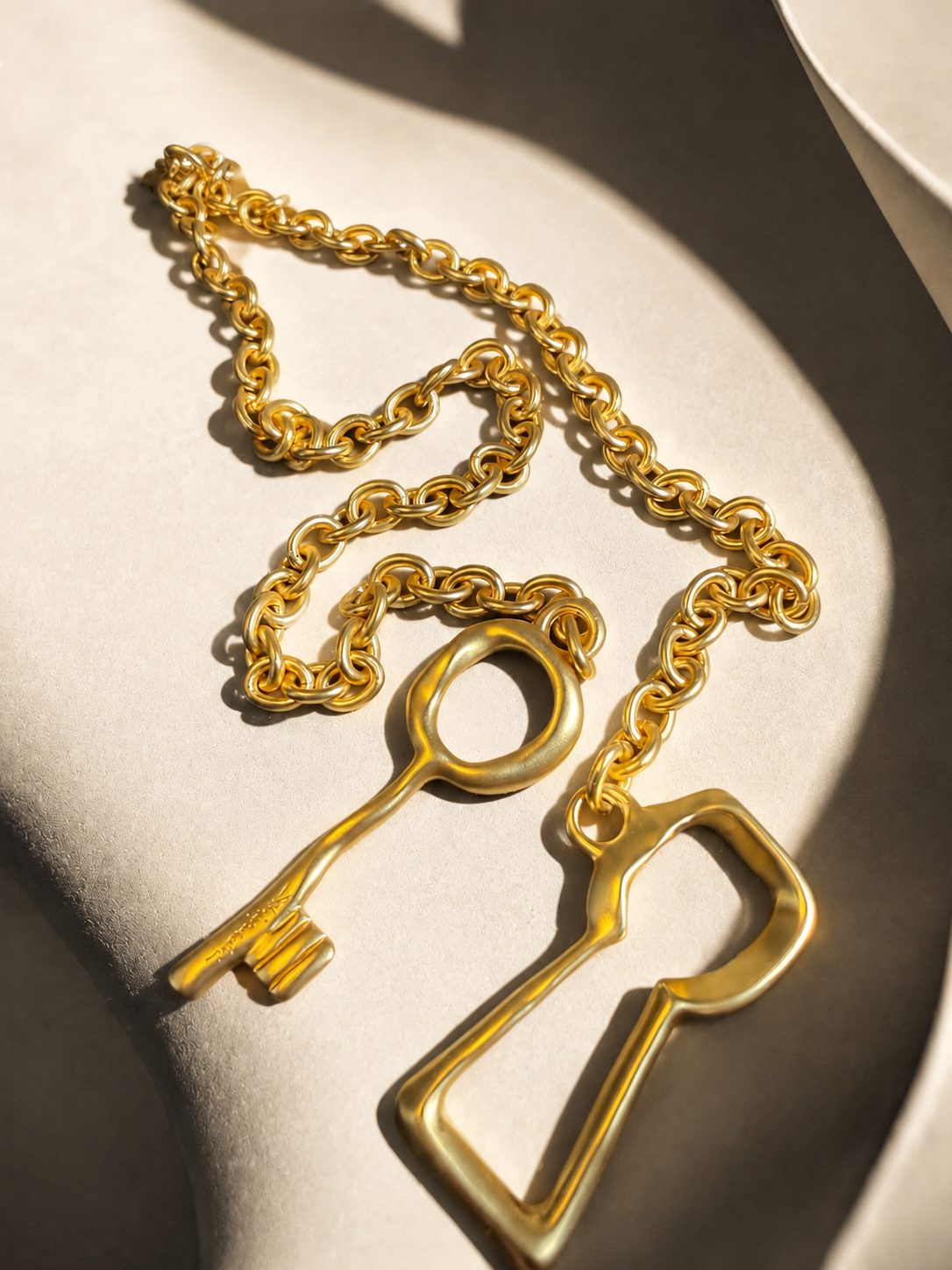
The oversized gold-tone key pendant makes the endpoint easy to identify. Use its outline as a reference when comparing a long ornament with a buckle. Obtain its total wearing length, designed adjustment range and pendant dimensions from the seller; those measurements are not supplied in the current product description, so its actual position cannot be inferred from the photograph.

If the necklace's upper curve also conflicts with your top, resolve that separately with our necklace and neckline guide. A good neckline fit does not automatically settle the lower endpoint.
Check the seated view
Sit normally and look down without pulling the top flat. Fabric can fold between the two pieces, and the pendant may move closer to the belt. Stand again and see whether the necklace returns naturally or needs constant rearranging.
Keep the version that works in both positions. When browsing necklaces, compare the entire ornament's length and shape, not just chain length. You are choosing a relationship between two real objects on an outfit, not following a fixed pendant-to-waist formula.