
Acrostic jewelry uses the initial letters of gem names to form a word, name or message. To read it reliably, you need the intended sequence and the relevant gem names—not a guess about what each color resembles. If either is missing, the message remains a possibility rather than a discovery.
Begin with a documented sequence
Jack Ogden's Gem-A article “Spell bound” gives a familiar example: ruby, emerald, garnet, amethyst, ruby, diamond and sapphire spell REGARDS. Each initial has a defined place. The repeated ruby matters because the word contains two Rs; the seventh stone supplies the S.
| Position | Name in this example | Initial |
|---|---|---|
| 1 | Ruby | R |
| 2 | Emerald | E |
| 3 | Garnet | G |
| 4 | Amethyst | A |
| 5 | Ruby | R |
| 6 | Diamond | D |
| 7 | Sapphire | S |
The National Museum of Western Art separately catalogs a REGARD ring. Its record should not be silently changed to REGARDS. A familiar general formula is a comparison aid, not permission to add a missing letter or gem to a specific object.
Preserve the order before decoding
Use a photograph and number the relevant positions on a copy, leaving the original file untouched. Note the orientation: top to bottom, left to right, or a documented route around a setting. Where a cluster contains both central and surrounding accents, do not assume that every visible accent participates in the message.
If the direction is not documented, write “reading order unknown.” Trying every direction until something resembles a word can create a convincing story from coincidence. Decorative borders, spacers and repeated accents need their own role established before they become letters.
Names and language are part of the code
Ogden's research discusses historical gem names and language differences that complicate decoding. That means a modern English gem-name list is not a universal key to every older piece. Retain the terminology used by the original record, with an explanation where a specialist has supplied one; do not casually substitute a different synonym to make your preferred word fit.
Chaumet’s account of Joséphine’s acrostic bracelets explains how colored stones represented letters spelling her children’s names. An attributable maker account can establish an intended reading in a way that a photograph alone cannot.
Let a blank remain a blank
For an unfamiliar jewel, make three parallel rows: visible color, documented material name, proposed initial. Enter an initial only when the name and its place in the intended system are supported. A red accent with no material record belongs in the color row; it does not automatically supply R for ruby.
Preserve repair records as well. If an accent has been replaced, record the replacement and any known original separately. Do not rearrange pieces, commission a replacement gemstone, or remove an accent simply to force a suspected word into existence. Historical interpretation and a repair decision are different tasks.
Try the method on color without a claimed code
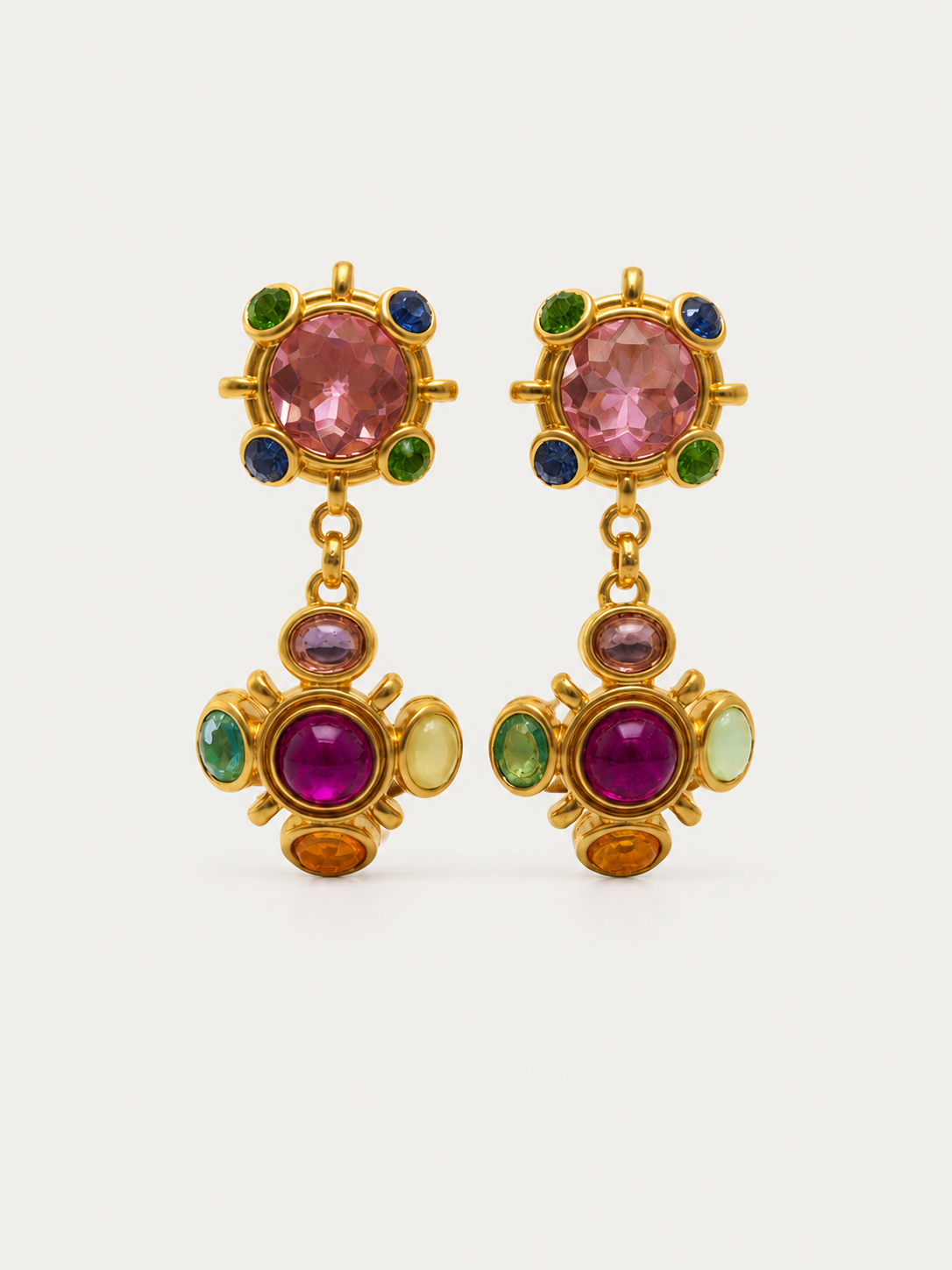
The gold-tone multicolor stone-style drop earrings offer several colors to describe, but no documented acrostic. Their color arrangement is not evidence that the accents are ruby, emerald or any other particular gems.

The material-wording guide helps keep stone-style language separate from material identification. Other examples in the earrings collection can be appreciated as color compositions without a hidden alphabet.
State the result at the right level
Your conclusion can be “maker-documented message,” “sequence supported by an object record,” or “unresolved possibility.” Include the source and the orientation, so another reader can follow the same path. A clear unresolved result is better than a charming message that exists only because its interpreter supplied the missing evidence.