
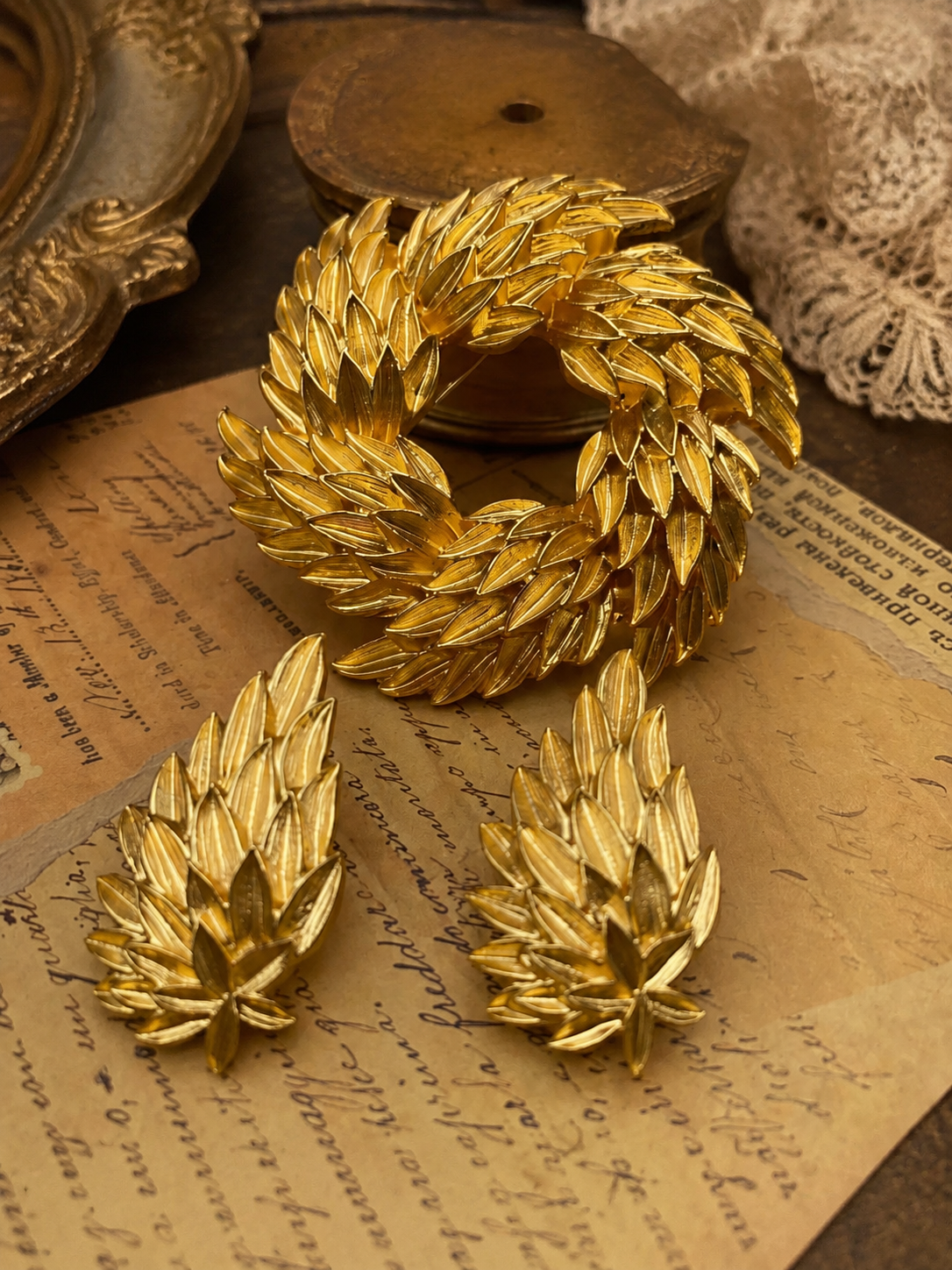
Relief tells you that parts of a design stand above their surroundings. Repoussé, chasing and casting tell you something about how a metal object was made or detailed. Those are different kinds of information. You can accurately describe a raised leaf without knowing which workshop process produced it.
Follow the direction of the work
In repoussé, relief is developed by working sheet metal from the reverse. Chasing works the front with tools to shape or refine details. The V&A's metalworking guide distinguishes these operations from engraving, which removes metal, and from casting, where molten metal takes the form of a mould.
Imagine making a leaf in three different ways. You could develop its volume in a metal sheet and refine the veins from the front. You could cast a model of the complete leaf. You could also add finishing work after a cast form has been made. This thought experiment explains the terms; it does not identify the method used on an object you have not examined.
The names are consequently not always competing answers to one multiple-choice question. A single object can combine forming, assembly and decorative processes.
Separate the large form from the small detail
Look first at the leaf's overall volume: a broad raised body, a curved tip, or a low outline. Next, look at the fine detail: veins, lines, dots, or an edge texture. Ask whether a record describes the process for the whole object or just one detail. “Chased decoration” does not by itself describe every stage that formed the underlying body.
GIA's metalwork overview discusses repoussé and chasing together among techniques that can enhance jewelry. The Met's short record for Etruscan gold earrings names both repoussé and granulation. The examples encourage component-level description rather than assuming one technique excludes another.
Why common shortcuts do not settle the method
- “It looks hollow.” That observation does not establish which process formed it or whether you can see the complete assembly.
- “The pattern repeats exactly.” Repetition alone does not identify a mould, a die, or the amount of finishing work.
- “It has irregular lines.” Irregularity is not a certificate of hand chasing.
- “It is light.” A hand impression of weight is not a record of wall thickness or manufacture.
The V&A also describes die stamping: sheet metal can be shaped under pressure between dies. This is another reason not to equate every raised sheet-like ornament with hand repoussé. Avoid the opposite shortcut too: a documented cast object can involve skilled modelling and finishing. A process label is not a complete quality ranking.
Practice with one raised leaf
The gold-tone leaf brooch and stud earrings set shows raised, sculptural leaf forms. The product description identifies the set and its stud earrings, but it does not establish repoussé, chasing, casting, gold content or antique manufacture.

For a useful personal caption, write: “Gold-tone leaf forms with raised surfaces and linear detail; manufacturing process not stated.” That sentence still tells another person what to look for. It does not make the object less interesting by declining to invent the workshop story.
To compare shine, texture and surface appearance separately, use the surface-finish vocabulary guide. The brooch collection provides other silhouettes for practicing this distinction; no shared manufacturing process is implied.
Make the next question specific
If construction matters to your understanding of a piece, ask what forms the main body and what finishes its decoration. A useful response might identify a cast body with subsequently worked details, or sheet construction with documented repoussé. Request the source of that description, especially when it comes from an old family label rather than the maker.
Keep the appearance sentence even after the process is established. It tells you what the object looks like; the process sentence tells you how it was made. Neither needs to replace the other.