
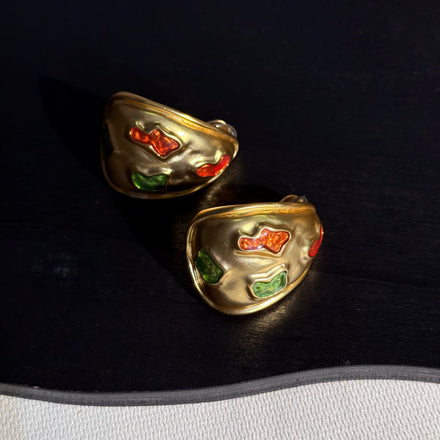
In jewelry history, Retro refers especially to designs associated with the 1940s and surrounding years, when sculptural curves often reworked Art Deco geometry. Art Deco is frequently associated with graphic repetition and bounded shapes, but the two are related rather than strict opposites. Use the comparison to choose a design emphasis—not to date contemporary earrings.
Retro means more than generally old-fashioned
In everyday conversation, retro can describe almost any backward-looking design. In a jewelry-history discussion, it has a more particular context. GIA's historic design overview places 1940s Retro after Deco and describes bold curved forms alongside mechanical, floral and bow references.
That range matters when shopping. A rounded design need not represent a plant, and a mechanically suggestive design need not have sharp corners. Nor must a current item copy a documented historical object to appeal to someone who enjoys this vocabulary. Ask what the seller means by retro before treating the word as a period attribution.
Follow the change from outline to volume
GIA's Retro guide explains how designers softened earlier geometry and gave it a more dimensional, sculptural presence. The distinction is not simply straight versus curved. Geometry remains part of the relationship.
Consider a cylinder. It has a clearly bounded shape, yet its broad curved surface can be the feature you notice first. A repeated row of cylinders creates a different rhythm from one continuous swelling form. Likewise, a rectangular outline can hold rounded sections. Calling every version geometric is accurate but does not explain which one you would rather wear.
For your shortlist, decide whether you prefer a design that reads mainly as an outline, a sequence of connected units or a continuous sculptural surface. These possibilities can overlap. They describe visual organization, not measured setting depth, weight or comfort.
Color is not an era test
GIA's Art Deco discussion emphasizes repeated geometric elements and strong color contrast. Its Retro overview also includes vivid color, with changing preferences across the period. Neither a bright accent nor a warm metal-colored surface can sort an unfamiliar object conclusively.
Keep your color preference and historical question apart. You might want red and green details in a rounded gold-tone form, or deep blue within a linked outline. The choice remains useful without converting the colors into rubies, emeralds or sapphires, or the gold-tone appearance into a particular alloy.
Compare two current earring designs

The rounded sculptural clip-on design presents broad contoured fronts interrupted by small color accents. Much of its visual interest comes from the surrounding gold-tone surface rather than from a long chain of separate decorative units.

The Navy Blue geometric drop earrings organize rounded stud tops, small connecting links and elongated outlined drops. Your eye can move from one part to the next. The horizontal bands and curved ends complicate any attempt to call the design purely linear or purely rounded.
These are contemporary design comparisons. Neither image establishes an Art Deco or Retro production date, maker, manufacturing method or historical material specification.
A curved geometric design is not a contradiction
The useful lesson is continuity. A design can retain a clear axis and repeated modules while making its surfaces fuller and more curved. “Deco or Nouveau?” is therefore not the only question available whenever you see a curve.
Our separate Art Deco versus Art Nouveau guide addresses that earlier comparison. Here, the question is how related geometric vocabulary can produce different kinds of sculptural presence. It is not another test for identifying botanical motifs or assigning a movement from symmetry.
Choose the emphasis you actually enjoy
If you prefer the rounded fronts, say that you want a continuous contoured surface with inset-looking color details. If you prefer the drops, say that you want distinct linked modules and a readable outline. Those preferences are more useful than demanding an undefined retro look.
Browse the earring collection for that organization of forms, then check practical requirements separately. A historical reference can sharpen your eye without becoming a claim about the current piece's age or identity.