
An inscription on a seal matrix can look backward because the intended result is the mark made from it. The engraved object and its impression are not interchangeable views. Before trying to read unusual lettering on a ring or pendant, identify which one you are looking at.
This is an image-reading task, not an invitation to press unfamiliar jewelry into wax or clay. A labeled photograph and a clearly marked comparison copy can answer the orientation question without making a new physical impression.
Name the tool and the result
The National Archives' guide to seals distinguishes the engraved matrix from the impression it produces. It also notes that “seal” can refer to either. That ambiguity matters when a caption says only “seal of...” beside a photograph.
Look for more explicit words: matrix, die, impression, cast or drawing. If two images appear together, do not assume that both show opposite sides of the same object. One may show the engraved face and the other a separate impression. A catalogue's object description should settle this before you interpret the lettering.
Separate left-right reversal from raised and recessed forms
These are two changes, not one. Recesses in an intaglio matrix can create raised features in an impression. The image is also mirrored from side to side. Kenyon College's Seal with Greek Monogram record explains both relationships using incisions of different depths.
A horizontal image flip is not the same as rotating a photograph upside down. Nor is it the same as typing the letters in reverse order: the individual letter shapes reverse too. With a circular inscription, an uncertain starting point adds another reading problem.
For the surface distinction itself, see cameo, cabochon and recessed intaglio forms. Knowing that a design is recessed still does not prove that it was used as a working seal.
Make a comparison that cannot be mistaken for evidence
- Save the original photograph unchanged, with its source and any caption.
- Establish whether the source already calls the image an impression or a reversed view.
- If useful, make a separate horizontally flipped copy. Label it “mirrored image for reading,” not “seal impression.”
- Compare the same feature in both views: an asymmetric letter, a figure's direction or a recognizable emblem.
- Record what becomes clearer and what remains unreadable. Keep uncertain characters unresolved.
The edited copy is an aid to orientation. It does not reproduce the physical relief, depth, wear or legibility of an actual impression. A reflection or shadow in the original may also remain misleading after the image is flipped.
Do not overwrite the source image. Otherwise someone later may reverse your comparison again, or mistake a digitally altered view for the object's actual face.
A museum attribution shows why “suggests” matters
The Met's Seal Ring with Inscription has mirror-reversed text on its carved stone. The museum says this suggests the stone may once have served as a seal. That carefully limited interpretation is more useful than a rule that every backward inscription proves documented use.
For an unidentified object, a similar orientation can prompt a question. It cannot establish age, owner, authenticity or the language of the inscription. Someone familiar with the script may still be needed even when the correct viewing direction is known.
A practical inquiry includes both labeled views and the complete object, not just a sharpened crop of a few letters. Ask whether the design is consistent with a matrix and whether the proposed reading can be supported. Do not ask the photograph to supply a provenance it does not contain.
Do not turn a familiar medallion into a working seal
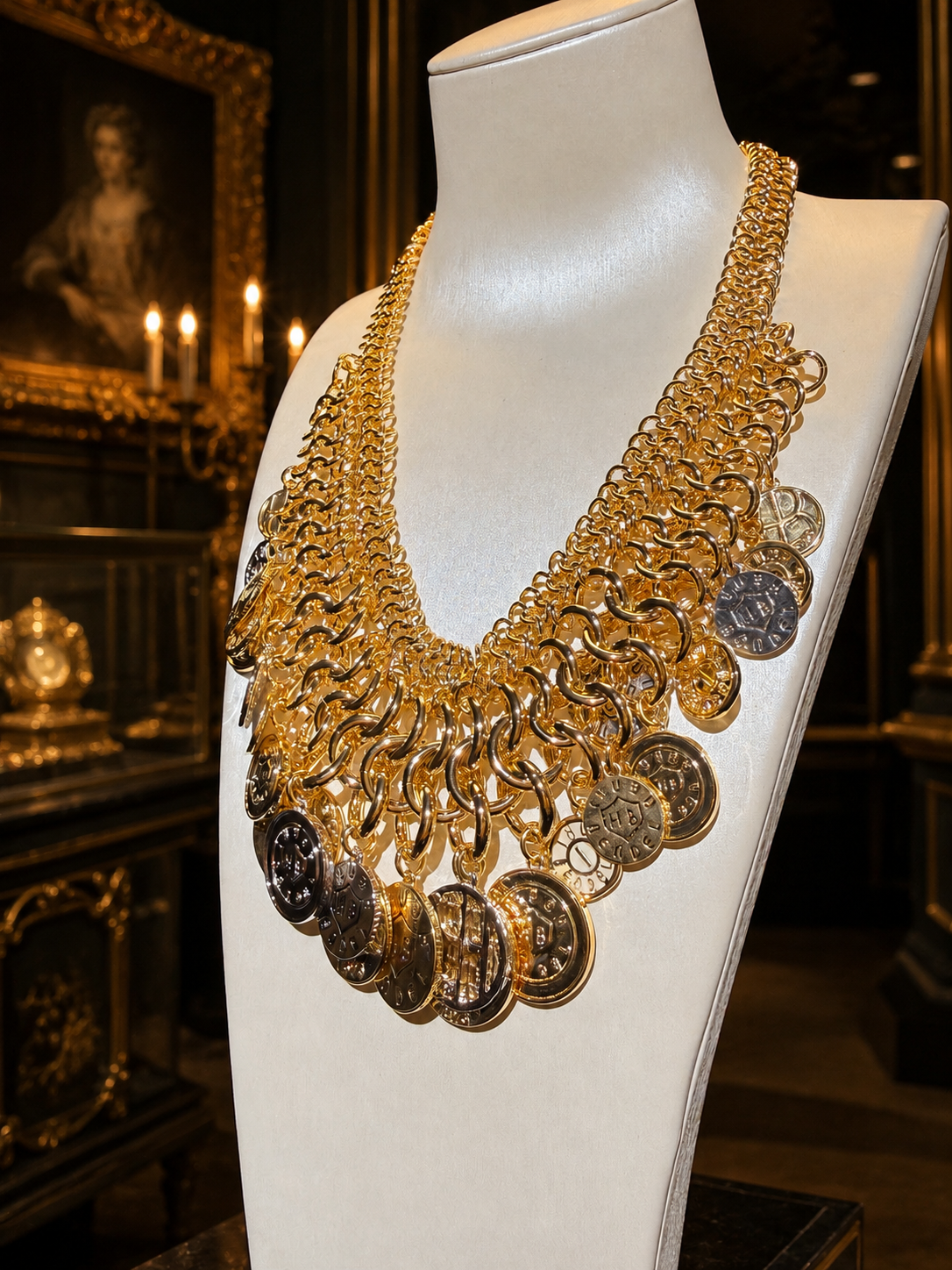
The gold-tone medallion chain necklace contains coin-style decorative motifs. The product description does not identify the charms as seal matrices, working signets or ancient objects. A circular face or classical-looking image is not enough to add those functions.

Use the necklace collection for comparisons of visible motifs, while keeping functional attributions tied to evidence. A clear final note might read: “Engraved face photographed; mirrored comparison supplied; reading unresolved; no physical impression made.” That gives the next reader a reliable starting point rather than an unexplained backward image.