
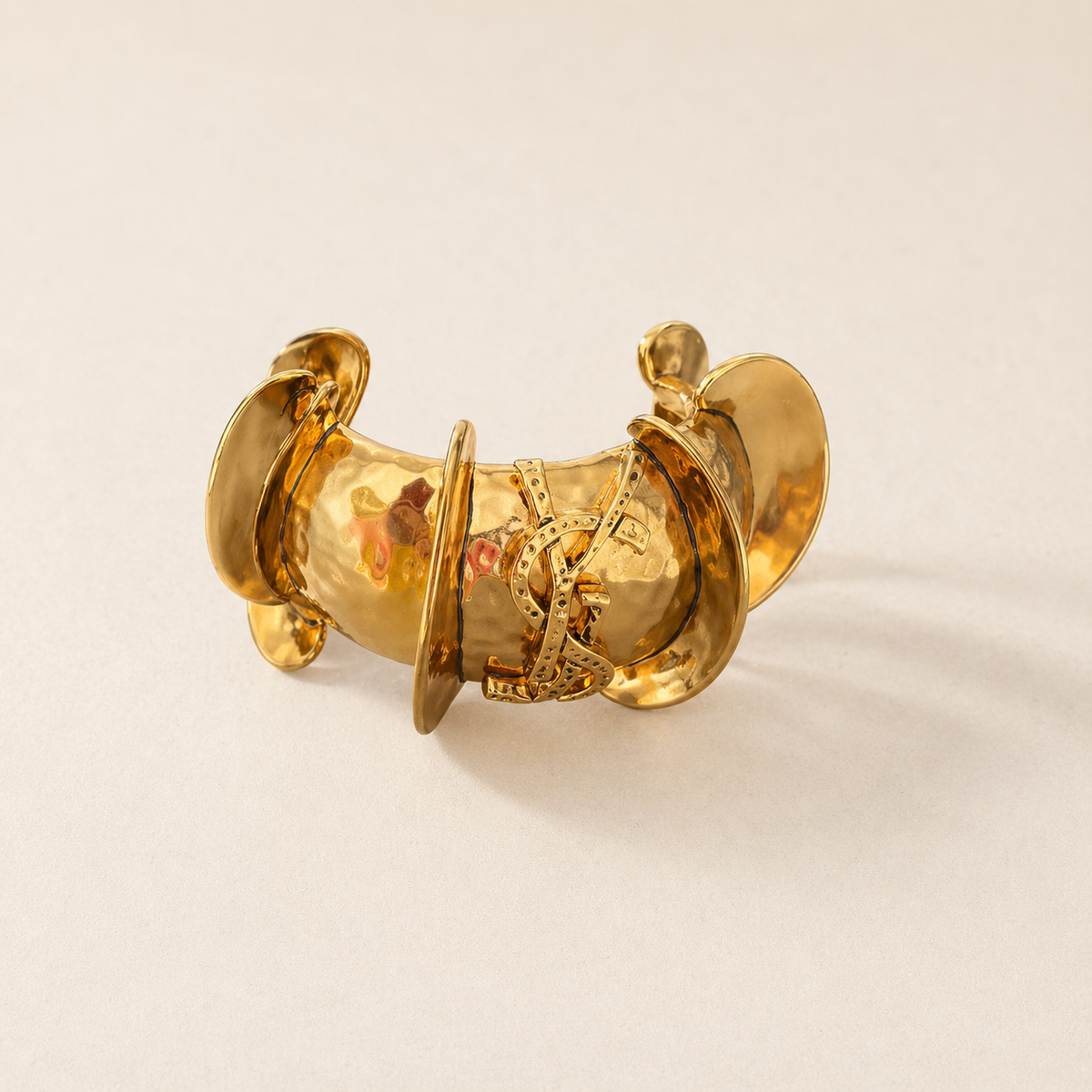
A curved jewel is not automatically a serpent, and a serpent-shaped jewel is not automatically flexible. To describe the motif, trace the head, the course of the body and any tail. Then ask a separate question about construction. The animal represented and the way the object moves are different kinds of information.
Find the head before naming the coil
Look for a distinct head shape, an eye, a mouth or another clearly depicted feature. Follow its connection to the body rather than treating an isolated colored accent as an eye merely because you expect a snake. Some designs have more than one head; others simplify the animal so much that a catalog description is needed to make the intended subject clear.
The Met's ring with snake's head terminals identifies the subject through the ends of the form. That is a useful counterpoint to a broad spiral whose only serpent-like quality is its curve. Without further evidence, the latter may be better described simply as coiled.
Trace the body without inventing the hidden section
On a copy of a photograph, follow one continuous path. Mark visible crossings and record where the path disappears behind another element. If two sections cannot confidently be connected, leave a gap in the sketch. Do not turn “possibly one continuous body” into “one snake” just to simplify the caption.
Stylized animals need not follow natural anatomy. The Met's record for a Mississippian pendant with serpent design explains a highly compressed representation using multiple perspectives. Its curatorial interpretation belongs to that object and cultural context; it is not a general decoding key for all abstract coils. The online record currently provides no image, so its described features should be attributed to the text.
You can distinguish your own observation from a named subject: “interlocking curved forms; cataloged as a serpent design.” This preserves both the visible complexity and the attribution without pretending that every part was obvious.
Keep the animal's body separate from the object's mechanism
A useful documented contrast is the Elsa Peretti necklace in the Met, whose record specifically identifies an articulated snake and an adjustable jaw arrangement. That mechanism is supported for that particular necklace. It does not follow from the snake motif alone.
For an unfamiliar object, do not bend a coil, pull a tail or squeeze a head to see whether it functions similarly. A mouth-shaped detail may be decorative. A visible gap may be part of a rigid form. Look for instructions that identify the exact movable component before operating it.
The same restraint applies to a scale-like surface: it can suggest an animal skin without establishing how the metal was formed or joined. The filigree and openwork guide addresses another instance of separating surface appearance from construction terminology.
Use an abstract curve as a control example
The sculptural gold-tone cuff has curved raised forms. Its record does not establish a snake subject, an articulated body or an adjustable mechanism. Calling those forms sculptural and curved is informative; adding a serpent and a mechanism would be two unsupported claims.

As you compare objects in the brooch collection, try asking which feature changes a neutral curve into a recognizable animal. Sometimes the answer is a clearly modelled head. Sometimes only the maker's explanation supplies the intended reading. Both can be recorded, but not as the same type of evidence.
Do not give every snake the same story
The museum records place serpent imagery in distinct historical and cultural contexts. A general statement that every snake means eternal love, healing or protection would erase those differences. Preserve a meaning only when the relevant maker, object record or attributable family account supplies it.
A final description might read: “Two head-shaped terminals face one another around a coiled body; no movement mechanism documented.” Add a separately sourced cultural interpretation only if you have one. You have then explained the design without borrowing an operating instruction or a story from a different jewel.