
A soft cloth and a polishing cloth are not necessarily interchangeable. “Soft” describes how the fabric feels; “polishing” can describe an action produced by substances in that fabric. Before following an instruction to wipe jewelry gently, check that you have not picked up an impregnated treatment cloth instead.
This distinction matters most when the metal, coating or decorative surface is unknown. A cloth suitable for one documented silver object is not automatically suitable for gold-tone costume jewelry.
Read the job printed on the packaging
Separate three possible jobs: lifting light residue, removing tarnish or polishing a surface, and inhibiting tarnish during storage. Products can combine functions, so read the actual instructions rather than classifying them by color or texture.
| Label or description | Question to settle before use |
|---|---|
| Untreated lint-free wiping cloth | Does the item's care guidance permit light dry wiping? |
| Impregnated metal polishing cloth | Which material and finish is the treatment intended for? |
| Tarnish-inhibiting storage fabric | Is it a housing product, and is it suitable for this whole object? |
A loose unlabeled cloth from an old jewelry box may be impossible to classify reliably. Set it aside rather than trying it on a hidden area of the piece.
Understand why a dry cloth can still remove a surface
The Canadian Conservation Institute's silver-care note explains that silver polishing cloths contain abrasive material. Their use may be appropriate for particular silver objects, but their softness does not make the action equivalent to plain fabric.
CCI's metal-care guidance also explains that polishing removes surface material and that thin plated layers are vulnerable. This does not identify the finish of your jewelry. It explains why an unknown finish is a reason to pause before abrasive treatment.
Nor does a dark mark left on a cloth provide a home test for metal purity or prove that all removed material was harmless dirt. Do not keep rubbing to make the cloth come away clean.
Check every surface the cloth would cross
An ornate piece may combine metal-colored framing, pale round details, colored accents and intentionally dark recesses. A polishing product labeled for a metal does not thereby cover every neighboring material. Drawing the whole piece through a folded cloth can also catch projections you cannot see.
Plan any permitted wipe as a light, local action on a stable area. Do not drag the cloth through a cluster, pull a chain taut between its folds or use it to “test” a loose decorative element. If the piece sheds flakes or the surface changes unexpectedly, stop and seek advice.

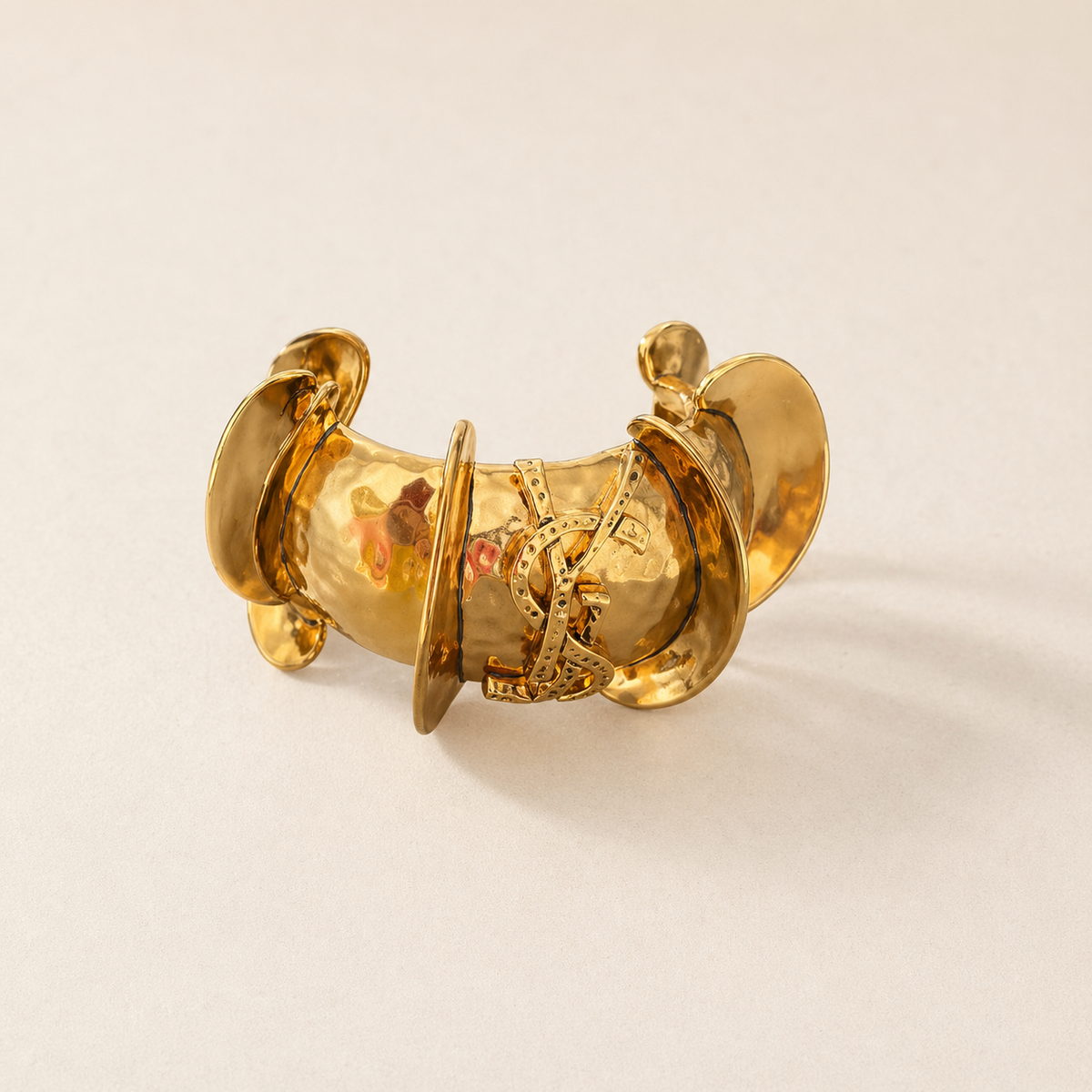
The sculptural gold-tone cuff offers an example of raised forms and recesses. Its appearance does not establish solid gold, a particular plating or compatibility with a silver-polishing treatment. For similarly detailed objects in the brooch collection, consider the full surface before choosing a tool.
Keep wiping tools separate from treatment tools
Store a known untreated cloth separately and label its container. Follow its washing instructions if provided, and do not reuse a cloth carrying grit or polish residue as a general wiping cloth. Keep treated products with their packaging so their purpose and exclusions remain available.
Do not replace a polishing cloth with toothpaste or household abrasive paste. The GIA cleaning-myths guide warns that abrasives can erode metal and scratch some gems. The useful response to uncertain suitability is better information, not another abrasive format.
Decide whether polishing is actually the task
If the concern is a fingerprint on a stable surface with documented wiping instructions, a gentle wipe may address it. If the concern is a changed finish, a dark recess or a newly dull patch, first establish what changed. More shine is not always a valid preservation goal, and polishing cannot be assumed to restore a lost coating.
The everyday care guide covers the broader routine. Keep this tool check beside it: know the cloth, know the surface, and stop when either is uncertain.