
Pack for the space each piece actually needs
A small travel jewelry kit works best when every piece has a defined place, enough clearance, and a count you can repeat when you arrive. Start with the jewelry laid out, not with an empty organizer that you feel obliged to fill. A pair of earrings, a necklace, and a brooch may need very different compartments even when they belong to the same outfit.
This is a packing problem rather than a challenge to create the smallest possible bundle. Compressing a sculptural necklace into a ring section saves space only by putting pressure where it does not belong. Choose fewer pieces if the organizer cannot accommodate their shapes without force. Keep everyday maintenance separate: the gold-tone costume jewelry care guide covers care between wears.
Before packing, take a clear overhead photograph of the entire kit. Include both members of each earring pair and any separate backs or removable parts. The picture becomes your own reference at each change of accommodation; it is not an appraisal or proof of insurance coverage.
Make a six-position packing map
Draw the organizer as a simple rectangle and label its usable spaces A through F. A position can be a lined compartment, an individual pouch, or a separate supported box. Write what belongs there before inserting anything. This is an example layout, not a recommendation to bring six items:
| Position | Assigned contents | Check before closing |
|---|---|---|
| A | Left statement earring | No pressure on its fastening |
| B | Right statement earring | Separated from the first earring |
| C | One necklace | Chain cannot cross neighboring pieces |
| D | One brooch | Pin secured in its intended catch |
| E | One ring | Raised face clears the lid |
| F | Empty return space | Reserved for a temporarily isolated item |
Count physical pieces as well as outfits. The table contains five jewelry objects, although the earrings are one wearable pair. If separate earring backs are not attached, record them in a small identified container rather than letting them migrate into the empty space. Keep the map on your phone or inside the case where it cannot rub against jewelry.
Give necklaces a route, not a tight bundle
Lay a necklace along the natural direction of its links. Let the decorative front occupy a broad area, with the chain in its own channel or pocket. If the case has a necklace holder, check what it actually supports: a hanging point does not necessarily prevent a large front section from swinging into neighboring pieces.
A smooth, flexible chain and a necklace with projecting links need different layouts. Do not thread an oversized fitting through an improvised tube, pull a chain taut, or bend a rigid section to make it fit. Choose a wider compartment or leave the necklace out. A travel pouch can separate surfaces, but soft fabric alone does not create clearance under a loaded case lid.

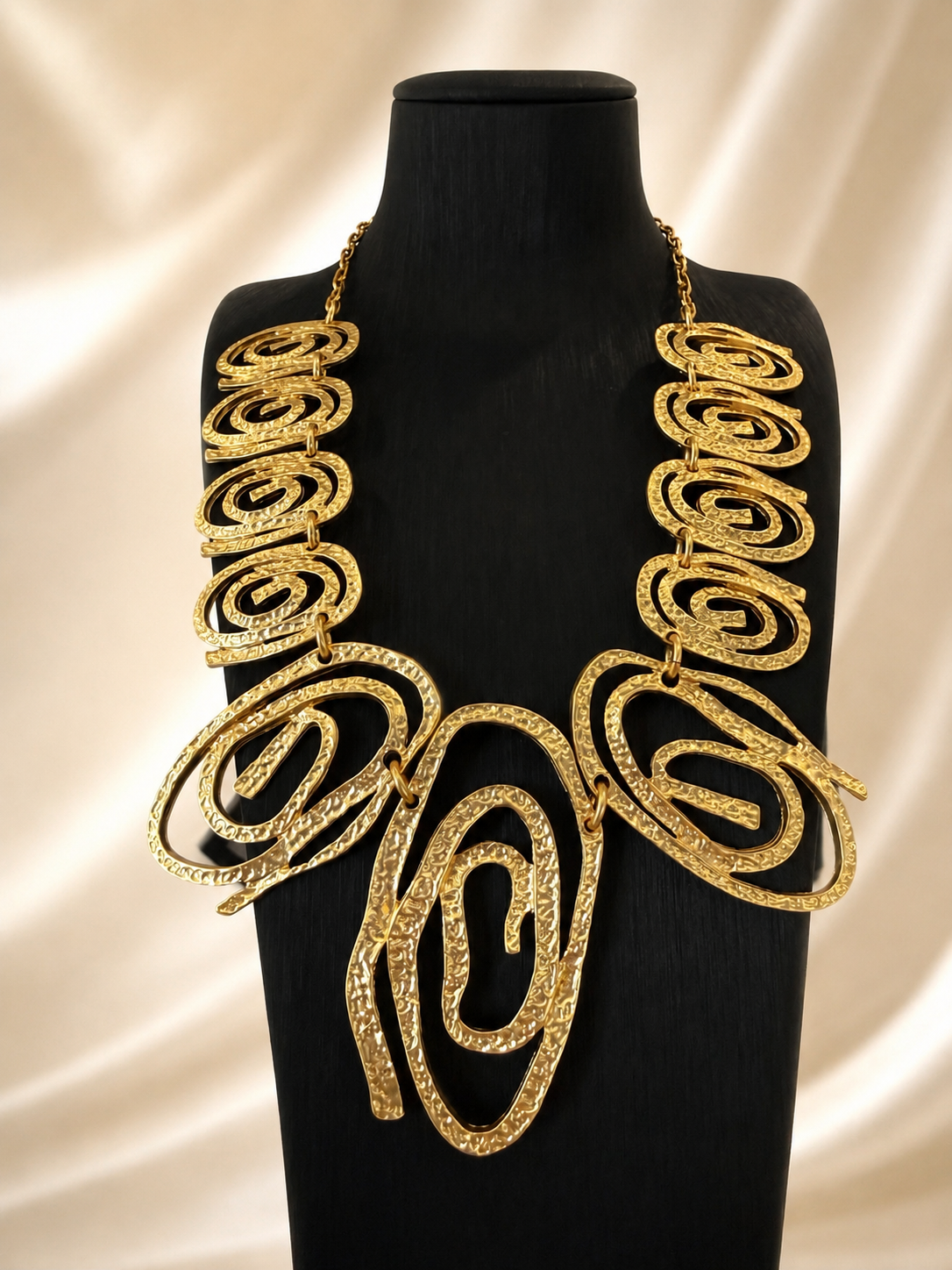
The pictured design is described with oversized openwork swirl links. Use that shape as a planning example, not as evidence that a particular travel case will fit it. The useful measurement is the space around the arranged necklace, including its highest point, rather than the necklace's length alone.
Separate earrings without stressing the hardware
Keep the two earrings identifiable as a pair while preventing their decorative fronts from rubbing together. For large pieces, adjacent separate compartments can work better than placing both into one small pocket. Position posts or clips so the holder does not push them sideways. A panel intended for pierced earrings is not automatically suitable for clip-on mechanisms.
Remove a panel if the case is designed to allow that and the resulting space is more useful. Do not modify the jewelry to suit the organizer. For a brooch, confirm that the pin is in its intended closed position before placing it in a supported area. An exposed point should never be left loose among fabric pouches or clothing.
Choose clean, smooth separation material appropriate to the piece. Avoid loose cotton fluff that can catch around small settings. GIA's travel packing tips explain the value of documenting and separating pieces; our compartment map adds a way to check that separation repeatedly.
Test the packed case without shaking it
Bring the lid down slowly while watching the tallest elements. Stop if it meets jewelry before reaching its normal closing position. Do not use the zipper to compress the contents. A lid that closes only when pressed is a failed layout, even if the outer dimensions of the case appear generous.
Next, lift the case level, keeping its contents under observation if possible. Look for pieces sliding out of their assigned spaces. Reposition the supports rather than shaking the case to see what happens. The objective is a stable arrangement under gentle ordinary handling, not a stress test.
Keep the jewelry container apart from toiletries and other items that could leak. Do not treat a travel organizer's outer material description as a guarantee that its contents are protected from water or crushing. Your packing plan should not depend on either assumption.
Repeat the count at arrival and departure
Open the kit on a clear surface away from a sink, bed folds, or an open bag. Compare positions A through F with the photograph. Check that each pair is complete, small components remain contained, and nothing appears newly bent, detached, or caught. If something looks wrong, set that piece aside instead of trying to straighten or repair it during unpacking.
Before leaving the accommodation, return each item to its assigned position and repeat the same count. Check the temporary return space as carefully as the main compartments. This closes the loop between what you brought, what you wore, and what you are taking home.
When planning another compact kit, browse the Rustic Jewel Co catalog with your compartment map beside you. Select pieces whose shapes you can accommodate, rather than relying on extra padding to rescue an overcrowded case.