
If you want amber as a material, look for an explicit fossil-resin description, not just a warm golden color. If you want the color, an amber-colored glass accent may suit that purpose without being amber. A third possibility needs closer attention: a piece can contain some amber while also containing another material. Ask what the entire accent is made from before treating “contains amber” as “all amber.”
Amber can name the substance or the shade
GIA describes amber as fossilized plant resin. In that use, amber identifies a material. In phrases such as amber-colored, amber-tone, or amber-yellow, it describes a color. Those phrases can apply to an accent whose composition is something else—or whose composition is not stated.
The word resin needs context, too. Amber began as plant resin, but an unspecified resin accent is not thereby fossil amber. Conversely, amber is not simply another name for a modern polymer. A seller who says only “resin” has left the particular material unresolved. Ask which resin the description identifies rather than supplying the answer yourself.
This distinction lets you keep two shopping goals separate. A translucent golden rectangle may be exactly the visual detail you want. A purchase specifically for fossil amber requires a material statement that the color alone cannot provide. Neither goal needs to masquerade as the other.
Pressed pieces and added materials are separate questions
GIA's amber buyer's guide discusses pressed or reconstructed amber made from smaller amber pieces. That wording raises a construction question: is the accent one piece, or has it been formed from pieces? A separate question is whether other substances are part of the finished accent. Do not assume that a construction label answers both.
A Winter 2013 laboratory report published by GIA describes a specimen combining a natural amber core with surrounding polymer resin. It contained both a naturally occurring insect inclusion and an introduced one. This was one examined specimen, not a survey showing how all amber jewelry is made.
The useful buying lesson is about the scope of a claim. Evidence that one portion is amber does not establish that the entire object is amber. Likewise, an insect-like feature is not an answer to the composition question. Ask how the claimed material relates to the complete accent, rather than treating an attractive detail as confirmation.
Two current listings show why the qualifier matters
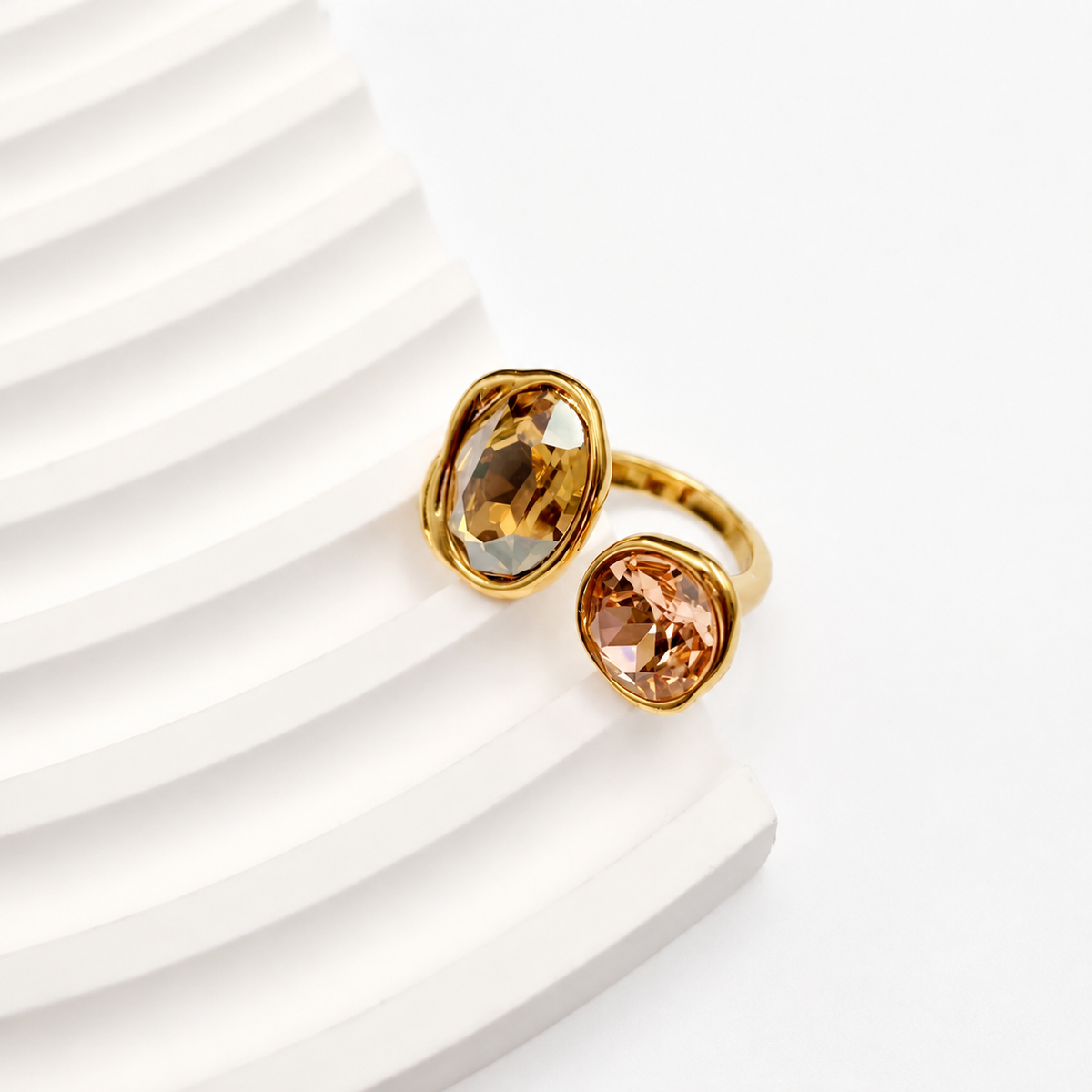
The Amber & Peach Faceted Glass Open Statement Ring explicitly describes two faceted glass accents in amber and peach colors. Here, glass is the seller's stated material; amber and peach identify the color palette. Calling its amber-colored accent fossil amber would contradict that description.

The Gold-Tone Amber Glass-Style Rectangular Drop Stud Earrings use different wording: amber glass-style rectangular accents. The photograph shows elongated warm-colored drops beneath rounded tops, but glass-style is not an explicit identification of glass. It also does not establish amber or a particular resin.

These are wording examples, not a calibrated comparison of transparency or color. Different lighting, backgrounds, and photography can change how warm tones appear. If the color is the deciding feature, the photo color-check guide addresses that separate concern. For the broader distinction between stated glass and appearance language, use the rhinestone, crystal-style, and glass guide.
Find out what the material statement covers
A useful inquiry names the component you mean. “What is the amber-colored rectangular drop made from?” is more precise than “Is this real?” The first question can receive a concrete answer; the second might produce a general reassurance about the complete piece without identifying the accent.
If a listing does claim amber, ask whether that description applies to the entire accent, an exposed portion, a core, or fragments within another material. Then ask whether it is described as one piece, pressed or reconstructed pieces, or a mixed composite. Keep the seller's exact wording instead of shortening a qualified answer to “natural amber.”
For example, imagine a supplier says that a pendant contains amber fragments in another resin. That answer is informative, but it does not satisfy a requirement for an accent made entirely from fossil amber. Another supplier might explicitly describe amber-colored glass. That is a different, clearly stated material—not an unanswered amber claim. These are hypothetical replies, not additional RJC products.
Let a specific answer resolve the purchase
If you are shopping for the color, your next questions may be the drop shape, the dimensions, and whether the warm tone works with what you plan to wear. You can appreciate an accurately described glass design or a listing that preserves its style qualifier without inventing a geological story for it. The two current examples above remain distinct because their actual material wording differs.
For a fossil-amber requirement, keep that requirement open until the item-specific documentation addresses composition and construction. If a report is supplied, check that it refers to the particular item and component being offered, and read what it actually identifies. A report about a sample or a different portion should not silently become a statement about the entire purchase.
An answer that repeats “beautiful amber color” has answered a color question. It has not answered a fossil-resin question. Choose the design if its documented appearance is enough for your purpose; if amber itself is essential, pause for the missing material answer rather than trying to settle it from the photograph or an improvised home test.