
Decide whether the same wrist is worth testing
A bracelet and watch can look coordinated while still meeting every time the arm drops. The practical decision is not whether the combination is permitted by a style rule. It is whether the exact pieces have enough usable wrist space to remain positioned through ordinary movement, with a contact risk you accept.
Begin with the watch alone in its normal fitted position and the bracelet alone at its intended fit. Do not tighten either item beyond its designed adjustment range to force a gap. If you are still choosing bracelet length, use the wrist and clasp-bracelet measurement guide before this pairing test. Fit evidence and watch clearance are separate: a bracelet can fit the wrist and still travel into the watch.
Check the watch maker's care guidance, especially for a finish, strap, coating, collectible condition, or service requirement you want to preserve. Audemars Piguet's care page, for example, advises against wearing jewelry on the same wrist because of scratch risk. That guidance applies to its watches, not as a universal material prediction. If the watch's instructions say to keep other jewelry away, use the opposite wrist.
Map the occupied space before adding motion
Put the watch on, add one bracelet, and photograph the wrist from the dial side and the crown side. Label five possible meeting points: case flank, lugs, crown or pushers if present, watch-band edge or clasp, and the bracelet's nearest link or clasp. Record only features you can identify on the actual pieces; do not infer hardness or plating from color.
Next, mark the bracelet's starting position as hand side or forearm side. A visible gap while the palm faces up is not enough. Note whether the bracelet stays at that position after the arm hangs naturally. If it immediately slides into the case, the still-photo gap is not usable clearance.
Totapari's detailed placement guide identifies case surfaces, crown or pushers, clasps, projected fittings, and movement as points to examine. Use those as inspection locations, not as proof that one category is safe beside another. The specific bracelet and watch must supply the result.
Run a two-cycle contact test
Perform this five-action sequence twice over a clear surface:
- Let the arm hang for ten seconds, then raise the forearm to horizontal.
- Rotate the palm upward and downward once.
- Bend the wrist gently toward and away from the palm within your normal range.
- Type a short sentence or hold a phone in the usual position.
- Put on and remove the jacket or sleeve planned for the outfit.
For each action, record no contact, rub, strike, catch, or position changed. Also note the two components that met. Sound can reveal a collision, but silence does not prove separation; watch the side view or ask another person to observe.
Do not deliberately bang the pieces together, pull a caught link, or test during driving, exercise, cooking, or another task that needs full attention. Stop if either fastening opens, the watch shifts substantially, or the bracelet traps against a control. The procedure is a low-force wear check, not a durability test.
Retest one safer same-wrist position
If contact occurred on the hand side, move the bracelet to the forearm side and repeat both cycles of the five-action sequence at the new position. Both Totapari and Mapple Gems describe the forearm side as giving a moving bracelet more room away from the case. This is a retest position, not a guaranteed barrier: gravity and fit can bring the bracelet back toward the watch.
If the bracelet will not remain there, do not add a spacer item or tighten the bracelet merely to hold it back. A third object creates another surface and another movement pattern. Daniel Wellington's styling guide also presents separate wrists as a practical option when a bold bracelet and watch would overcrowd one wrist.
Move the bracelet to the opposite wrist when contact repeats in either cycle, a link meets the crown or pushers, a clasp catches, the bracelet crosses onto the case, a sleeve drives the pieces together, or the watch instructions discourage adjacent jewelry. Opposite wrists are also the conservative choice when any contacted surface or material is unknown and marking either item would be unacceptable.
Use a documented bracelet as a test candidate
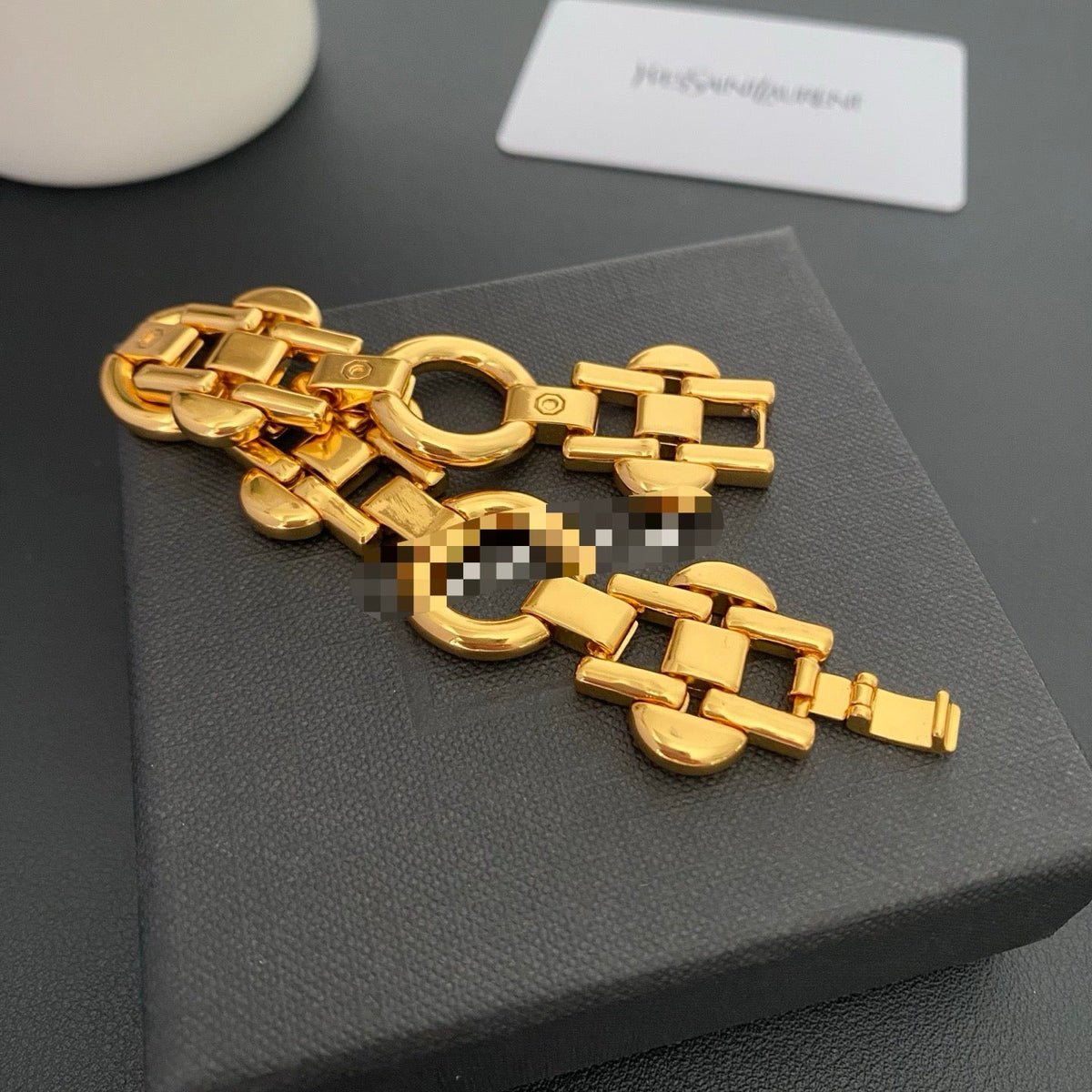
A current gold-tone geometric link bracelet is documented with alternating rounded rings, polished rectangular links, sculptural half-moon details, and 6.7-inch and 7.5-inch length options. That information helps select the exact variant and identify links to watch during movement. It does not establish material hardness, fixed clearance, or scratch-free compatibility with a watch.

Use the bracelets collection to compare documented construction and size options. If you are deciding between a link bracelet and a rigid silhouette, the cuff-versus-bangle guide addresses visual focal-point choices; it does not replace this moving clearance test.
Write a narrow clearance conclusion
Your same-wrist log needs seven fields: watch, bracelet and size, starting side, action, contact type, contact location, and result. Conclude same-wrist test passed only when two complete cycles show no contact or catching and both pieces remain positioned. Conclude opposite wrists when contact repeats, controls or clasps are involved, movement cannot be contained, or the preservation threshold is stricter than the observed risk.
A useful note reads: “The bracelet returned from the forearm side and rubbed the watch case during both arm-hang tests; use opposite wrists.” Another valid note is: “No contact occurred in two cycles with this watch, bracelet size, forearm-side position, and sleeve.” The second result is not a scratch-proof guarantee. It reports only the movements and setup observed today.