
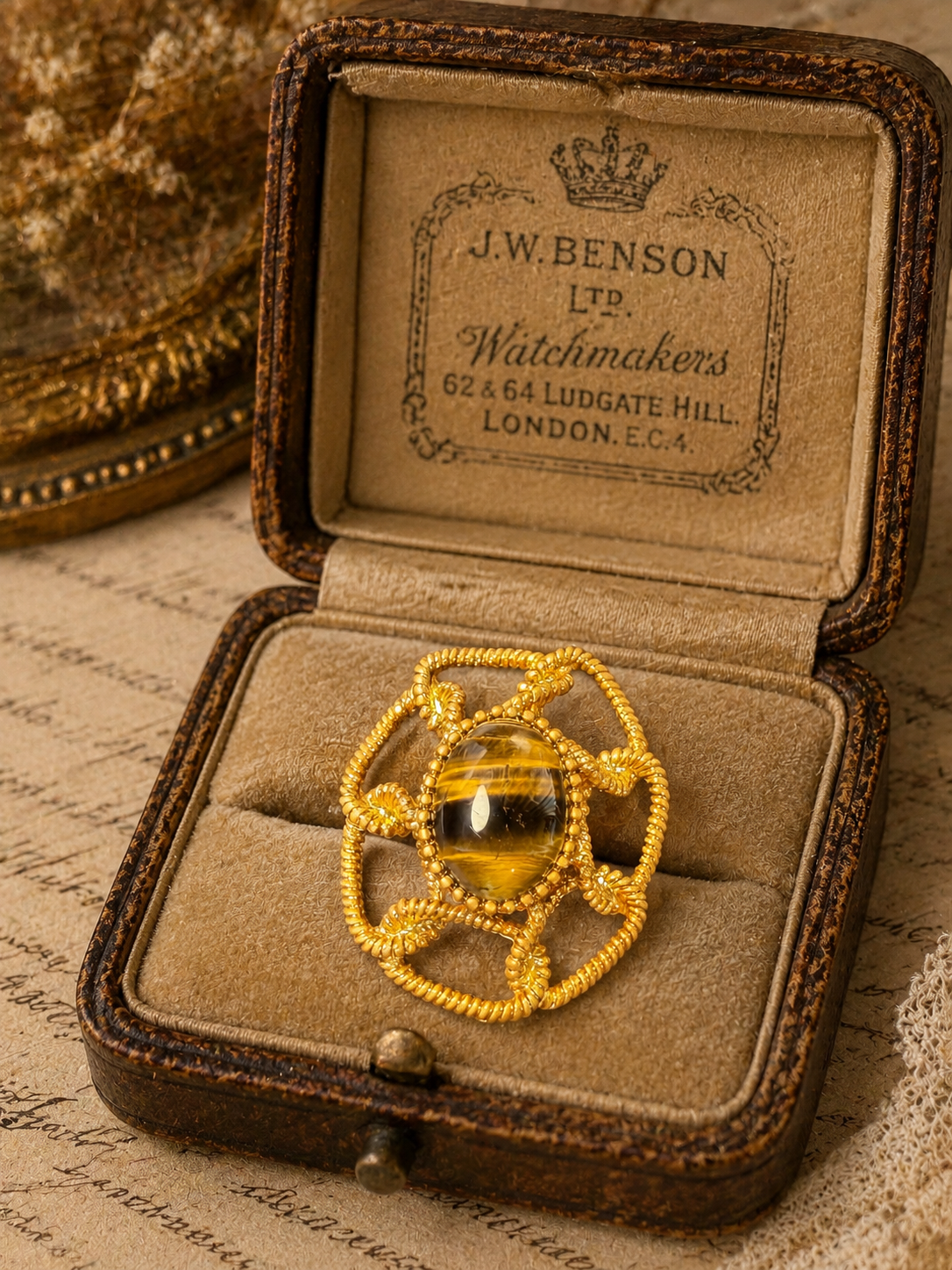
A tiger-eye-style stripe or cat-eye-style highlight does not identify a gemstone, and one photograph cannot establish a moving light band. Decide which feature you want: the pictured pattern, an angle-dependent optical effect, or a particular material. Ask for a view showing movement when movement matters, and item-specific material information when composition matters. Those are separate requests, even when the same design name prompts both.
A stripe, a highlight, and a moving band are different observations
A stripe is a pattern you can point to within the photographed accent. A highlight may simply be a reflection from the light used for the photograph. Chatoyancy refers to an optical effect that can appear as an eye-like band as the lighting and viewing relationship changes. A single still can leave those different appearances looking deceptively similar.
That does not make the still useless. It can show whether you enjoy a striped brown-and-gold color arrangement or a pale oval within a gold-tone frame. It just cannot show a sequence of movement. Describing a stripe is a narrower, better-supported statement than promising that the stripe will glide across the accent when worn.
A rounded surface is another separate feature. A dome can carry a broad surface reflection without proving a particular internal optical phenomenon. If you are comparing smooth and faceted surfaces, use the cabochon-versus-faceted guide for that geometry question rather than treating “domed” as an identification.
Identified specimens show why the effect is not a material ID
The GIA Museum's tiger's-eye quartz exhibit describes chatoyant sheen associated with reflected light and fibrous structure in its identified specimen. That explains a phenomenon in the museum object; it does not identify a similarly colored ring photographed elsewhere.
The effect is not confined to that material. A Summer 2015 GIA Microworld article describes an identified tourmaline with chatoyant bands. Its appearance changed with the lighting arrangement and the gem's rotation. The specimen demonstrates why an eye-like band cannot, by itself, be treated as one mineral's name.
A Winter 2017 GIA Lab Note on cat's-eye alexandrite discusses aligned inclusions and also notes that some synthetic or imitation constructions can produce an eye-like effect. These are particular documented examples, not evidence that all eye-style jewelry uses one material—or that any RJC accent uses one of the materials in those reports.
The practical distinction is simple: an effect can be worth asking to see without being an identity test. Even a convincing demonstration of a moving band would leave a separate question about what the accent is made from.
Keep the two RJC variants matched to their own photographs
The current Gold-Tone Tiger Eye-Style and Cat Eye-Style Large Adjustable Open Ring has two differently named selections. The assigned Tiger Eye-Style image shows a striped brown-and-gold oval. The assigned Cat Eye-Style image shows a pale oval with soft highlights.


The listing describes the choices as a warm striped look and a soft luminous look, with a stone-style centerpiece. It does not identify the centers as quartz, chrysoberyl, tourmaline, glass, or another particular substance. The two photographs also do not supply an observed motion demonstration.
You can choose a pictured color and pattern without making a mineral claim. If the effect is the reason you are buying, however, do not let the name or the other variant's photograph answer that question. Keep the selected variant and the evidence together.
Ask for a motion view that answers the actual question
A useful request is: “Could you show this exact variant in one continuous, slow turning view, and state the lighting used? I want to see whether a band changes across the oval.” Naming the variant avoids a demonstration of a similar-looking option. A continuous view is more informative for this purpose than a montage that switches between unrelated photographs.
Watch the relationship between the accent, the light, and the camera rather than assigning a mineral name to what appears. If the view shows only a stationary stripe, it has not demonstrated the moving feature you requested. If it shows a changing band, it may help you decide whether you enjoy that appearance under those conditions; it still does not establish natural origin or composition.
The lighting statement matters because one dramatic setup is not a promise about every room. For a separate question about why a pale or warm color changes between photographs, the photo color-check guide is the appropriate next step. Do not use apparent brightness as a substitute for either a motion view or material documentation.
A missing demonstration leaves the effect unconfirmed
If no motion view is available, treat the moving-band question as unanswered. That does not prove the accent lacks an effect, just as a bright still does not prove it has one. You can still decide whether the documented stripe or pale oval is enough for your purchase.
If you require a particular material, ask a different question: “What material is this exact variant's center identified as, and what item-specific documentation supports that description?” An attractive video cannot answer that request simply by looking convincing. Nor does the phrase cat-eye-style establish a particular mineral or a manufactured substitute.
For example, a shopper who wants the brown-and-gold pattern may have enough visual information to keep considering Tiger Eye-Style while checking the ring's separate size details. A shopper who specifically wants a demonstrated moving band should leave that requirement unresolved until the exact variant is shown. A shopper requiring an identified mineral needs the material record as well. Keeping those decisions separate avoids buying an imagined feature on the strength of a familiar name.