
A chatelaine is an accessory-carrying assembly: a support connects suspended objects that can be useful, personal or decorative. Historic examples often attach at the waist. Understanding one means following those connections, not merely counting attractive dangling pieces.
If you encounter an unfamiliar example in a family collection, resist rearranging it into a pleasing symmetrical display. Its present attachments, empty positions and nearby loose objects are information. Record the arrangement before deciding what belongs where.
Start at the support and follow the connections
The Met describes its late-eighteenth-century watch and chatelaine in the context of waist-hung sewing, writing and personal-care implements. A useful reading sequence is therefore support, attachment, suspended component, then that component's possible function.
Do not begin by naming every small object. An unfamiliar case can be recorded as a closed case until its function is established. Do not force it open to decide whether it held needles, a scent bottle or something else.
Different assemblies can have different arrangements. The presence of a watch does not require a particular number of other tools, and a chain with an empty end does not tell you exactly what used to hang there.
Draw relationships, not just a list
Make a simple connection map while the object remains supported. Name the top support A. Assign the branches B, C and D according to their current positions in one labeled photograph. Then write relationships such as A connects to B; B ends in a closed case; C ends in an empty connector.
The letters are your recording aid, not marks to apply to the jewelry. State the photograph's orientation so that “left branch” remains meaningful if someone later turns the assembly over.
The Met's detailed Téterger watch-and-chatelaine record describes a concealed hook that allows the watch to be attached with either its dial or case back visible. This illustrates why connection details can explain an arrangement better than a front-facing count. It is not permission to operate an unfamiliar historic fitting.
Distinguish present, detached and hypothetical parts
Use three groups in your map:
- Attached now: a component connected in the arrangement you actually observed.
- Found separately: an object discovered nearby, with its original location and any accompanying note recorded.
- Proposed association: an interpretation that still needs documentary or specialist support.
A separate thimble that fits an empty space is not automatically an original component. Similar decoration, a convenient size or a matching metal color can suggest a question without answering it.
Cooper Hewitt's account of an American chatelaine reports eight chains with objects on seven. That observation is useful precisely because it distinguishes visible attachments from a presumed missing object's identity. Your record should be equally clear about what is present and what is only proposed.
Work through a small hypothetical assembly
Suppose your photograph shows one upper clip, three suspended chains, a closed case, a watch and an empty connector. A loose miniature tool is in the same box. The record contains two attached objects, one empty endpoint and one separately found object. It does not yet contain an “original three-tool set.”
Draw the loose tool beside the map, not joined into it. Add where it was found and whether a dated photograph shows it attached. If later evidence establishes an association, add that finding without deleting the as-found record.
Support the suspended objects together when moving the assembly rather than lifting it by a single dangling accessory. The Canadian Conservation Institute's handling guidance emphasizes assessing weak points and supporting objects appropriately. Uncertain connections should be assessed, not pulled to test their strength.
A pendant motif is not the same kind of object
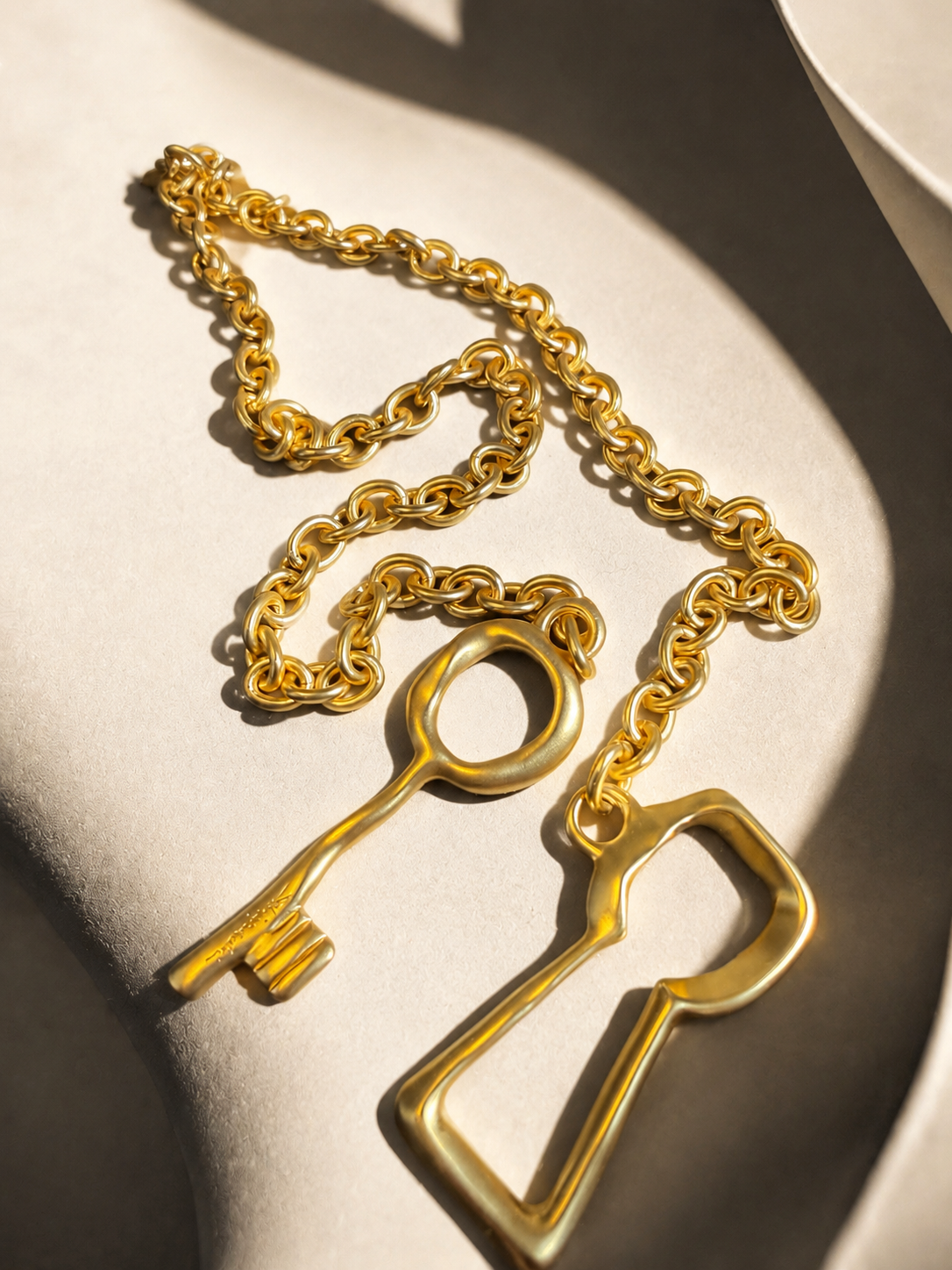
The gold-tone key-pendant necklace uses a recognizable key form. Its description does not establish a working key or a historic chatelaine assembly. It is a useful contrast between depicting a tool and documenting an object made to carry accessories.

The distinction also differs from parure and demi-parure terminology, which concerns coordinated suites. Here, the central question is how parts connect within one assembly, not how many matching jewelry categories a set contains.
Compare pendant motifs in the necklace collection without borrowing a historical function. For an actual chatelaine, an honest connection map preserves more than an unsupported declaration that the assembly is complete.