
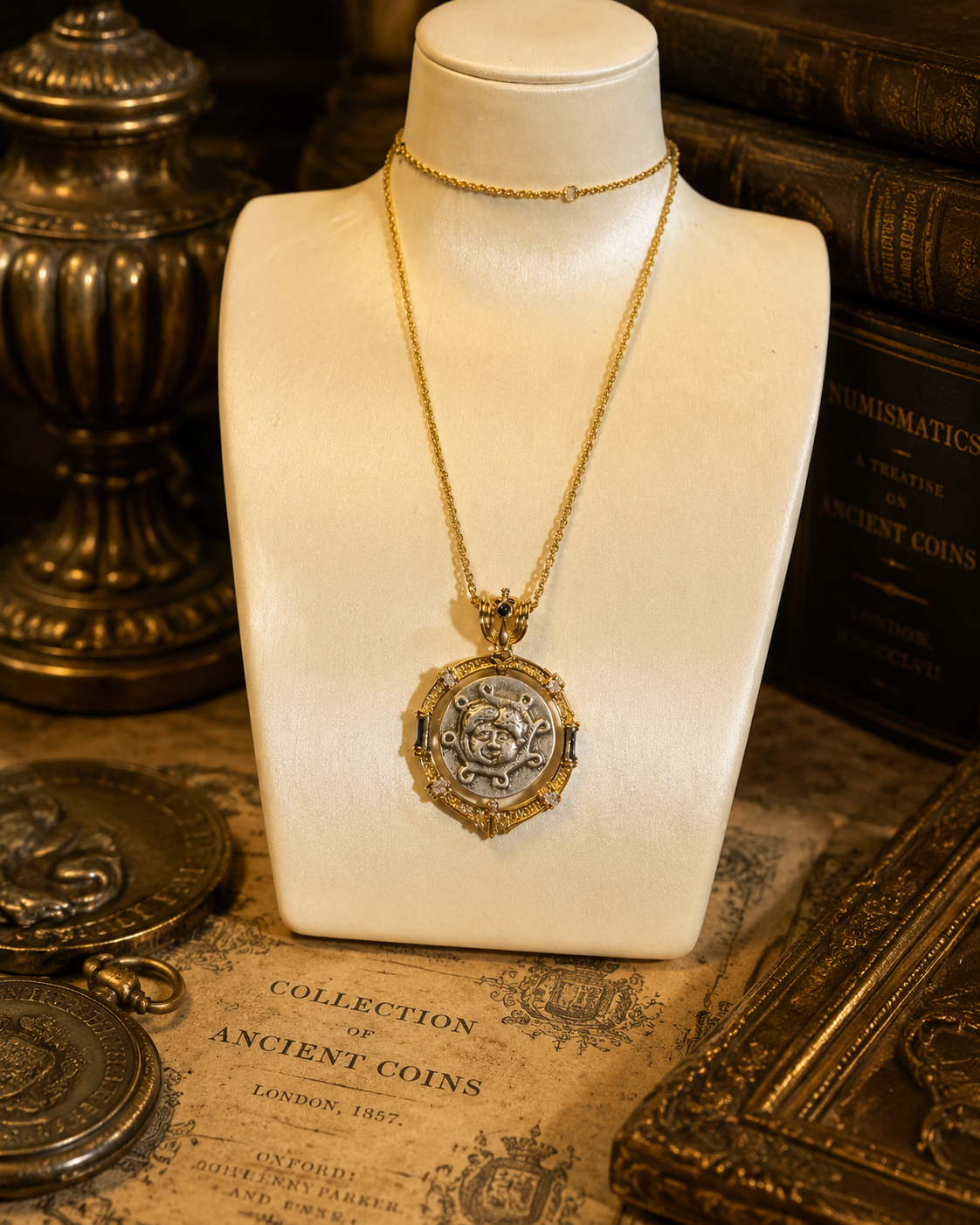
In jewelry listings, a coin necklace may contain a genuine coin or simply a pendant with coin-like imagery. Medallion is a broader design term often used for a prominent round ornament. Neither word, by itself, proves that the pendant was once money, is ancient, or has a documented collecting history.
Decide which part attracts you: a portrait relief, a patterned circular pendant, or an actual historically issued object. Those interests can lead to similar-looking necklaces, but they call for different evidence. A decorative coin-style piece can satisfy a design preference without needing a monetary story.
One round outline can carry several different claims
A coin-style pendant borrows familiar features such as a profile, border, lettering-like marks, or two decorated faces. A floral medallion may share its rounded outline while having no currency imagery. A genuine coin mounted as jewelry adds a separate claim about the object inside the mounting.
| Description | Main question it answers | What it does not establish alone |
|---|---|---|
| Coin-style pendant | Does the design evoke a coin? | Official issue, age, or previous circulation |
| Decorative medallion | What substantial round motif leads the necklace? | A monetary function or historical award |
| Genuine coin in a mount | Which issued coin is incorporated? | The mount's date or the object's ownership history |
These are useful reading distinctions rather than rigid categories every seller follows. A medallion can be openworked, domed, or elaborately framed. You need not reject a pendant because it fails a rule that all medallions must be plain, flat, solid discs.
Why history makes the words less tidy
The U.S. Mint glossary distinguishes a coin issued as money from a medal made to recognize a person, place, group, or event without a stated monetary value. Those are institutional terms. A modern jewelry seller's medallion description does not necessarily claim either kind of official issue.
Historical objects can combine categories. The Met's account of a Byzantine pectoral describes genuine coins alongside an unofficial pseudo-medallion, with an officially struck medallion formerly attached. Similar imagery did not give every component the same origin or function. That documented example is a reason to ask what a particular component is, rather than authenticate it from its resemblance to a museum object.
Compare a coin-style portrait with a floral medallion

This listing offers two Greek-inspired relief looks on a reversible pendant. The reference is to its design; it does not identify an excavated Greek coin or a documented ancient mint issue. If the portrait-like imagery is what you enjoy, the coin-style wording is useful precisely because it names that appeal.

The second necklace puts a flower motif beneath a line of deep red beads. Its attraction comes from ornament and color rather than a simulated monetary face. Comparing these two designs shows why medallion can be useful even when coin is not the right description.
Choose the visual feature you will actually notice
If you want the coin reference to remain readable, inspect the relief and its border at the scale the pendant will appear when worn. An elaborate surrounding frame may command more attention than the central image. If you prefer pattern and color, a floral medallion can provide a strong circular focus without asking the viewer to recognize a ruler or deity.
Do not automatically attach wealth, protection, or a classical identity to the wearer. Historical meanings belong to their documented contexts, while a present-day person may simply like the shape. You can appreciate the reference without claiming the pendant carries an ancient power or a fixed personal message.
When the monetary history is your reason for buying
If you specifically want a genuine historical coin, look for the proposed issuer, denomination, date range, identification, and evidence tied to the exact object. Ask separately about the mounting and any alterations. An antique-looking frame or a seller's general story does not resolve those questions.
Our vintage versus vintage-inspired guide covers the related age distinction. For a design-led necklace, browse the necklace collection for the motif you prefer. Choose a documented historical object when history is the requirement, and an accurately described decorative pendant when the design is the pleasure.