
Crescent, starburst and sunburst are useful design words, but they do not form a universal scientific classification of jewelry. A crescent is read through its curved body and two tips. Starburst and sunburst descriptions emphasize forms radiating from a center, and their usage can overlap. A precise outline description can remain useful even when the preferred motif name is uncertain.
Read a crescent through its open side
Trace the outside curve, then the inward curve facing the opening. Note the two tapering ends and the width of the body between them. This describes more than “moon-shaped”: a slender crescent and a broad, almost circular crescent have different proportions while retaining the same basic relationship.
The Met's cataloged Fatimid-period earrings explicitly use the crescent, or hilal, form. Their museum record establishes the historical context of those earrings. It does not make every crescent jewel an object from that period or assign the same cultural meaning to an unrelated design.
In a composite ornament, keep the crescent separate from anything inside its opening. A small star suspended within a crescent is a second element, not another point on the crescent. If the image does not show whether it is attached or merely overlaps, describe position without claiming movement.
Map rays rather than enforcing a point-count rule
For a radiating design, first identify the center. Then count the visible outward points or rays, noting whether they are equal, alternate in length, or form several layers. Finally, describe the spaces between them. Long separated rays create a different outline from a nearly solid disk edged with short points.
The Met's record of gold appliqués includes a star with sixteen rays. It is a useful reminder that star imagery is not restricted to a five-point outline. The record currently lacks an image, so the ray count is a catalog fact, not a count made from its photograph.
The Royal Collection's notebook RCIN 4819 describes a sunburst pattern as part of its decoration. A radiating pattern can therefore occur on a surface as well as around an object's outer edge. When describing your piece, say whether the rays shape its silhouette or remain within a circular panel.
| Observation | Useful wording |
|---|---|
| Long and short rays alternate | Alternating-length radiating rays |
| Points surround a broad round center | Pointed border around a circular center |
| Fine lines spread within a closed outline | Radiating surface pattern |
| Only part of the perimeter is visible | Ray count not established |
Five arms do not automatically make a celestial star
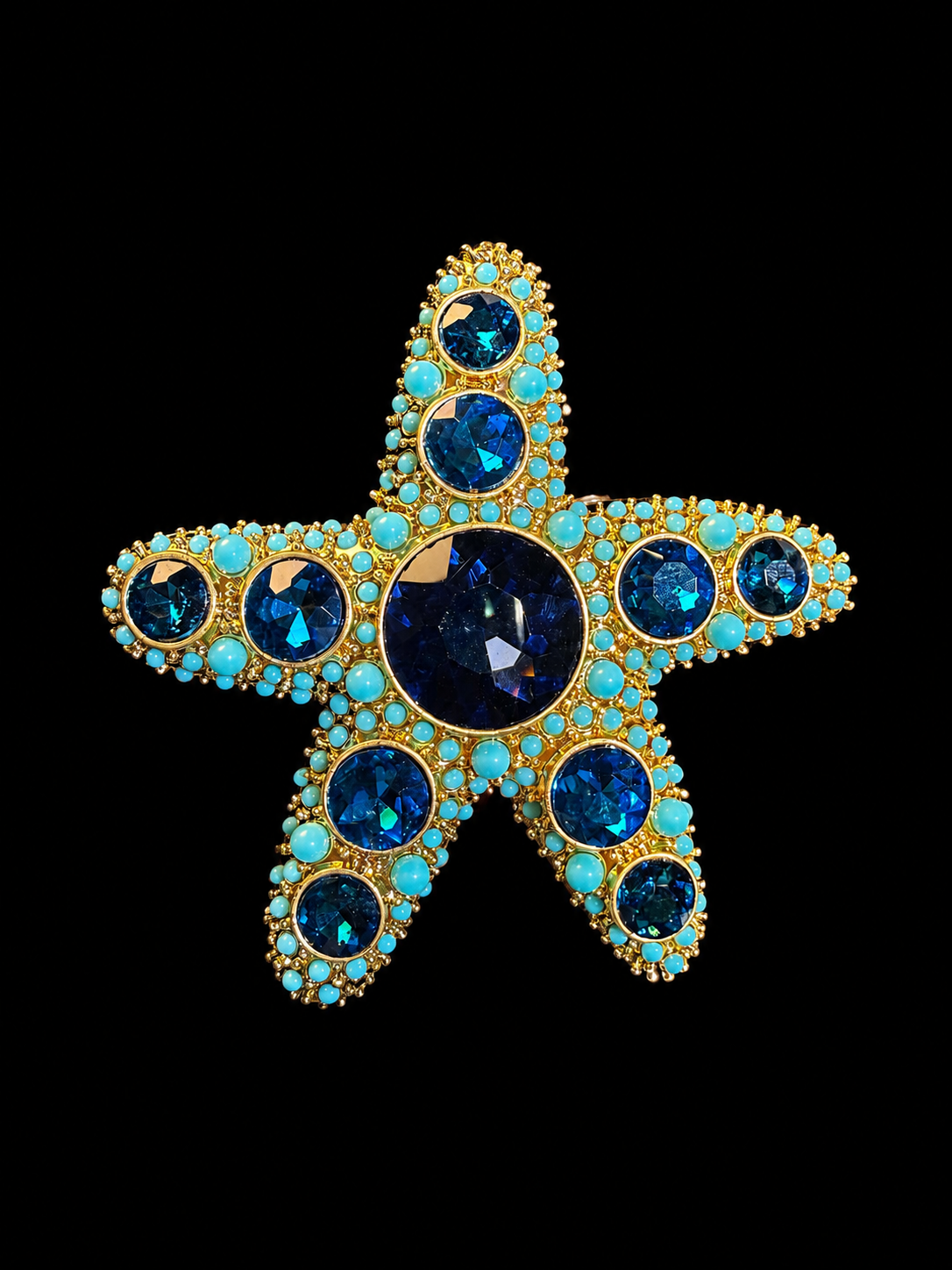
The gold-tone blue starfish brooch-pendant is explicitly a starfish design. Its product identity gives a marine reading to the arm-like outline. Renaming it a celestial starburst because both forms radiate would discard useful information.

Keep the product's blue color description separate from gemstone identity. Its documented brooch-and-pendant functions also do not establish compatibility with an arbitrary chain. Neither a motif name nor a color supplies that missing specification.
Other designs in the brooch collection can be described in the same geometric vocabulary while retaining their own subjects. A flower, starfish and celestial burst may all radiate, but “radiating” names a structural resemblance rather than a shared meaning.
Write the outline first, the attribution second
For your collection notes, separate “eight long points alternating with eight short points” from “called a starburst in the original record.” The first records shape; the second preserves a name and its source. If you have neither a complete view nor an attributable name, “radiating ornament” is sufficient.
The vintage versus vintage-inspired guide addresses a further boundary: design resemblance does not establish age. Avoid using a crescent or sunburst alone to date a piece, name its maker, or attach a universal promise of luck or protection. The outline is already worth describing accurately.