
Find out what the gram number includes
An earring weight in grams is only useful when the listing says whether the number applies to one earring or the pair. "8 g" could mean 8 grams on each ear, 8 grams for both earrings together, or even the packaged shipping weight if the field is poorly labeled. Before comparing two products, identify the scope of each number. A stated per-earring value can be copied directly; a pair total can produce only a nominal average per earring unless the two pieces are weighed individually.
Look for exact phrases such as weight per earring, weight per piece, weight per pair, or total weight per pair. Then confirm what the purchase includes. A listing that says "pair" should normally mean two matching earrings, but quantity belongs in your notes rather than in an assumption. If the listing offers a single earring option, a set with several components, or different sizes, the same weight field may not apply to every choice.
Normalize each pair listing to a nominal average per earring
The practical task is a one-line calculation for each candidate. Create four columns: listed weight, listed scope, quantity included, and either stated per-earring weight or calculated nominal average per earring.
- If the listing says weight per earring, copy that number directly.
- If it says weight per pair and the pair contains two earrings, divide the listed number by two and label the result nominal average per earring.
- If it gives a range, keep the range. Do not replace it with an average unless the seller explains what causes the range.
- If it does not name the scope, write unknown. Do not divide merely because the title uses the plural "earrings."
- If variants differ in size or construction, record the selected variant beside the weight.
- If exact left and right weights matter, each complete earring must be measured separately; pair-total arithmetic cannot prove they are identical.
Use the same unit throughout. One gram equals 1,000 milligrams, so 750 mg becomes 0.75 g. Do not confuse product weight with carat weight. A carat figure can refer to a stone or the total stones in a pair; it is not the mass of the complete earring, setting, post, and back.
Work three comparable examples
Current retail pages show why the scope label matters. An Aza Fashions product page states 16 grams per pair. With two earrings in that pair, the nominal average is 8 grams per earring. A Dylan James product page lists a total pair weight of 23.4 grams, producing a nominal average of 11.7 grams per earring. A Bohomoon product page says 1 gram per pair, producing a nominal average of 0.5 gram per earring.
Those calculations do not prove the exact mass of either member of a pair, and they do not rank quality, value, or suitability. They simply put three differently presented pair totals on a comparable nominal-average basis. Your worksheet would read:
- Candidate A: 16 g per pair ÷ 2 = 8 g nominal average per earring.
- Candidate B: 23.4 g per pair ÷ 2 = 11.7 g nominal average per earring.
- Candidate C: 1 g per pair ÷ 2 = 0.5 g nominal average per earring.
Keep the source wording next to your arithmetic. If a seller later changes the page, you can see why you divided the number. If a listing says only "weight: 16 g," the responsible result is not 8 g per earring; it is scope not stated. If the listing gives only a pair total, do not remove the word average from your calculated result.
Keep mass separate from visible size and movement
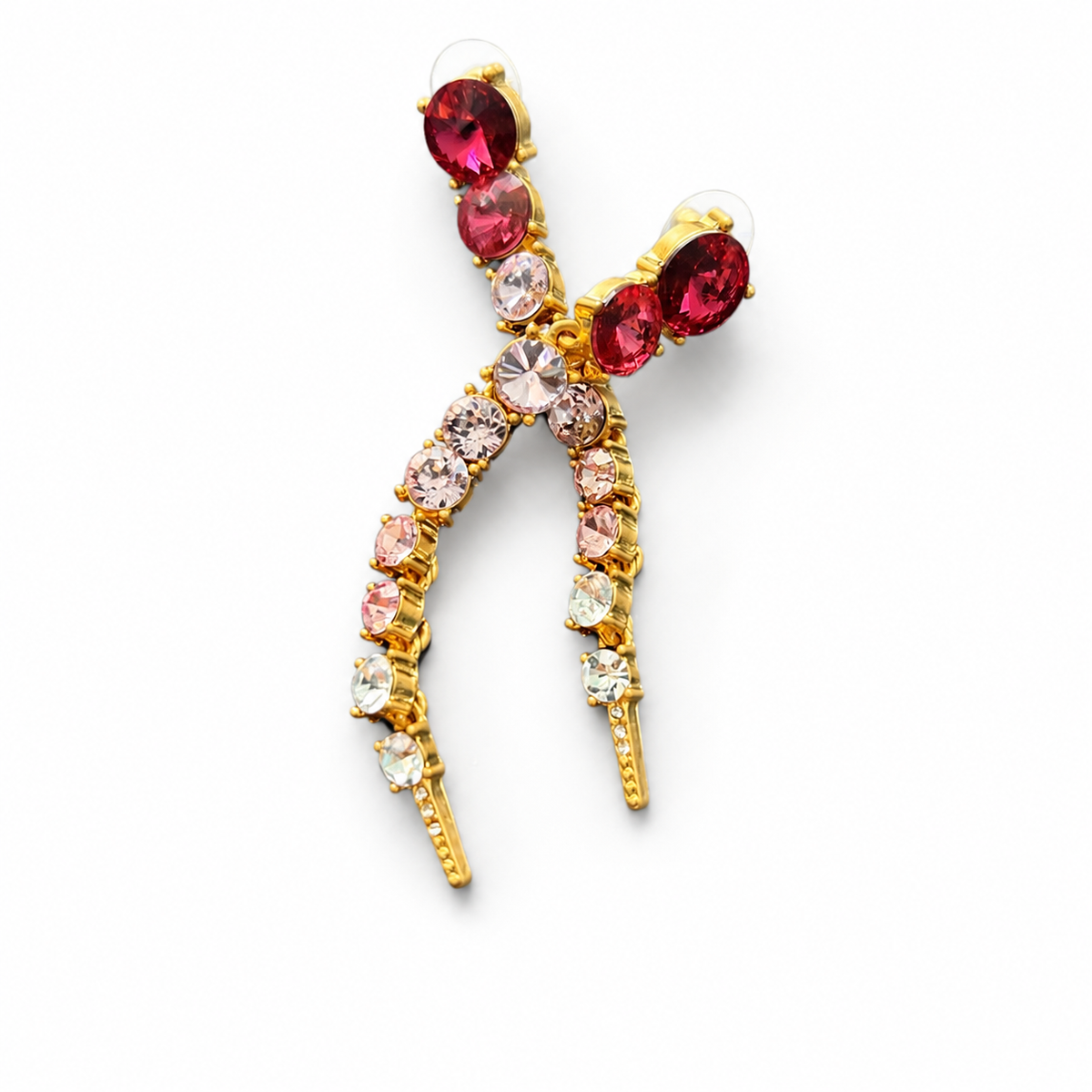
A photograph cannot reveal grams. A long, narrow earring can weigh less than a compact, dense design, and two similarly sized earrings can use different construction. Dimensions tell you the space a piece occupies; weight tells you its mass. Record both, but do not substitute one for the other.

If you also need to compare height, width, drop, or setting depth, use the separate guide to judge earring dimensions in an online listing. Keep those measurements in adjacent columns. A complete comparison can include grams per earring, total dimensions, closure, and moving sections without turning any one field into a universal wearing rule.
Check quantity, variant, and included hardware
Before accepting the calculation, verify that the gram figure describes the exact thing placed on one ear. Does it include the earring back? Is it for the stud-style option, the clip-on option, or both? Is the displayed color also the measured variant? Does a "set" include a necklace, extra charms, or multiple earring pairs?
For matched designs, confirm that the purchase includes two earrings and that the photos show the same orientation and details you expect. The matched-pair inspection guide covers quantity, left-right orientation, and visible differences. That task is separate from weight normalization, but it prevents dividing a set total by the wrong number of pieces.
If a listing offers stud and clip-on versions, do not carry a weight from one hardware style to the other unless the seller explicitly says the number applies to both. Hardware can change the complete piece being weighed. Preserve qualifiers such as stud-style when that is the seller's wording; do not promote a visual description into confirmed post hardware.
Ask a question the seller can answer precisely
When the scope is missing, send one compact request: "Please confirm the weight in grams of one complete earring, including its normal back or clip, for the selected variant. If your listed number is for the pair, how many earrings are included? If the two earrings were weighed separately, please provide each reading." That question names the unit, the object, the hardware, the variant, the quantity, and the evidence needed for exact left-right values.
Avoid asking only whether the earrings are "heavy" or "light." Those words do not create a comparable specification, and an answer about another person's experience cannot establish yours. There is no single gram threshold in this guide that promises comfort or a pain-free result. Weight is one documented input; closure, dimensions, movement, individual fit, and wearing conditions remain separate.
For store-policy context before ordering, review Rustic Jewel Co's frequently asked questions. Product-specific weight questions should still identify the exact item and variant.
Finish with a documented comparison, not a promise
Your comparison is ready when each candidate has a stated weight scope, quantity, selected variant, and either a stated per-earring reading or a clearly labeled nominal average from a pair total. Mark any missing field as unknown. Then browse the earrings collection with the worksheet beside you and ask for exact individual weights when they matter and the listing does not provide them.
The useful conclusion is factual: "Candidate A is listed at 16 g per pair, or an 8 g nominal average per earring if the pair contains two; exact left and right weights were not provided." It is not a claim that each piece weighs exactly 8 g, that the earring will feel a certain way, or that it will perform like another design with the same average mass. Clear scope makes listings more comparable; it does not turn pair arithmetic into an individual measurement or a universal verdict.