
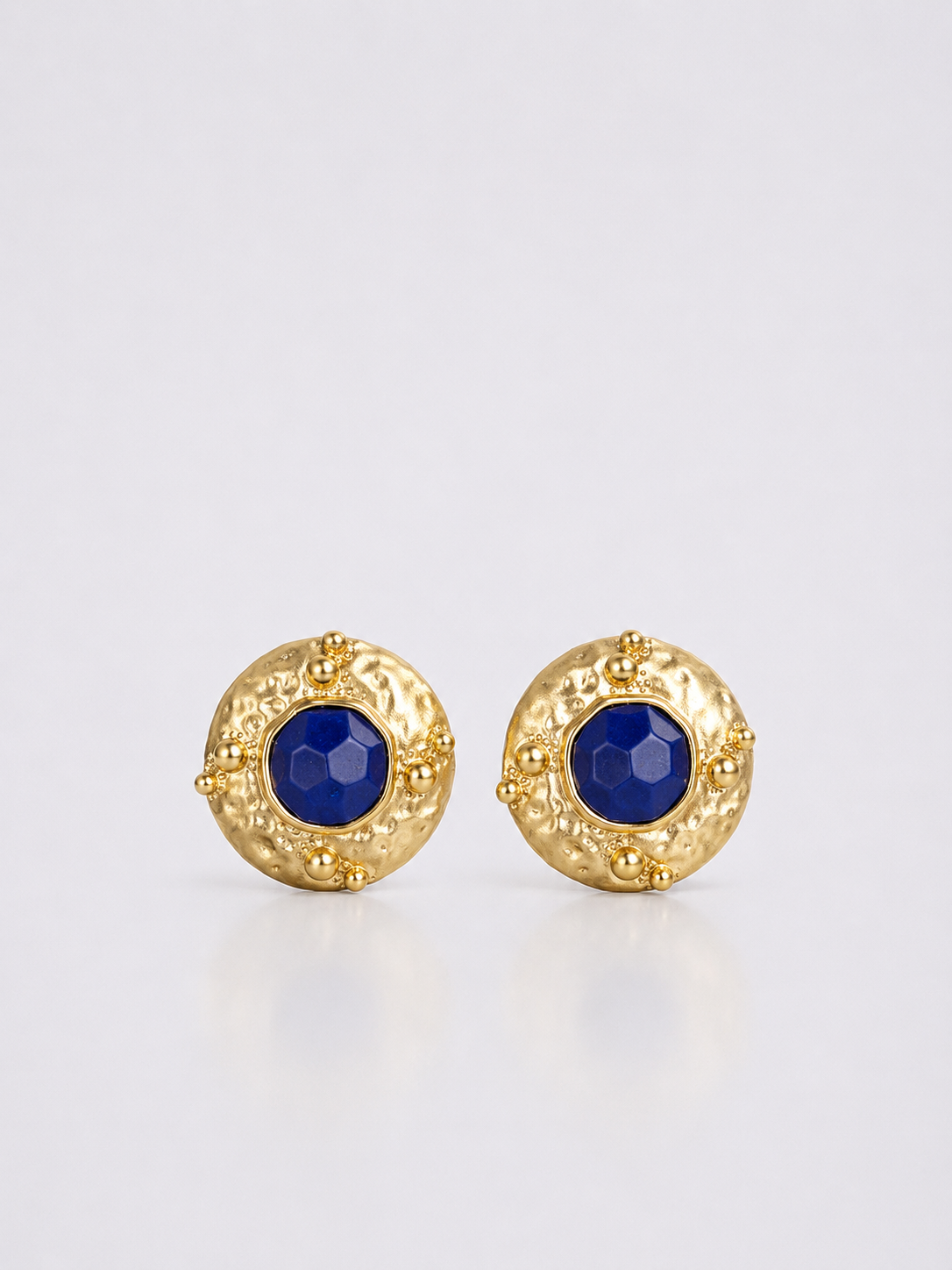
Choosing earrings for your face shape starts with the effect you want, not a list of shapes you must avoid. A slim vertical outline, a broad circle, and an open branching design frame the face differently. You may want contrast, repetition, or simply a pair that looks good with your usual hair and neckline.
Use round, oval, square, heart, diamond, or oblong as rough descriptions if they help. If two descriptions seem equally plausible, you can still make a useful choice without settling the label.
Choose a direction before choosing a category
Look at a pair you already wear often. Do you enjoy the shape sitting close to the ear, extending downward, or spreading outward? That observation gives you a better starting point than a face-shape quiz answered with an unfamiliar photograph.
Brilliant Earth's face-shape guide describes length, width, curves, and visual emphasis, while also noting that the purpose is not to correct your features. Keep that distinction: a styling direction is a choice, not a requirement to hide part of your face.
Turn familiar face-shape advice into options
| If you want this effect | A shape worth comparing | A different valid choice |
|---|---|---|
| A more vertical outline beside a rounder face | A slim drop or an elongated open shape | A round earring that deliberately repeats the curves |
| Curves beside an angular jawline | A rounded hoop or curved drop | A geometric design that echoes the angles |
| More detail near the lower face | A design with its main ornament toward the bottom | A compact ornament near the lobe |
| Less emphasis on downward length | A compact or outward-spreading shape | A longer design if that is the line you enjoy |
These comparisons explain why advice can differ without giving one face a single correct earring. The same rounded outline can be chosen because it contrasts with one feature or because it repeats another.
Read the complete outline, not just the center accent
A circular center does not make every earring look round overall. Borders, branches, hanging details, and empty spaces are part of the design. The gold-tone example below groups its decoration within a rounded front; the silver-tone example spreads blue and clear-looking accents through a more open chandelier structure.


These are shape examples, not a shared-scale comparison or a prediction of fit on a particular face. The photographs do not provide physical dimensions, mass, or a wearing test. The rounded gold-tone blue-center listing is clip-on. The silver-tone chandelier listing does not currently state its fastening; verify that detail before choosing it rather than inferring it from the front view.
Make one comparison with your actual hairstyle
Try two existing pairs with the same top and hairstyle. First look straight ahead, then turn slightly. Notice where the widest detail sits relative to your cheek and jaw, and whether hair hides a detail you wanted to show. You are comparing the whole look, not testing whether you qualify for a category.
If you use photographs, keep the camera position and distance consistent. A close selfie and a full-length outfit photo answer different questions. Use the first for visible details and the second for how much attention the earrings receive within the outfit.
Let the preferred effect lead the shortlist
Finish with a concrete preference: a contained round outline, an open geometric shape, or a visible drop. That gives you something to look for in the earring collection without ruling out a whole category because of your face shape.
Before ordering, use the earring-dimensions guide to check the actual scale and ask about missing weight or fastening information. Appearance and attachment are separate decisions; a shape you enjoy should also be a piece you can wear appropriately.