
Start With Evidence, Not Adjectives
An accurate jewelry product description is a compact record of what a buyer can rely on. The writing task is not to make every detail sound more luxurious. It is to separate documented facts from visible design observations, preserve every necessary qualifier, and leave unsupported claims out.
The Federal Trade Commission's Jewelry Guides overview says marketers should truthfully represent attributes such as type, metallic content, size, treatment, origin, and manufacturing. Its broader advertising guidance adds that claims should be truthful, non-deceptive, and supported by evidence. For a working product record, that means a confident sentence still needs a source.
Start with a four-column evidence ledger before drafting the description. Use the current product listing or supplier documentation for recorded facts, use photographs only for plainly visible design, and mark everything else unresolved. Do not fill a gap with what a finish, setting, or silhouette seems to imply.
Build a Fact, Unknown, and Claim Table
Create one row for every detail you may want to publish. A useful status vocabulary is Recorded fact, Visible description, Qualified wording, or Unresolved claim. Each status has a different drafting rule.
| Candidate statement | Evidence available | Status | Allowed wording |
|---|---|---|---|
| Sold as a coordinated brooch set | Product record identifies a set; images show the listed pieces | Recorded fact | “Brooch set” |
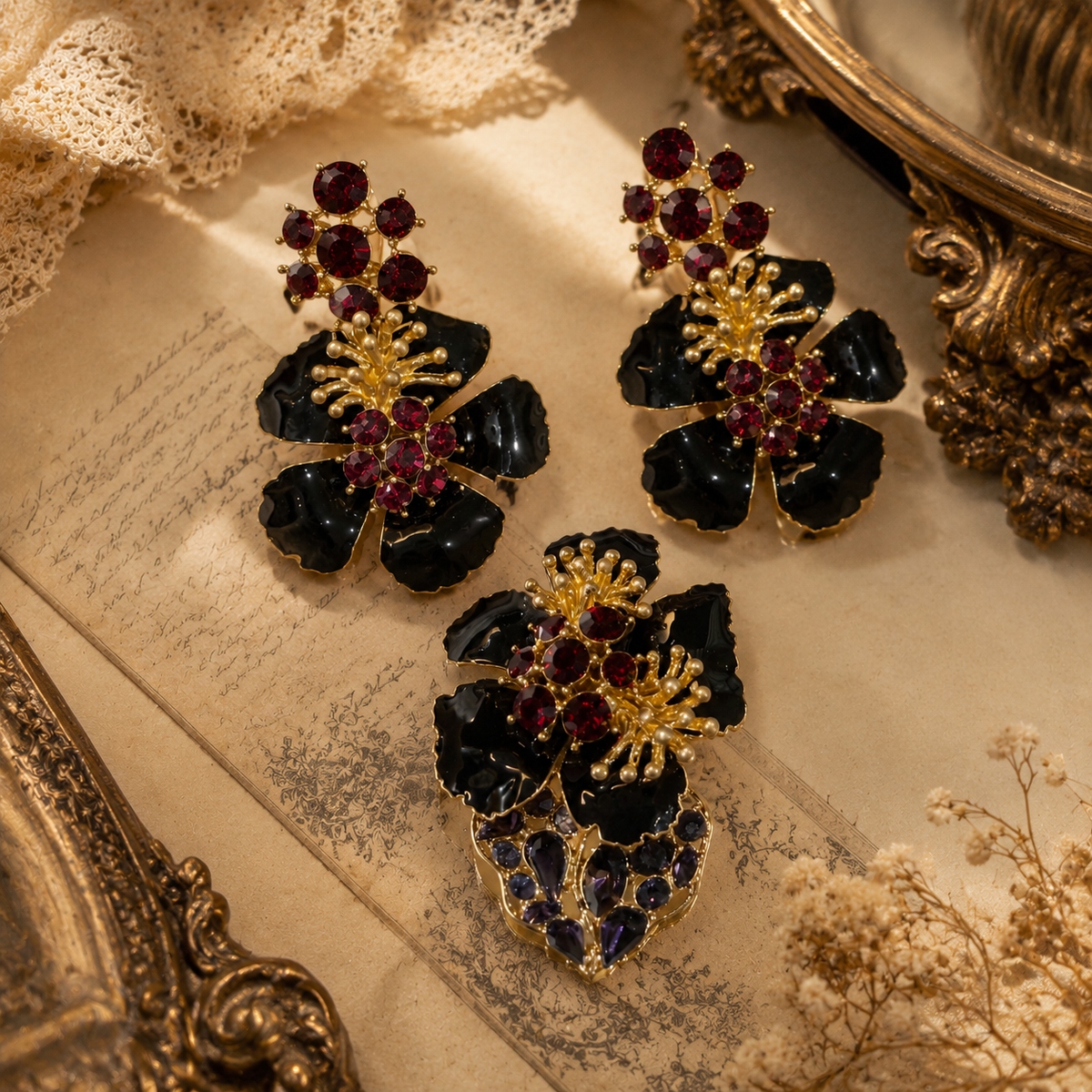
| Black surfaces with gold-tone floral forms | Visible in the product photographs and consistent with the listing | Visible description | Describe the visible color and form without naming an undocumented process |
| Enamel-style, crystal-style, and pearl-style details | Those qualified terms appear in the product record | Qualified wording | Keep every “-style” qualifier in the final copy |
| Authentic vintage, ruby, pearl, handmade, or solid gold | No supporting record supplied for this exercise | Unresolved claim | Do not publish the claim |
A photograph can support “red,” “floral,” “elongated,” or “pin back visible” when those features are clear. It generally cannot establish a gemstone identity, exact metal, age, maker, manufacturing method, or authenticity. If a detail matters to the buyer but remains unresolved, keep it in the internal question list rather than turning it into sales copy.
Preserve Qualifiers That Change the Meaning
Words such as style, tone, inspired, and look are not decorative hedges. They define the boundary of the statement. “Pearl-style detail” describes an appearance; “pearl” identifies a material. “Gold-tone” describes color; “gold” can imply composition. The FTC's gemstone and pearl education page explains why clear qualifications matter when a familiar jewelry term could imply a different product.
Run a qualifier audit before polishing the prose. Circle each source phrase ending in “-style,” each color word ending in “-tone,” and every phrase using “inspired.” Then confirm that the same boundary survives in the draft. The related Journal guides on enamel-style versus enamel or resin, rhinestone, crystal-style, and glass labels, and vintage versus vintage-inspired wording provide narrower checks for those terms.
Do not upgrade a qualifier because the shorter phrase reads smoothly. If the available evidence only supports “ruby-red crystal-style accent,” removing either “-red” or “-style” changes the statement from color and appearance toward identity.
Rewrite One Description Without Adding Claims
Consider this deliberately inaccurate first pass:
Authentic vintage black enamel ruby and pearl brooches, handmade in gold.
The sentence sounds concise, but it introduces several unsupported claims in this exercise. “Authentic vintage” asserts age and authenticity. “Enamel,” “ruby,” and “pearl” identify materials. “Handmade” asserts a production method, while “gold” can be read as metallic content. None of those conclusions follows from a front photograph alone.
Now rewrite from the ledger:
A coordinated costume-jewelry brooch set with black enamel-style surfaces, ruby-red crystal-style accents, pearl-style details, gold-tone floral forms, and pin-back styling visible in the supplied back-view image.
The second version is useful because it tells the buyer what the documented record and visible images support. It does not apologize for unknowns or bury the design under disclaimers. It simply chooses accurate nouns and preserves the qualifiers that carry meaning.
For readability, place the most decision-relevant facts first. Etsy's current listing-description guidance recommends leading with important information and using clear paragraphs or bullets. That organizational advice can improve scanning, but it does not verify a material, measurement, or product claim; the evidence ledger still controls the words.
Use the Product Image as a Limited Design Record
The current black enamel-style brooch set listing is a strong qualifier-preservation exercise. Its record supplies “set,” “enamel-style,” “ruby-red crystal-style,” “pearl-style,” “gold-tone,” and “vintage-inspired” language. The selected front image shows the coordinated floral forms and color arrangement. It does not independently prove enamel composition, gemstone identity, pearl identity, age, maker, or manufacturing method.

When a visible detail and the product record agree, write it plainly. When only appearance is available, frame the statement as appearance. When a claim requires composition, history, provenance, or process evidence, pause it until the record supplies that evidence.
Finish With a Description Record
Before approving the draft, save a short record beside it. List the product record reviewed, the image views reviewed, the date of review, the exact qualified terms retained, and every unresolved field. Then read the description once with a buyer's questions in mind:
- Does each material, size, closure, quantity, or manufacturing statement have a documented source?
- Are visible colors and forms described without turning appearance into composition?
- Did every “-style,” “-tone,” and “-inspired” qualifier survive editing?
- Are set contents and photographed backs described only as shown or recorded?
- Did the draft avoid age, authenticity, origin, maker, and performance claims that remain unresolved?
For more coordinated-piece examples, browse the brooch sets collection and check each product record before using its facts. A related listing does not resolve any detail in the current description.
The finished description should be specific without pretending to know more than the record. A fact table makes that discipline repeatable: document the fact, describe only what is visible, retain meaningful qualifiers, and hold every unsupported claim.