
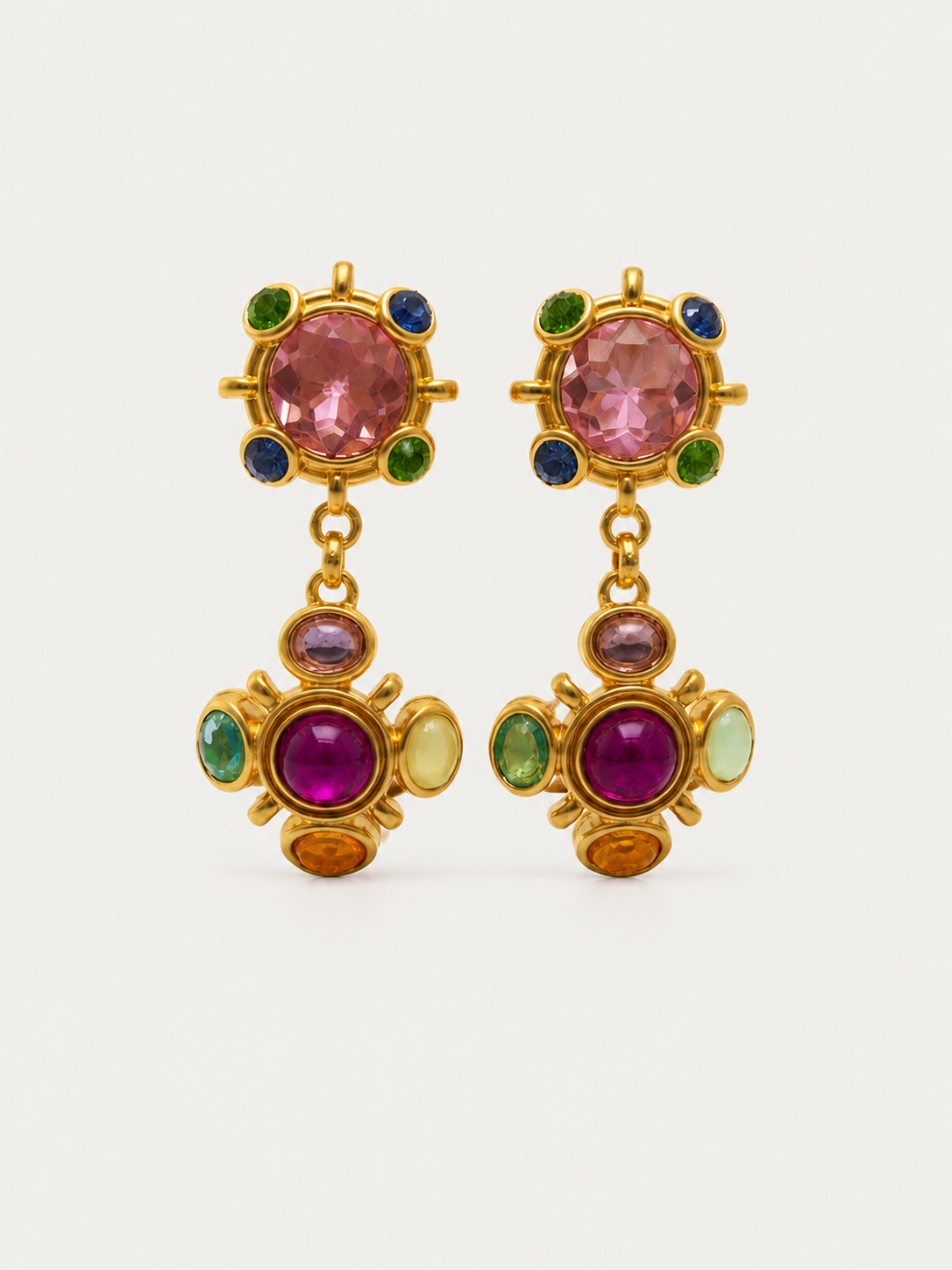
Start with earrings when styling a one-shoulder dress. They let you add detail without automatically crossing the diagonal neckline with another line. A necklace can still work, but it should be a deliberate second shape—not something partly hidden beneath the strap.
Find the dress's busiest side
Some one-shoulder dresses have a narrow strap; others have a bow, ruffle, sleeve, or sculptural fold. Stand in front of a mirror and notice how far that detail extends toward your ear. The amount of open space can differ sharply from one side to the other.
Try turning toward the covered shoulder. An earring that clears the dress while you face forward may touch it as soon as you move. Make this a fit decision before making it a color decision.
Choose earrings by their lower outline
Look at where a drop widens. A narrow upper section with a broad lower ornament can be more likely to meet a raised shoulder than a compact design. Do not decide from total length alone; width and movement matter too.

The pictured multicolor drops have two clearly separated sections. They are a useful visual comparison for an asymmetric dress, but the image does not establish their physical dimensions. Check the listing or ask for the measurements needed to compare them with your shoulder detail.
When a necklace is worth trying
A necklace is easier to evaluate when it sits clearly above the diagonal edge or intentionally over a plain section of fabric. If it continually slips under one side, changing the necklace length may help—but only within the piece's actual fastening range.
Compare the same outfit with the necklace removed. If the diagonal becomes clearer and nothing feels missing, stop there. If you prefer the layered lines, keep that preference without pretending it is the only correct way to dress.
A bracelet does not have to “balance” the bare shoulder
There is no requirement to place a bracelet on the arm opposite the strap. Consider sleeves, a watch, the hand carrying your bag, and what feels practical. An exposed wrist may provide a convenient place for detail, but visual balance is not a calculation of equal objects on each side.
If the dress has a long sleeve, check whether a bracelet contacts its cuff. Do not reshape a bracelet to make it fit over fabric unless the maker explicitly permits that adjustment.
Finish with a movement check
Put on the wrap you will use, turn both ways, and sit down. If one earring keeps meeting the shoulder, choose a different shape rather than accepting repeated contact for the sake of the photograph.
The earring measurement guide helps translate a listing into a useful comparison. Browse earrings for the space you actually have, not an imagined perfectly symmetrical neckline.