
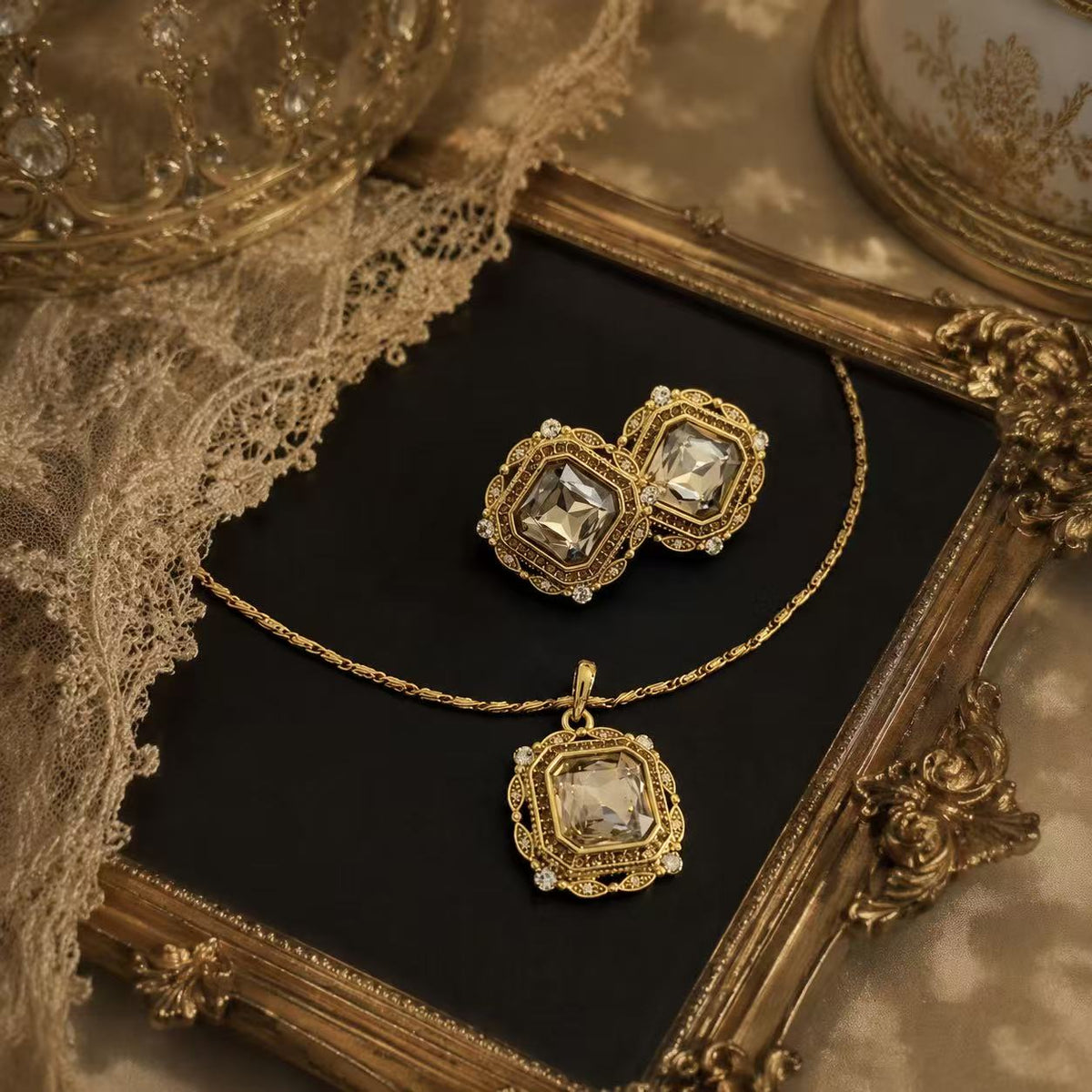
If a pendant sits tilted on a seamed top, first check what it is resting on. A visible line can be nearly flat, while another seam with a similar outline contains a raised fold or cord. Changing the necklace's color or making its outline wider does not answer that physical difference.
The useful question is whether this particular ornament settles as intended on this particular surface. You are not trying to straighten every seam or make every pendant lie perfectly flat; some jewelry is deliberately curved or dimensional.
Inspect the surface, not just the seam name
With the necklace off, look across the outside of the worn top from an angle. Locate any raised ridge, step between panels or thicker junction beneath the intended pendant position. Do not pull the cloth taut to create a flatter result than the garment normally provides.
In the Folds shows flat-felled construction with the enclosed allowance on either side of the garment. Closet Core's seam-finish guide describes other ways of folding and enclosing that fabric. Neither the name nor a front photograph tells you the exact outside profile of your finished top.
A corded seam is another case: Tilly and the Buttons describes fabric wrapped around piping cord and sewn between garment pieces. That construction can introduce more than a drawn line. Inspect yours rather than assigning every piped seam the same height.
Establish how the necklace normally settles
Use a familiar necklace before buying a replacement. Observe it at its usual fastening setting over a smooth top, then over the seamed top. Keep your posture and the necklace setting consistent, and let it settle without holding the pendant face forward.
This is a comparison, not a controlled experiment: the tops may drape differently. If the pendant tilts in both arrangements, do not blame the seam. Its intended shape or suspension may already explain the angle. If it changes only where it meets the ridge, inspect that contact more closely without pressing or rocking the ornament against the fabric.
Compare the same panel drawing with two surfaces
Imagine two tops with the same neckline and a horizontal yoke seam at the same apparent height. The first has a smooth join; the second has a raised cord along that join. Use the same hypothetical pendant, whose reverse spans the seam.
On the smooth version: suppose the pendant settles in its familiar position and the garment remains undisturbed. There is no reason to move it merely because a seam is visible behind it. The line can remain underneath the ornament.
On the raised version: suppose the cord meets one part of the reverse while another edge stands away from the cloth. The pendant now rests at an angle you dislike. This version calls for a different resting area, not a different metal tone or another panel-matching rule.
Those are contrasting possible outcomes, not observations of the pictured product. A raised seam that does not change your pendant's behavior is not automatically a problem.
Distinguish a local crossing from a continuous ridge
For a horizontal yoke ridge, an available fastening setting may place the complete pendant above or below it. Check the whole ornament, including its frame and lower details, rather than moving only its center clear. Use only the necklace's designed settings.
A vertical ridge continuing down the center presents a different decision. Shortening a centered necklace may simply move the pendant to another point on the same ridge. If every suitable endpoint has that contact, compare a different necklace whose actual reverse settles acceptably, change the top, or omit the necklace. Do not pin the chain sideways, tape down the pendant or compress the seam to manufacture a resting place.
Request the reverse view before choosing a new piece
The square-accent pendant in the champagne-colored necklace and clip-on earrings set provides a clear front outline, not evidence of a flat back. Its wearing length, designed adjustment range, pendant dimensions and weight are not supplied in the current product description. Obtain them and a clear reverse/side view before assessing this interface.

Our necklace measurement guide helps specify the endpoint information. When comparing necklaces, record both the desired position and the surface underneath it. A seam that is unsuitable beneath a pendant is not thereby a suitable brooch mounting point.