
Flat storage is the cautious starting point when a necklace has a heavy decorative front, uncertain stringing or components that seem stressed when suspended. Hanging can be convenient for a sound, appropriately flexible chain with item-specific guidance that permits it. The useful question is where the weight goes, rather than which method looks tidier.
You do not need a pull test to make this decision. Use existing care information and a supported view of the actual necklace. If its construction remains unclear, keep it supported while you ask.
Follow the load from the front to the support
Imagine a necklace on one hook. Its lower portion is carried by the sections above it, and ultimately by the part touching the hook. A broad centerpiece, narrow connecting links and several decorative branches do not all play the same role. A hook placed through an ornamental opening might load a feature that was never meant to carry the whole object.
Trace that route visually while the piece is resting on a tray. Note string, chain, joints and fixed sections without pulling them straight. The CCI's discussion of support and weak attachments provides the general handling principle behind this load check; it does not certify a particular necklace for suspension.
Give flat storage its natural shape
Flat does not mean flattened. Lay the necklace along the broad curve it accepts without force. Let a rigid front keep its shape and give each strand its own path. Do not coil a stiff section tightly or tuck the clasp underneath a raised accent to save room.
For a fictional necklace with five linked plaques and a short chain at each end, the useful arrangement is a wide arc with the plaques supported. Folding it into a narrow rectangle would save drawer width by asking the joints to make tighter turns. Choose a larger resting space instead.
Stringing deserves separate attention. GIA notes that wet silk in a pearl strand can stretch; that is specific evidence about known pearl stringing, not proof that a pearl-style necklace contains silk. Unknown threads and cords should not inherit another product's care routine.
Use hanging storage only after the construction question
For a sound chain whose care instructions allow hanging, select a smooth support that accommodates the chain without pinching it. Keep the decorative front clear of the base and neighboring jewelry. Leave enough room to lift the piece off without dragging it across another hook.
Close an undamaged clasp normally if that is part of the suitable arrangement. Do not use the clasp's tiny moving lever as a hanging point. If the necklace twists, catches or gathers its weight on one questionable joint, return it to supported storage rather than adjusting the jewelry to fit the stand.

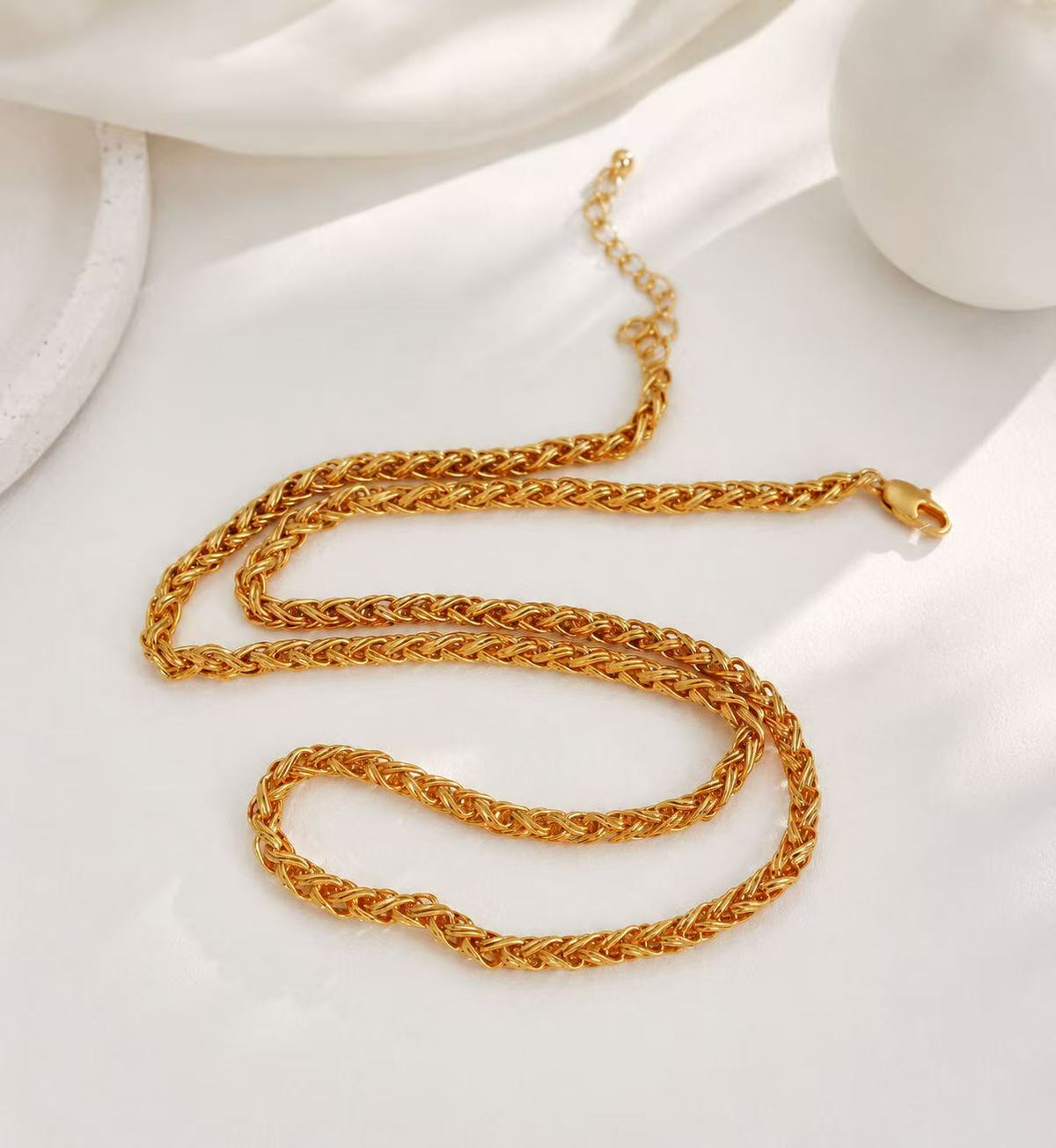
The gold-tone woven-look chain necklace shows a continuous chain silhouette. That visual description does not establish tensile strength, exact flexibility or a recommended hanging period. Use its care record and actual condition for that decision.
Compare three situations without ranking one method
- Sound flexible chain, documented suitable support: hanging may offer clear separation and easy access.
- Broad front with articulated sections: a supported arc can keep the front from loading small joints during storage.
- Unknown stringing, loose connection or newly changed shape: supported isolation and advice come before choosing a permanent display.
This is a conservative decision aid, not a durability test. The CCI's metal-care guidance likewise treats padding and support as responses to an object's form and fragility, rather than as a single arrangement for every object.
Record the position you can maintain
Photograph the resting layout and note why you chose it. Reconsider it after a repair or a change in condition. A successful arrangement lets you return the necklace without bending, tangling or stacking its components.
The travel packing guide addresses movement inside a case; a dresser hook is a different situation. When reviewing the necklace collection, keep the display photograph separate from your own storage decision. A necklace arranged on a bust has not thereby been tested for continuous suspension.