
Use a copy of a photograph for a locket, and establish how the exact locket is meant to receive it before cutting anything. The jewelry's outer width does not tell you the insert size, and a seam does not tell you where or how to open it.
If an old locket already contains a photograph, hairwork or another insert, record it in place. Do not remove those contents to make room until you understand both their significance and the construction holding them.
Confirm that it is a photo locket
A pendant is an ornament that hangs; a photo locket has an intended compartment for an image. Some forms open, while other enclosed images may require professional access. Do not use a knife, pin or fingernail to investigate a resistant seam.
The Met's book-shaped locket record describes two photograph compartments with decorated covers and oval openings. That particular object demonstrates an important distinction: the shape of the outside, the space for the print and the visible image window can be different.
For a modern piece, locate the maker's insert instructions. For an unfamiliar older piece, ask a suitable jeweler or conservator to identify the access method. “Looks like it should open” is not enough.
Preserve the source image separately
Make a digital copy from a safely accessible photograph, keeping the uncropped file. If the original is fragile, stuck to glass or bound into a delicate album, obtain appropriate help rather than forcing it flat for a scan.
The Library of Congress's photograph-care guidance advises avoiding adhesives on photographs and handling them by their edges or housing. For this project, keep the treasured original in suitable storage and experiment only with replaceable prints.
Label the digital file with who is pictured and where the original is kept. A tiny portrait can lose its identity over time just as easily as a loose photograph.
Design for the window as well as the insert
Use the maker's exact template where available. Otherwise obtain the intended insert dimensions and visible-window shape from the person assessing the locket. Do not press modeling material into an unknown compartment or rub a pencil across the jewelry to create a template.
In a fictional oval locket, an insert can fit physically while the retaining border hides the sitter's face. Place the face within the visible window, leaving enough surrounding image for trimming. Prepare several paper copies with slightly different crops and compare them with the template away from the jewelry.
Monica Rich Kosann's personalization FAQ demonstrates a maker-specific approach: select the locket, resize the image and print a fitted copy. Its templates are evidence for that maker's system, not universal dimensions for other lockets.
Fit a replaceable print using the intended method
Check that the print is completely dry, then follow the exact insert instructions. Do not add a thicker backing, tape, laminate or glue because the print seems loose. Those changes may interfere with the retaining structure or closure, and their compatibility has not been established.
If the compartment will not accept the specified print or the locket will not close normally, stop. Recheck the template and paper specification with the maker or professional. Closing pressure is not a trimming tool.

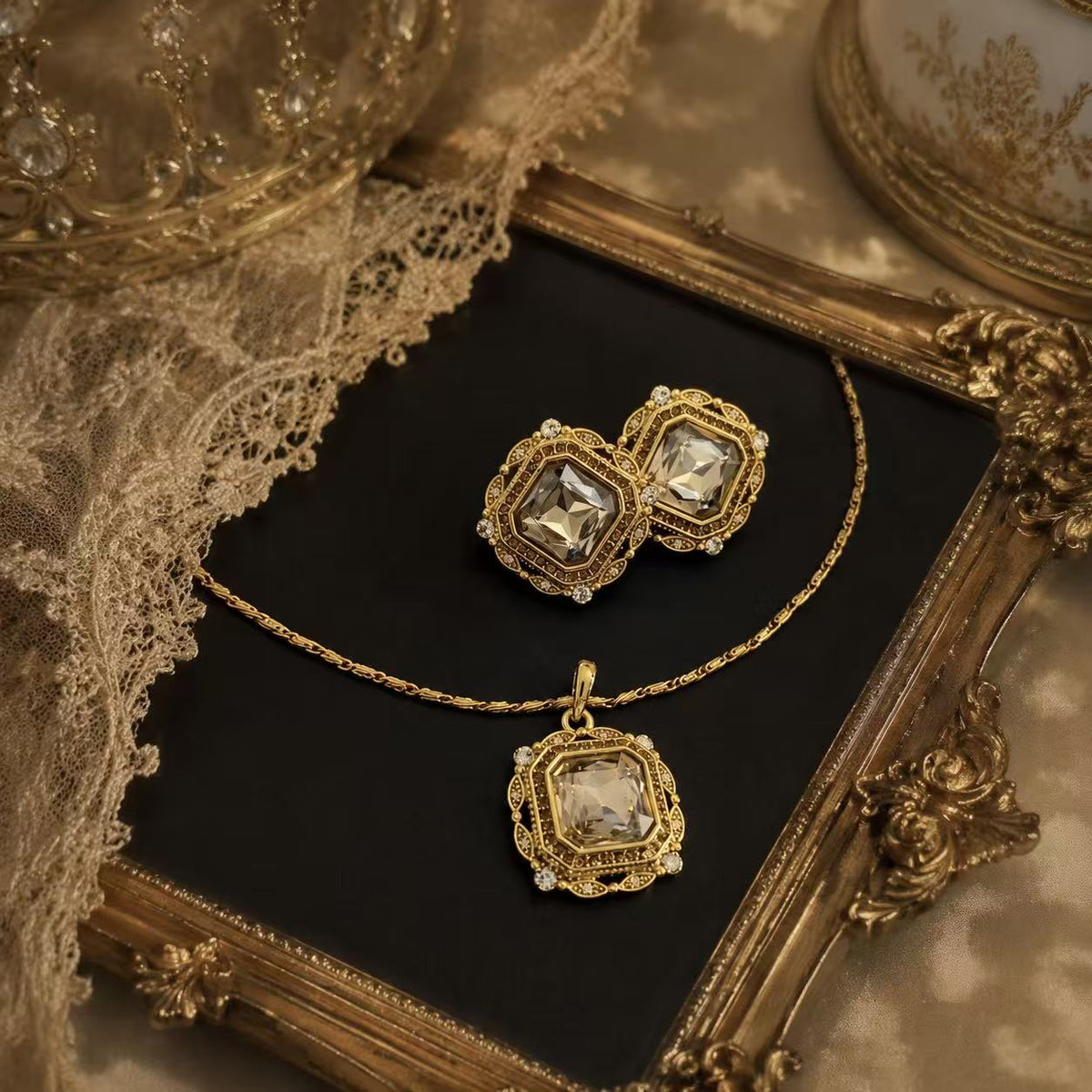
The champagne-colored pendant necklace and clip-on earrings set is a useful contrast. Its square decorative pendant is not documented as a photo locket. Browse the necklace collection for stated construction rather than treating any substantial pendant as a container.
Keep the insert reversible and the record complete
Save the crop, template reference and date with the original digital copy. Note whether older contents remain in place and who identified the access method. This makes a later replacement possible without starting from the original photograph again.
Choosing a carrier is a separate question: the pendant-and-chain compatibility guide covers the hanging connection. A successful photo insert is one that fits the documented compartment, leaves the closure working normally and preserves the original image elsewhere.