
Pack for movement, not for presentation
Parcel packaging has one practical job: keep a specific jewelry item supported and separated while the package is handled in different orientations. A pretty pouch, ribbon, or branded box may be part of the presentation, but presentation alone does not stop a clasp from opening, a chain from tangling, two surfaces from rubbing, or an item from moving inside an outer carton.
Keep this task separate from supportive jewelry gift wrapping, which focuses on the recipient's opening experience, and from a small travel jewelry kit, which stays under the owner's control. A parcel may be turned, stacked, vibrated, or processed with other packages. No packing method can promise a particular delivery outcome, so the useful standard is a documented pack that addresses the item's observed shape and the current carrier's rules.
Make a one-item support map
Before selecting materials, place the item on a clean surface and record what must not move. Do not call a part fragile merely because it looks delicate, and do not infer materials from color. Describe observable geometry and confirmed product facts instead.
| Area to check | What to record | Packing decision |
|---|---|---|
| Closure | Clasp, pin, post, clip, hook, or unresolved hardware | Close or restrain it only in the normal documented position |
| Long or linked section | Chain, drop, fringe, linked bracelet, or strand | Lay it in a controlled path so it cannot knot around another part |
| Projecting detail | Post, pin stem, raised setting, point, or ornament | Create clearance so the projection does not carry pressure |
| Contact surfaces | Places where pieces, pairs, or components could rub | Separate them with a clean, nonabrasive barrier |
| Unknown | Unconfirmed closure strength, finish response, or included component | Pause and resolve the record rather than improvising a claim |
This map is the original decision document for the pack. It prevents a generic rule such as “put jewelry in a pouch” from replacing an item-level review.
Support and immobilize the jewelry inside its first container
Begin with a clean support sized to the item. Earrings can be separated and secured through an appropriate card when their documented hardware permits it. A necklace can be laid in a controlled path with its chain restrained away from the pendant. A brooch pin should not be pressed against the container wall. A linked bracelet can be arranged in a compact curve, with the clasp closed if that is its normal position, then held so the links do not travel freely.
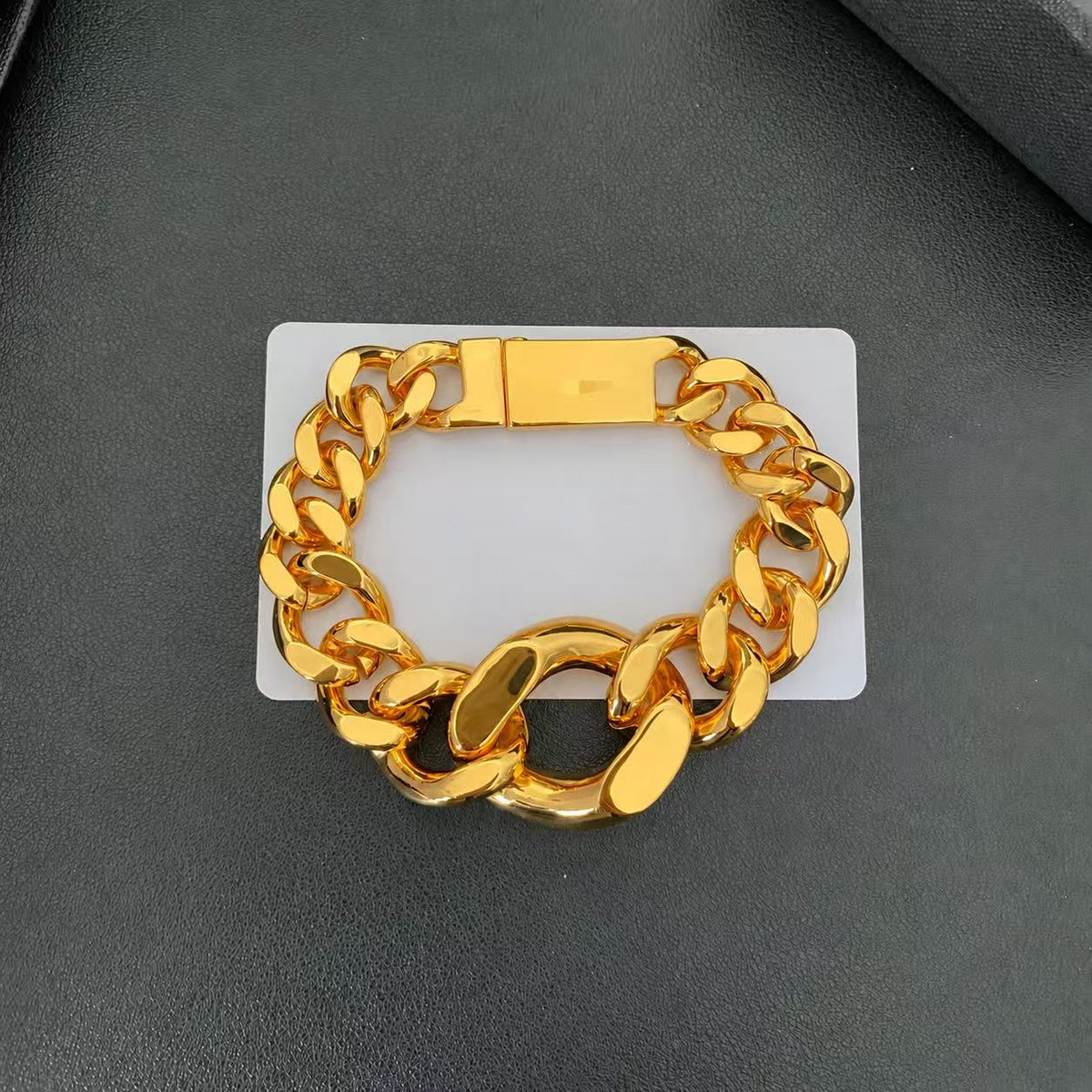
The current Rustic Jewel Co product record for the bracelet below documents brass with genuine gold plating, an approximate 7.9-inch length, and a box clasp. Those facts support a packing exercise: record the clasp, close it in its normal position, arrange the linked length without a tight fold, separate overlapping surfaces, and prevent the bracelet from sliding across the container. The listing does not establish how the parcel will perform in transit.

Avoid placing adhesive directly on the jewelry. Do not force an item into a card slot, pouch, or cavity that bends a post, compresses a raised detail, or creates a sharp crease in a linked section. If two items share an order, prepare each as its own supported unit before they enter a common inner container.
Build inner and outer protection as separate layers
The supported item now needs an inner container that maintains its arrangement. Choose a clean box or other rigid enclosure with enough clearance that the lid does not press on the highest point. Add soft separation where surfaces could touch. Fill internal empty space carefully enough to limit movement without crushing the item or bowing the container.
Then place the closed inner container inside a strong outer shipping box. Current USPS package guidance calls for strong packaging with cushioning room and prevention of shifting. UPS packaging guidance describes void-fill and cushioning options and explains when a two-box method may be appropriate. FedEx's breakables guidance likewise emphasizes a sturdy box, cushioning on all sides, restricted movement, and securely taped seams. These are carrier-level principles, not a single required recipe for every jewelry parcel; check the chosen carrier's current instructions for the actual shipment.
Keep the inner container away from every outer wall with suitable cushioning. Fill voids so the inner container does not migrate to a corner. Close the outer box flat and seal the seams with appropriate packing tape. Do not use decorative ribbon or loose cord on the exterior. Place the shipping label on a suitable flat face, and keep a duplicate destination and return record inside when that fits the carrier guidance and operating process.
Run the six-face movement test
Use one bounded test before applying the final outer seal. This is not a drop test and not proof of carrier acceptance. It is a movement check designed to expose an incomplete pack without intentionally stressing the jewelry.
- Close the supported jewelry inside the inner container.
- Hold the inner container over the packing surface and slowly turn it so each of its six faces becomes the top.
- Listen and feel for a slide, knock, loose component, or change in weight position.
- Open the container and compare the jewelry with its starting arrangement.
- If anything moved, change one support or separation point and repeat the six-face check.
- After the inner container passes, place it in the cushioned outer box, temporarily secure or hold all box flaps closed, and repeat a gentle orientation check before applying the final seal.
“Pass” means the documented arrangement stayed in place during this limited check. It does not mean the package is impact-proof, waterproof, insured, accepted by a carrier, or guaranteed to arrive without damage.
Complete the parcel pack record
Finish with a short checklist that another person can read without unpacking the order:
- Exact item, option, and included-piece count match the order record.
- Closure and projecting parts are identified and supported.
- Paired pieces and contacting surfaces are separated.
- Long, linked, or dangling sections cannot tangle freely.
- No adhesive touches the jewelry.
- The inner container closes without pressure on the highest point.
- The inner container cannot shift to an outer wall.
- The outer box is sound, flat-closing, and sealed at its seams.
- The six-face movement test result and any correction are recorded.
- The label and current carrier requirements are checked for this shipment.
After delivery, an incoming jewelry inspection serves a different purpose: it records what actually arrived. For current Rustic Jewel Co order, shipping, or return information, use the Shipping & Returns page. A completed pack record proves only what was prepared and checked before handoff; it does not prove carrier handling or delivery condition.