
Choose for the actual headshot use, not a generic rule
Jewelry for a professional headshot should be evaluated inside the image the employer, client, publication, or platform will use. A tightly cropped team directory, a circular profile thumbnail, and a wider personal-brand portrait can show very different portions of an earring or necklace. The useful task is to camera-test one or two candidates against the expected crop, lighting, pose, and professional context.
Ask the photographer or coordinator for four facts before the session: final aspect ratio, likely crop, background, and whether the image must match an existing team style. Also ask whether you will turn your shoulders or head between frames. Do not assume that “simple” is the only professional answer or that a statement piece is automatically wrong. Your role, workplace, cultural or personal identity, and the intended audience belong on the decision card.
Bring no more than two jewelry options to the test: a baseline you already wear confidently and an alternative that expresses more of your usual style. Hero Shot's current guidance likewise suggests bringing two earring pairs so the photographer can match the look to the role and audience. The test decides between them; it does not erase personal identity by formula.
Build a three-crop preview
Take a front-facing phone photo at eye level in the complete outfit. This is a planning preview, not proof of how studio lighting will behave. Make three copies without filters:
- Head and upper shoulders: check whether the whole visible jewelry element has intentional space around it.
- Tight face crop: check whether an earring is cut at an awkward point or a necklace becomes an unexplained fragment.
- Small circle or square: reduce the image to its likely profile size and note what remains readable.
Executive Lens advises paying attention to crop because long earrings can extend beyond a headshot frame and pendants can be cut by the neckline or image boundary. Use that as a question, not a ban. Mark each candidate fully shown, intentionally partial, or awkwardly cropped. If the final crop is unknown, ask rather than designing around a guess.
This process photographs a person wearing jewelry. For the separate task of making product-object images, use the phone jewelry photography guide rather than substituting its setup for portrait testing.
Test reflections under the photographer's light
A mirror cannot show what the camera sees from its own angle. Before final frames, ask for a test exposure with each candidate under the actual light setup. Look for a small, localized highlight versus a bright patch that obscures shape, repeats across frames, or pulls attention away from the eyes. Record the result on the monitor at both normal size and thumbnail size.
Do not promise that a textured, matte-looking, faceted, dark, or light-colored piece will photograph without reflection. Hero Shot notes that high-polish surfaces can create hotspots under studio light, while Executive Lens also warns that reflective jewelry may create distractions. Those are reasons to test. The photographer may be able to change the light angle, camera position, or pose, but that decision belongs to the photographer and may affect the rest of the portrait.
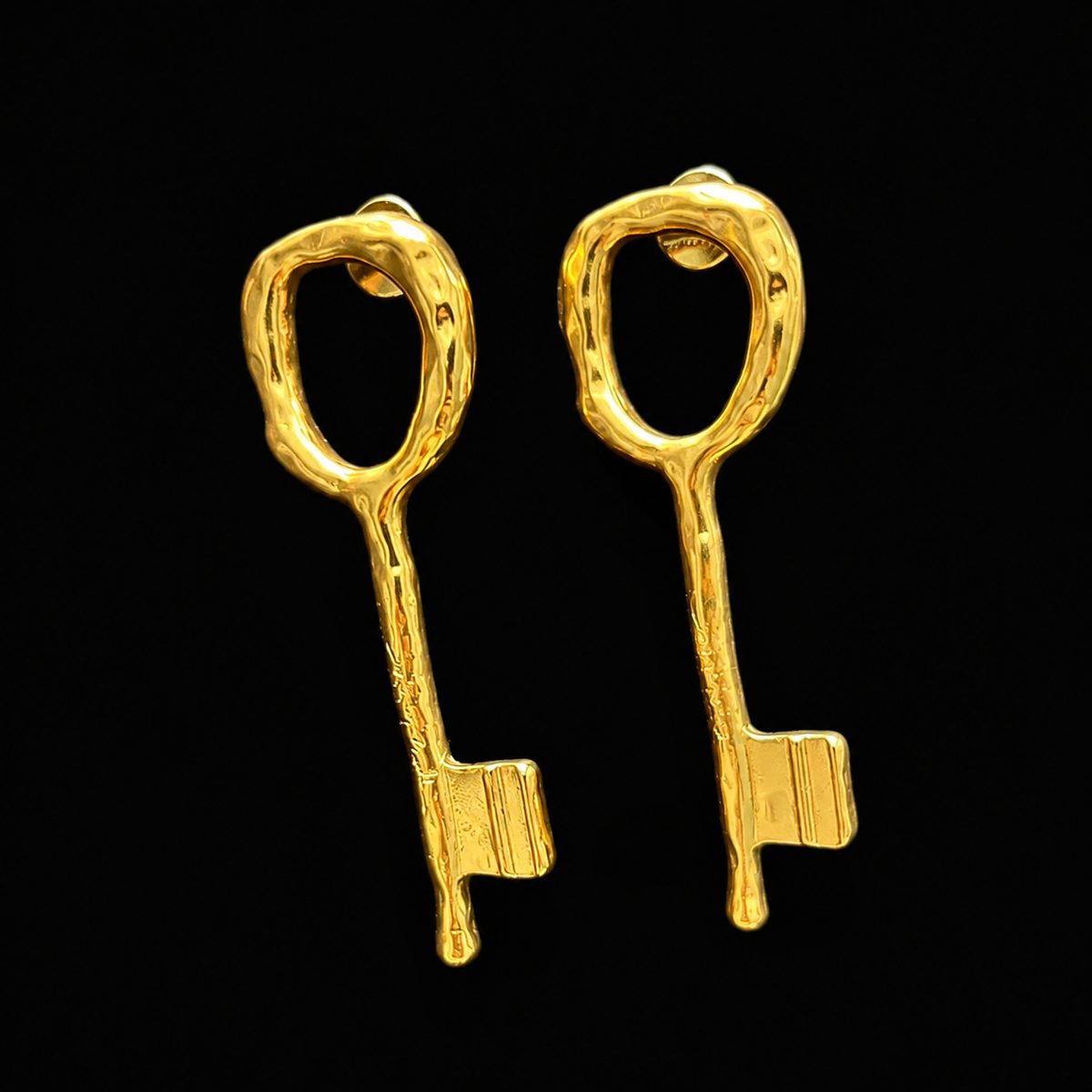
A current pair of gold-tone sculptural key stud earrings is documented as key-shaped, elongated, textured, gold-tone, and designed with post backs. Those product facts make the pair a legitimate candidate for a crop and reflection test; they do not predict the result under a particular studio setup.

Run a movement and reset check
Put on the final top, jacket, glasses, and hairstyle before testing movement. For each jewelry option, hold a neutral pose, turn the head left and right, shift the shoulders, look down briefly, and return to the starting mark. Then speak one sentence and smile naturally. Ask for a short sequence of frames rather than judging one still.
Review four things: whether earrings rotate to different angles, whether a necklace clasp migrates into view, whether a pendant meets the neckline, and whether hair or a collar repeatedly catches or hides part of the piece. Karen Vaisman Photography specifically recommends necklaces that stay in position and lengths that sit above or below rather than directly against the neckline. Treat any reset as data. If you must straighten the same piece after every pose, record that operating cost.
Change only one variable for the retest: jewelry option, necklace length setting, hairstyle position, or pose. Use intended clasps and adjustment points only. Do not tape jewelry to skin or clothing, bend hardware, remove a necessary back, or modify the piece for the session.
Coordinate the decision with the photographer
Show the photographer your card before the final sequence. A useful note says: “Option A remains inside the tight crop but creates a bright hotspot when I turn right. Option B stays readable in the circular thumbnail but rotates after shoulder turns. Which issue can the lighting or pose safely address without changing the required team setup?”
If color is important to the choice, compare the test frame with the item in neutral room light and keep camera white balance, background, and display differences in mind. The jewelry photo color-check guide explains why one photograph cannot establish an exact color match. Do not reject or approve a piece based on a filtered phone preview.
For the rest of the visible jewelry, use the earring, necklace, and ring coordination guide to edit the outfit. Return to this camera test for crop, reflection, and movement behavior in the professional portrait.
Choose from the contact sheet, then document why
Score each option on four evidence fields: crop integrity, reflection control, position after movement, and fit with the stated professional brief. Use passes as photographed, one controlled retest, or choose the other option. Do not rate career success, competence, or professionalism from jewelry alone.
When browsing the earrings collection, shortlist from documented shape, closure, dimensions when supplied, and color or finish wording. The final headshot choice still requires an on-person camera test because a product image does not reveal the portrait crop, lighting angle, hair interaction, or movement.
Your final note should be specific: “Option B remains completely inside the approved crop, shows no distracting hotspot in the photographer's test exposure, and returns to the same position after the pose sequence.” That conclusion applies to the tested setup. It is not a promise that the jewelry will photograph identically under another camera, light, crop, background, or movement pattern.